
Pulp Fiction, 1911 · page 128 of 196
Adventure, June 1911 — page 128: what you’re looking at
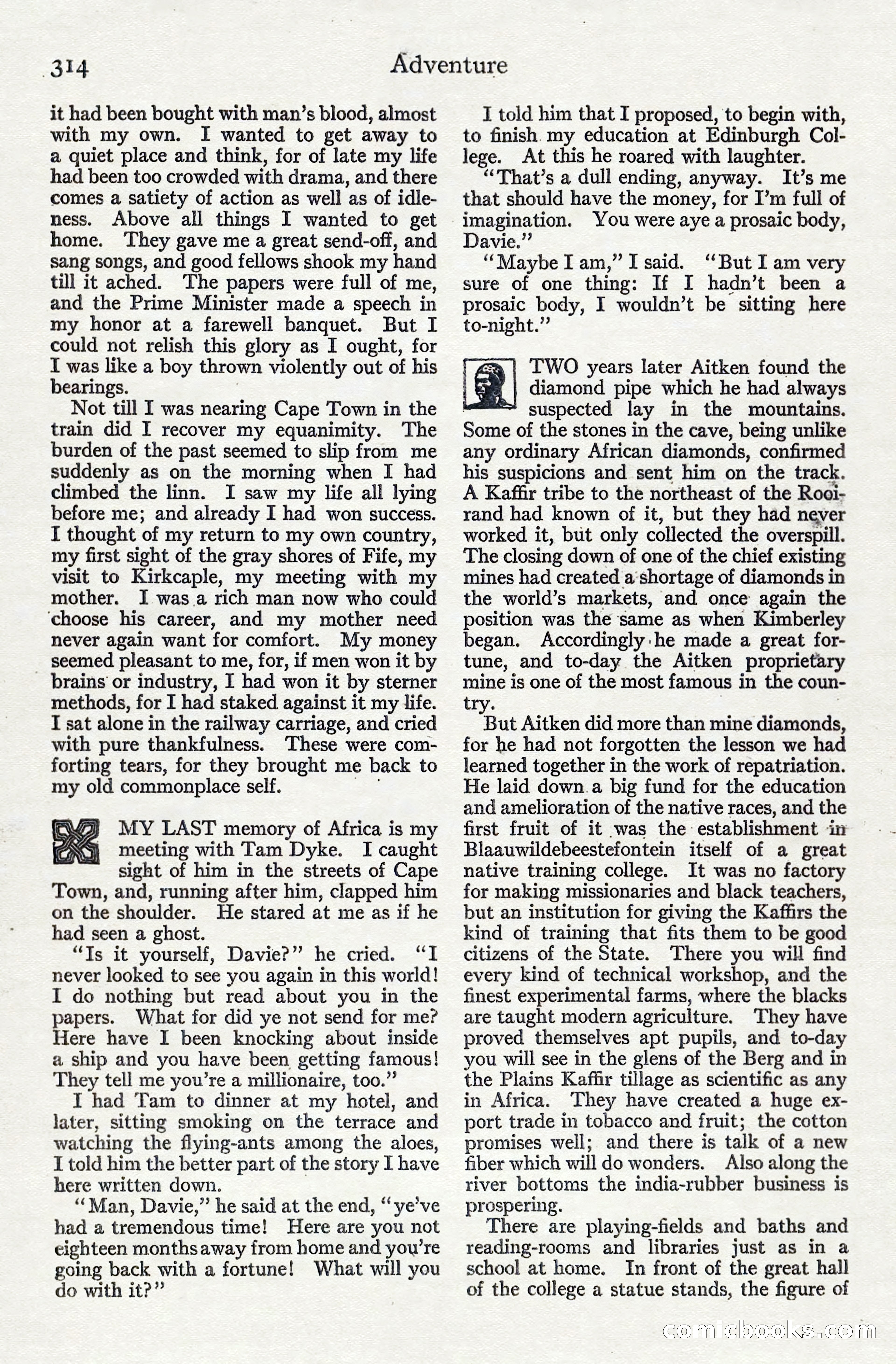
A restored page from Pulp Fiction, 1911. Page through the whole issue in the reader above.
📄 Transcribed text from this page (OCR, searchable)
Machine-transcribed from the original scan — historical spelling and the odd misread are preserved.
314 it had been bought with man’s blood, almost with my own. I wanted to get away to a quiet place and think, for of late my life had been too crowded with drama, and there comes a satiety of action as well as of idle- ness. Above all things I wanted to get home. They gave me a great send-off, and sang songs, and good fellows shook my hand till it ached. ‘The papers were full of me, and the Prime Minister made a speech in my honor at a farewell banquet. But I could not relish this glory as I ought, for I was like a boy thrown violently out of his bearings. Not till I was nearing Cape Town in the train did I recover my equanimity. The burden of the past seemed to slip from me suddenly as on the morning when I had climbed the linn. I saw my life all lying before me; and already I had won success. I thought of my return to my own country, my first sight of the gray shores of Fife, my visit to Kirkcaple, my meeting with my mother. I was.a rich man now who could choose his career, and my mother need never again want for comfort. My money _ seemed pleasant to me, for, if men won it by brains or industry, I had won it by sterner methods, for I had staked against it my life. I sat alone in the railway carriage, and cried with pure thankfulness. These were com- forting tears, for they brought me back to my old commonplace self. MY LAST memory of Africa is my meeting with Tam Dyke. I caught sight of him in the streets of Cape Town, and, running after him, clapped him on the shoulder. He stared at me as if he had seen a ghost. “Ts it yourself, Davie?” he cried. “I never looked to see you again in this world! I do nothing but read about you in the papers. What for did ye not send for me? Here have I been knocking about inside a ship and you have been getting famous! They tell me you’re a millionaire, too.” I had Tam to dinner at my hotel, and later, sitting smoking on the terrace and watching the flying-ants among the aloes, I told him the better part of the story I have here written down. ‘Man, Davie,” he said at the end, “ye’ve had a tremendous time! Here are you not eighteen monthsaway from home and you’re going back with a fortune! What will you do with it?” Adventure I told him that I proposed, to begin with, to finish. my education at Edinburgh Col- lege. At this he roared with laughter. “That’s a dull ending, anyway. It’s me that should have the money, for I’m full of imagination. You were aye a prosaic body, Davie.” “MaybeI am,” I said. “But I am very sure of one thing: If I hadn’t been a prosaic body, I wouldn’t be sitting here to-night.” TWO years later Aitken found the diamond pipe which he had always ™ suspected lay in the mountains. Some of the stones in the cave, being unlike any ordinary African diamonds, confirmed his suspicions and sent him on the track. A Kaffir tribe to the northeast of the Rooi- rand had known of it, but they had never worked it, but only collected the overspill. The closing down of one of the chief existing mines had created a‘shortage of diamonds in the world’s markets, and once again the position was the same as when Kimberley began. Accordingly he made a great for- tune, and to-day the Aitken proprietary mine is one of the most famous in the coun- try. : But Aitken did more than mine diamonds, for he had not forgotten the lesson we had learned together in the work of repatriation. He laid down.a big fund for the education and amelioration of the native races, and the first fruit of it was the establishment in Blaauwildebeestefontein itself of a great native training college. It was no factory for making missionaries and black teachers, but an institution for giving the Kaffirs the kind of training that fits them to be good citizens of the State. There you will find every kind of technical workshop, and the finest experimental farms, where the blacks are taught modern agriculture. They have proved themselves apt pupils, and to-day you will see in the glens of the Berg and in the Plains Kaffir tillage as scientific as any in Africa. They have created a huge ex- port trade in tobacco and fruit; the cotton promises well; and there is talk of a new fiber which will do wonders. Also along the river bottoms the india-rubber business is prospering. There are playing-fields and baths and reading-rooms and libraries just as in a school at home. In front of the great hall of the college a statue stands, the figure of EO 0)(0)) ANG SoC)