
Pulp Fiction, 1911 · page 129 of 196
Adventure, June 1911 — page 129: what you’re looking at
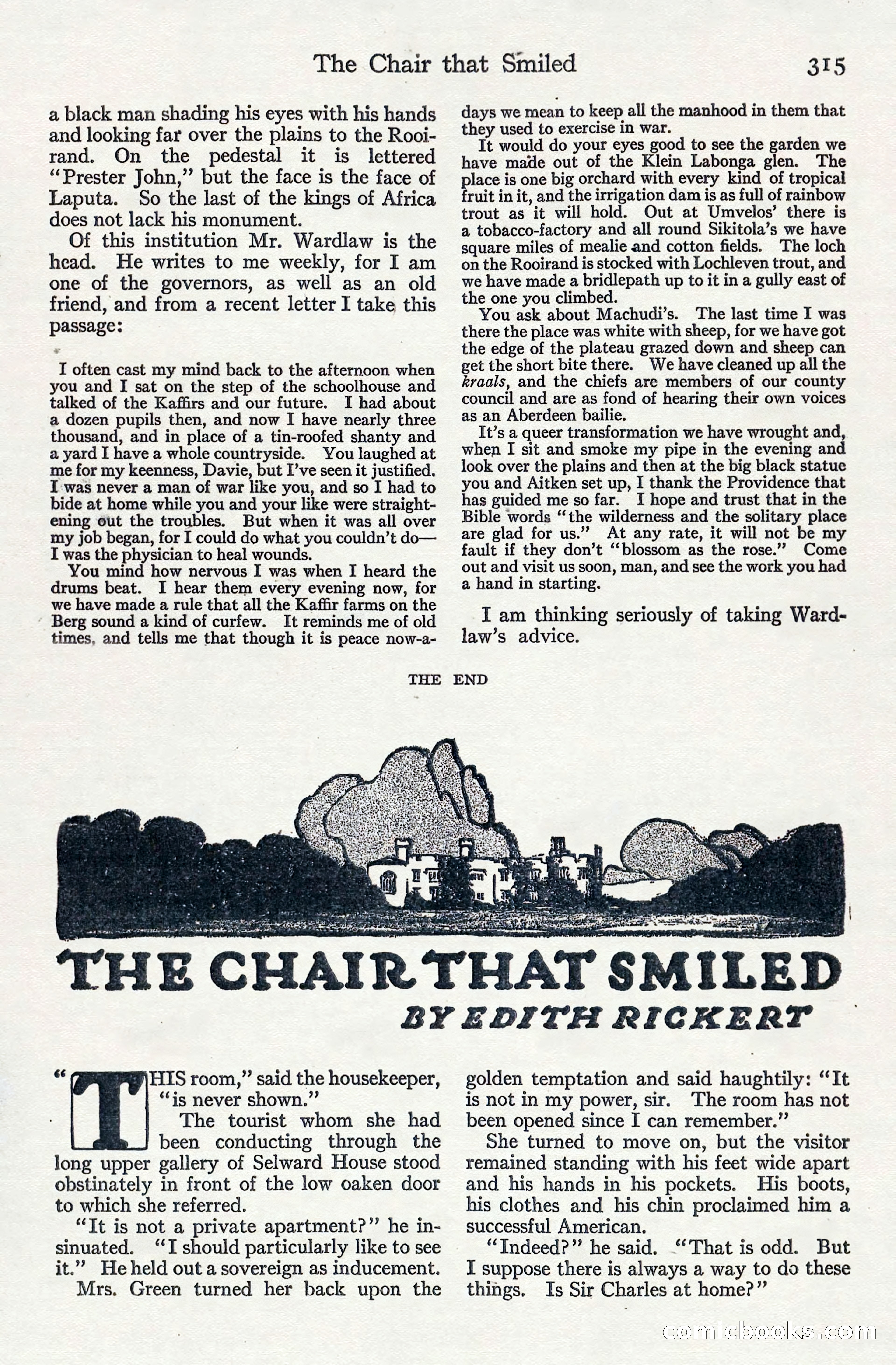
A restored page from Pulp Fiction, 1911. Page through the whole issue in the reader above.
📄 Transcribed text from this page (OCR, searchable)
Machine-transcribed from the original scan — historical spelling and the odd misread are preserved.
The Chair that Smiled a black man shading his eyes with his hands and looking far over the plains to the Rooi- rand. On the pedestal it is lettered “Prester John,” but the face is the face of Laputa. So the last of the kings of Africa does not lack his monument. Of this institution Mr. Wardlaw is the head. He writes to me weekly, for I am one of the governors, as well as an old friend, and from a recent letter I take this passage: x I often cast my mind back to the afternoon when you and I sat on the step of the schoolhouse and talked of the Kaffirs and our future. I had about a dozen pupils then, and now I have nearly three thousand, and in place of a tin-roofed shanty and a yard I have a whole countryside. You laughed at me for my keenness, Davie, but I’ve seen it justified. I was never a man of war like you, and so I had to bide at home while you and your like were straight- ening out the troubles. But when it was all over my job began, for I could do what you couldn’t do— I was the physician to heal wounds. You mind how nervous I was when I heard the drums beat. I hear them every evening now, for we have made a rule that all the Kaffir farms on the Berg sound a kind of curfew. It reminds me of old times, and tells me that though it is peace now-a- THE Aafia Ste pun pee oT ee he TR tie ate ea “te, o =/ 315 days we mean to keep all the manhood in them that they used to exercise in war. It would do your eyes good to see the garden we have made out of the Klein Labonga glen. The place is one big orchard with every kind of tropical fruit in it, and the irrigation dam is as full of rainbow trout as it will hold. Out at Umvelos’ there is a tobacco-factory and all round Sikitola’s we have square miles of mealie and cotton fields. The loch on the Rooirand is stocked with Lochleven trout, and we have made a bridlepath up to it in a gully east of the one you climbed. You ask about Machudi’s. The last time I was there the place was white with sheep, for we have got the edge of the plateau grazed down and sheep can get the short bite there. We have cleaned up all the kraals, and the chiefs are members of our county council and are as fond of hearing their own voices as an Aberdeen bailie. It’s a queer transformation we have wrought and, when I sit and smoke my pipe in the evening and look over the plains and then at the big black statue you and Aitken set up, I thank the Providence that has guided me so far. I hope and trust that in the Bible words ‘‘the wilderness and the solitary place are glad for us.” At any rate, it will not be my fault if they don’t ‘‘blossom as the rose.”” Come out and visit us soon, man, and see the work you had a hand in starting. I am thinking seriously of taking Ward- law’s advice. END THE CHAIR THAT SMILED BY EDITH RICKERT = HIS room,” said the housekeeper, “is never shown.” The tourist whom she had been conducting through the long upper gallery of Selward House stood obstinately in front of the low oaken door to which she referred. “Tt is not a private apartment?” he in- sinuated. “TI should particularly like to see it.” Heheld out a sovereign as inducement. Mrs. Green turned her back upon the golden temptation and said haughtily: “It is not in my power, sir. The room has not been opened since I can remember.” She turned to move on, but the visitor remained standing with his feet wide apart and his hands in his pockets. His boots, his clothes and his chin proclaimed him a successful American. “Indeed?” he said. ‘That is odd. But I suppose there is always a way to do these things. Is Sir Charles at home?” CORICLOO© C SnCO)