
Pulp Fiction, 1911 · page 163 of 196
Adventure, June 1911 — page 163: what you’re looking at
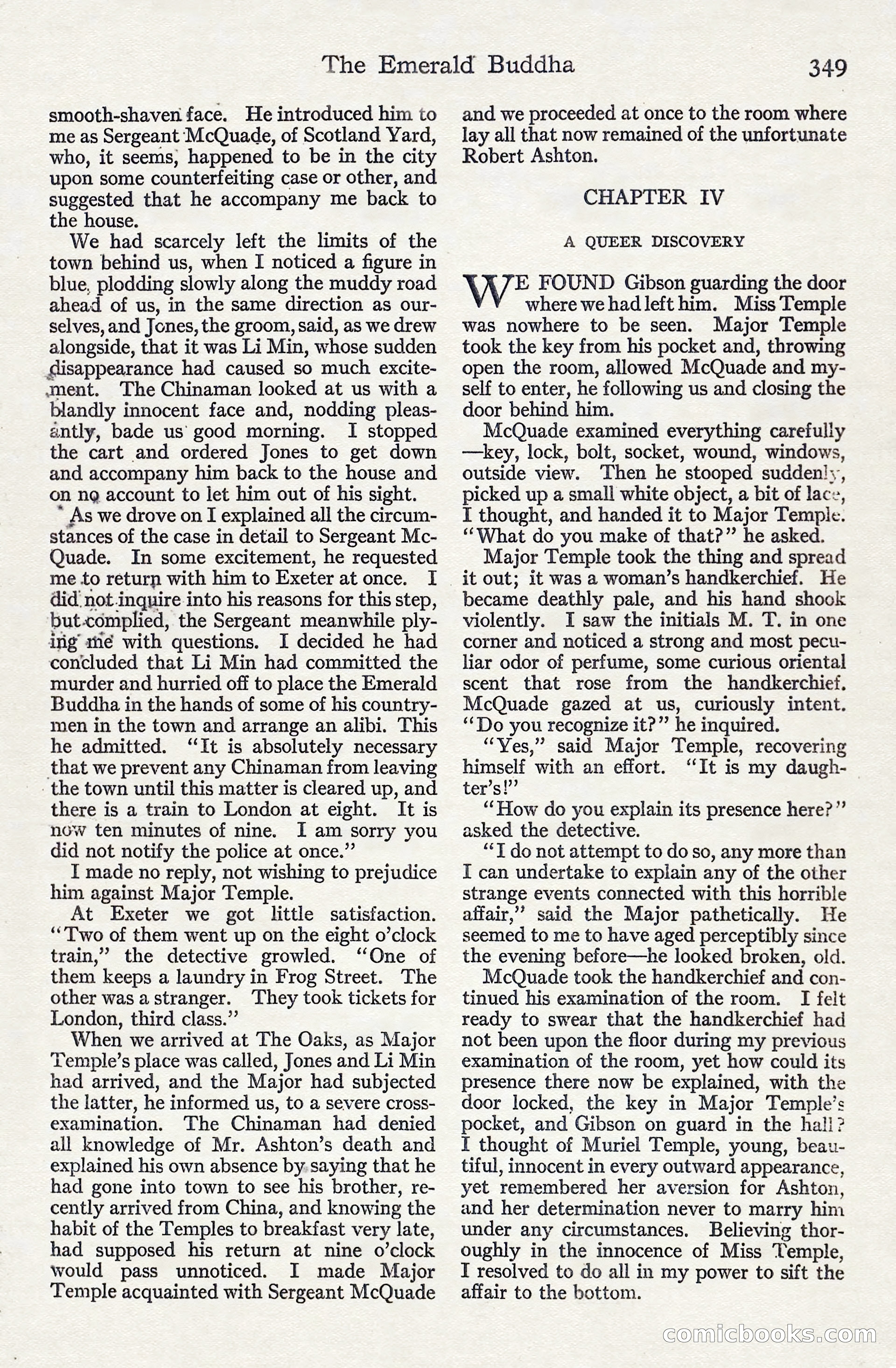
A restored page from Pulp Fiction, 1911. Page through the whole issue in the reader above.
📄 Transcribed text from this page (OCR, searchable)
Machine-transcribed from the original scan — historical spelling and the odd misread are preserved.
The Emerald Buddha smooth-shaven face. He introduced him to me as Sergeant McQuade, of Scotland Yard, who, it seems, happened to be in the city upon some counterfeiting case or other, and suggested that he accompany me back to the house. We had scarcely left the limits of the town behind us, when I noticed a figure in blue, plodding slowly along the muddy road ahead of us, in the same direction as our- selves, and Jones, the groom, said, as we drew alongside, that it was Li Min, whose sudden disappearance had caused so much excite- ment. The Chinaman looked at us with a blandly innocent face and, nodding pleas- antly, bade us’ good morning. I stopped the cart and ordered Jones to get down and accompany him back to the house and on ng account to let him out of his sight. * As we drove on I explained all the circum- stances of the case in detail to Sergeant Mc- Quade. In some excitement, he requested me to return with him to Exeter atonce. I did not inquire into his reasons for this step, but complied, the Sergeant meanwhile ply- ing’ aie with questions. I decided he had concluded that Li Min had committed the murder and hurried off to place the Emerald Buddha in the hands of some of his country- men in the town and arrange an alibi. This he admitted. “It is absolutely necessary that we prevent any Chinaman from leaving the town until this matter is cleared up, and there is a train to London at eight. It is now ten minutes of nine. I am sorry you did not notify the police at once.” I made no reply, not wishing to prejudice him against Major Temple. At Exeter we got little satisfaction. “Two of them went up on the eight o’clock train,” the detective growled. “One of them keeps a laundry in Frog Street. The other was a stranger. They took tickets for London, third class.” When we arrived at The Oaks, as Major Temple’s place was called, Jones and Li Min had arrived, and the Major had subjected the latter, he informed us, to a severe cross- examination. The Chinaman had denied all knowledge of Mr. Ashton’s death and explained his own absence by. saying that he had gone into town to see his brother, re- cently arrived from China, and knowing the habit of the Temples to breakfast very late, had supposed his return at nine o’clock would pass unnoticed. I made Major Temple acquainted with Sergeant McQuade 349 and we proceeded at once to the room where lay all that now remained of the unfortunate Robert Ashton. CHAPTER IV A QUEER DISCOVERY WE FOUND Gibson guarding the door where we had left him. Miss Temple was nowhere to be seen. Major Temple took the key from his pocket and, throwing open the room, allowed McQuade and my- self to enter, he following us and closing the door behind him. McQuade examined everything carefully —key, lock, bolt, socket, wound, windows, outside view. ‘Then he stooped sudden!;, picked up a small white object, a bit of lace, I thought, and handed it to Major Temple. “What do you make of that?” he asked. Major Temple took the thing and spread it out; it was a woman’s handkerchief. He became deathly pale, and his hand shook violently. I saw the initials M. T. in one corner and noticed a strong and most pecu- liar odor of perfume, some curious oriental scent that rose from the handkerchief, McQuade gazed at us, curiously intent. ‘“‘Do you recognize it?” he inquired. “Yes,” said Major Temple, recovering himself with an effort. “It is my daugh- ter’s!” “How do you explain its presence here?”’ asked the detective. “TI do not attempt to do so, any more than I can undertake to explain any of the other strange events connected with this horrible affair,’ said the Major pathetically. He seemed to me to have aged perceptibly since the evening before—he looked broken, old. McQuade took the handkerchief and con- tinued his examination of the room. [I felt ready to swear that the handkerchief had not been upon the floor during my previous examination of the room, yet how could its presence there now be explained, with the door locked, the key in Major Temple’s pocket, and Gibson on guard in the hall ? I thought of Muriel Temple, young, beau- tiful, innocent in every outward appearance, yet remembered her aversion for Ashton, and her determination never to marry him under any circumstances. Believing thor- oughly in the innocence of Miss Temple, I resolved to do all in my power to sift the affair to the bottom. COMmiICLOOckKkS. CO