
Pulp Fiction, 1911 · page 164 of 196
Adventure, June 1911 — page 164: what you’re looking at
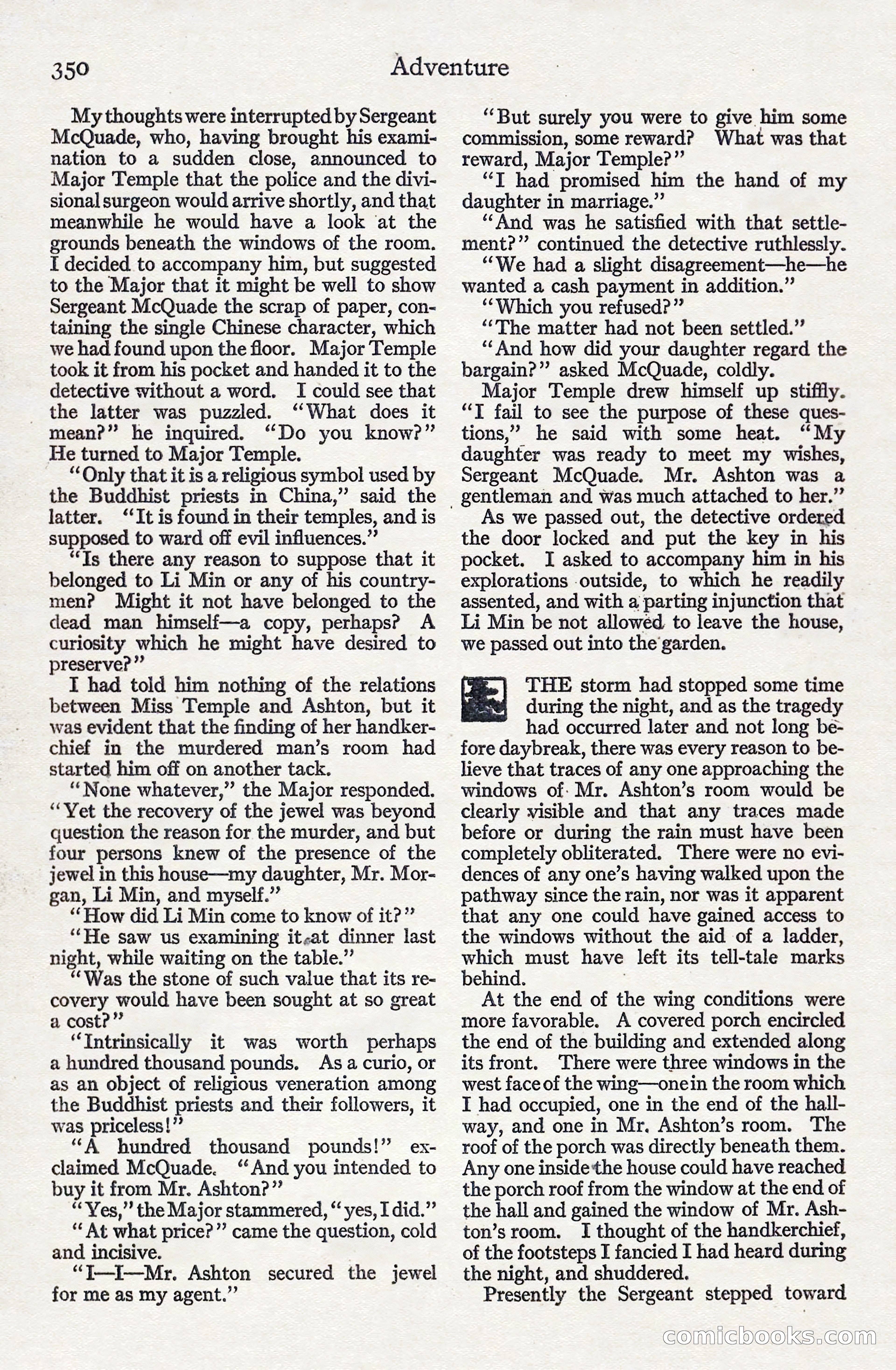
A restored page from Pulp Fiction, 1911. Page through the whole issue in the reader above.
📄 Transcribed text from this page (OCR, searchable)
Machine-transcribed from the original scan — historical spelling and the odd misread are preserved.
350 My thoughts were interrupted by Sergeant McQuade, who, having brought his exami- nation to a sudden close, announced to Major Temple that the police and the divi- sional surgeon would arrive shortly, and that meanwhile he would have a look at the grounds beneath the windows of the room. I decided to accompany him, but suggested to the Major that it might be well to show Sergeant McQuade the scrap of paper, con- taining the single Chinese character, which we had found upon the floor. Major Temple took it from his pocket and handed it to the detective without a word. I could see that the latter was puzzled. ‘What does it mean?” he inquired. “Do you know?” He turned to Major Temple. “Only that it is a religious symbol used by the Buddhist priests in China,” said the latter. ‘‘It is found in their temples, and is supposed to ward off evil influences.” “Is there any reason to suppose that it belonged to Li Min or any of his country- men? Might it not have belonged to the dead man himself—a copy, perhaps? A curiosity which he might have desired to preserve?” I had told him nothing of the relations between Miss Temple and Ashton, but it was evident that the finding of her handker- chief in the murdered man’s room had started him off on another tack. ‘“‘None whatever,” the Major responded. “Yet the recovery of the jewel was beyond question the reason for the murder, and but four persons knew of the presence of the jewel in this house—my daughter, Mr. Mor- gan, Li Min, and myself.” “‘How did Li Min come to know of it?” “He saw us examining it,at dinner last night, while waiting on the table.” “Was the stone of such value that its re- covery would have been sought at so great a cost?” “Tntrinsically it was worth perhaps a hundred thousand pounds. As a curio, or as an object of religious veneration among the Buddhist priests and their followers, it was priceless!” “A hundred thousand pounds!” ex- claimed McQuade. ‘And you intended to buy it from Mr. Ashton?” “Ves,” the Major stammered, “ yes, I did.” “* At what price?”’ came the question, cold and incisive. “J—J—Mr. Ashton secured the jewel for me as my agent.” Adventure “But surely you were to give him some commission, some reward? What was that reward, Major Temple?” “T had promised him the hand of my daughter in marriage.” ‘“‘And was he satisfied with that settle- ment?” continued the detective ruthlessly. “We had a slight disagreement—he—he wanted a cash payment in addition.” ‘Which you refused?” “The matter had not been settled.” “And how did your daughter regard the bargain?”’ asked McQuade, coldly. Major Temple drew himself up stiffly. “T fail to see the purpose of these ques- tions,” he said with some heat. “My daughter was ready to meet my wishes, Sergeant McQuade. Mr. Ashton was a _ gentleman and was much attached to her.” As we passed out, the detective ordered the door locked and put the key in his pocket. JI asked to accompany him in his explorations outside, to which he readily assented, and with a parting injunction that Li Min be not allowéd to leave the house, we passed out into thegarden. by THE storm had stopped some time 8 during the night, and as the tragedy had occurred later and not long be- fore daybreak, there was every reason to be- lieve that traces of any one approaching the windows of: Mr. Ashton’s room would be clearly visible and that any traces made before or during the rain must have been completely obliterated. There were no evi- dences of any one’s having walked upon the pathway since the rain, nor was it apparent that any one could have gained access to the windows without the aid of a ladder, which must have left its tell-tale marks behind. : At the end of the wing conditions were more favorable. A covered porch encircled the end of the building and extended along its front. There were three windows in the west face of the wing—onein the room which I had occupied, one in the end of the hall- way, and one in Mr. Ashton’s room. The roof of the porch was directly beneath them. Any one inside the house could have reached the porch roof from the window at the end of the hall and gained the window of Mr. Ash- ton’sroom. I thought of the handkerchief, of the footsteps I fancied I had heard during the night, and shuddered. Presently the Sergeant stepped toward Z Baz COnmmiclboooks (C@