
Pulp Fiction, 1911 · page 165 of 196
Adventure, June 1911 — page 165: what you’re looking at
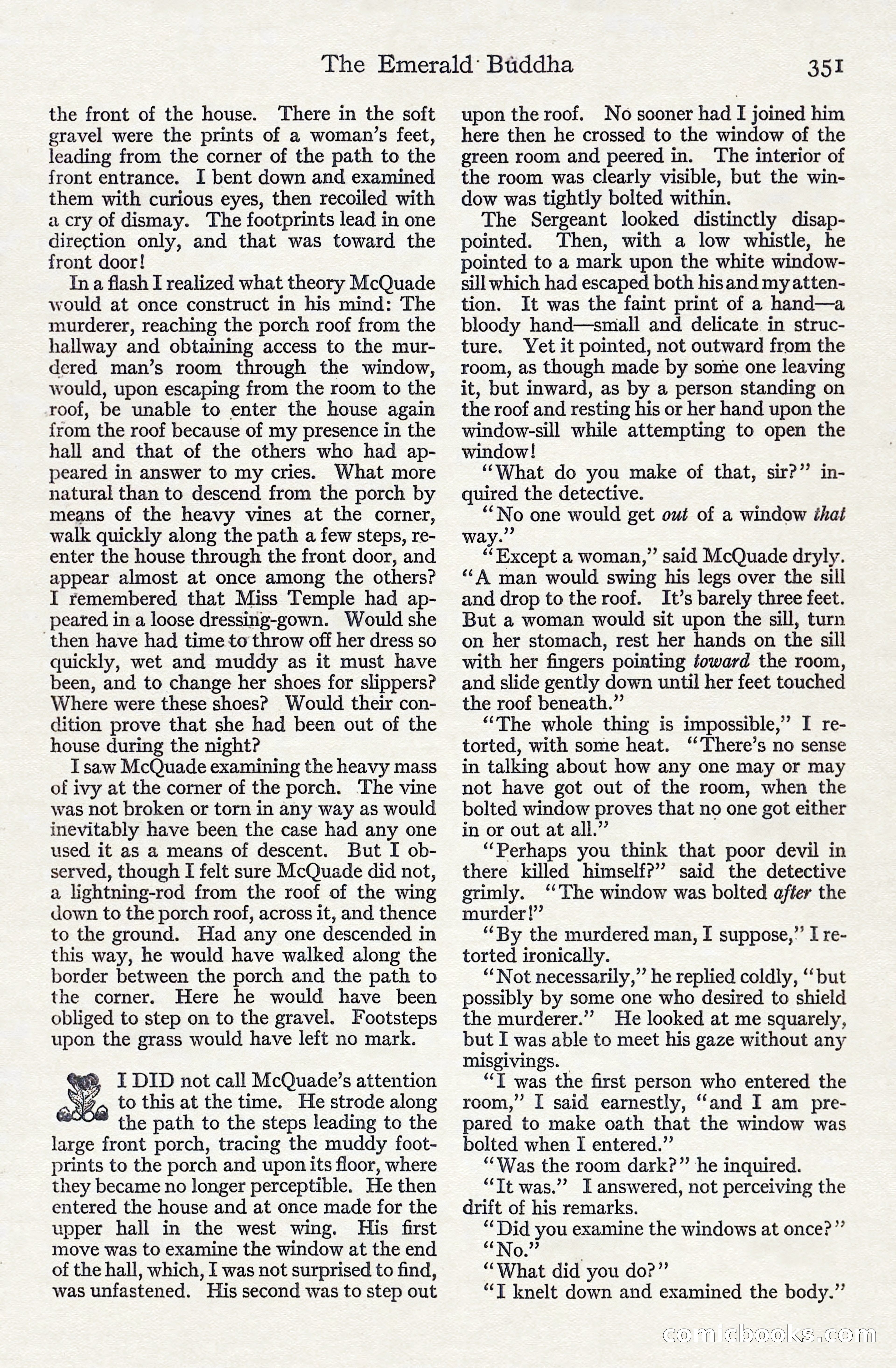
A restored page from Pulp Fiction, 1911. Page through the whole issue in the reader above.
📄 Transcribed text from this page (OCR, searchable)
Machine-transcribed from the original scan — historical spelling and the odd misread are preserved.
The Emerald: Btiddha the front of the house. ‘There in the soft gravel were the prints of a woman’s feet, leading from the corner of the path to the front entrance. I bent down and examined them with curious eyes, then recoiled with a cry of dismay. The footprints lead in one direction only, and that was toward the front door! In a flash I realized what theory McQuade would at once construct in his mind: The murderer, reaching the porch roof from the hallway and obtaining access to the mur- dered man’s room through the window, would, upon escaping from the room to the roof, be unable to enter the house again from the roof because of my presence in the hall and that of the others who had ap- peared in answer to my cries. What more natural than to descend from the porch by means of the heavy vines at the corner, walk quickly along the path a few steps, re- enter the house through the front door, and appear almost at once among the others? I remembered that Miss Temple had ap- peared in a loose dressing-gown. Would she then have had time to throw off her dress so quickly, wet and muddy as it must have been, and to change her shoes for slippers? Where were these shoes? Would their con- dition prove that she had been out of the house during the night? I saw McQuade examining the heavy mass of ivy at the corner of the porch. ‘The vine was not broken or torn in any way as would inevitably have been the case had any one used it as a means of descent. But I ob- served, though I felt sure McQuade did not, a lightning-rod from the roof of the wing down to the porch roof, across it, and thence to the ground. Had any one descended in this way, he would have walked along the border between the porch and the path to the corner. Here he would have been obliged to step on to the gravel. Footsteps upon the grass would have left no mark. I DID not call McQuade’s attention to this at the time. He strode along the path to the steps leading to the large front porch, tracing the muddy foot- prints to the porch and upon its floor, where they became no longer perceptible. He then entered the house and at once made for the upper hall in the west wing. His first move was to examine the window at the end of the hall, which, I was not surprised to find, was unfastened. His second was to step out 351 upon the roof. No sooner had I joined him here then he crossed to the window of the green room and peered in. The interior of the room was clearly visible, but the win- dow was tightly bolted within. The Sergeant looked distinctly disap- pointed. ‘Then, with a low whistle, he pointed to a mark upon the white window- sill which had escaped both hisand my atten- tion. It was the faint print of a hand—a bloody hand—small and delicate in struc- ture. Yet it pointed, not outward from the room, as though made by some one leaving it, but inward, as by a person standing on the roof and resting his or her hand upon the window-sill while attempting to open the window! “What do you make of that, sir?” in- quired the detective. “No one would get out of a window thai way.” “Except a woman,” said McQuade dryly. ‘‘A man would swing his legs over the sill and drop to the roof. It’s barely three feet. But a woman would sit upon the sill, turn on her stomach, rest her hands on the sill with her fingers pointing toward the room, and slide gently down until her feet touched the roof beneath.” “The whole thing is impossible,’ I re- torted, with some heat. ‘‘There’s no sense in talking about how any one may or may not have got out of the room, when the bolted window proves that no one got either in or out at all.”’ “Perhaps you think that poor devil in there killed himself?” said the detective erimly. “The window was bolted after the murder!” “By the murdered man, I suppose,” I re- torted ironically. “Not necessarily,” he replied coldly, ‘but possibly by some one who desired to shield the murderer.’’ He looked at me squarely, but I was able to meet his gaze without any misgivings. — “I was the first person who entered the room,” I said earnestly, “and I am pre- pared to make oath that the window was bolted when I entered.” “Was the room dark?” he inquired. “It was.” I answered, not perceiving the drift of his remarks. “*Did you examine the windows at once?” ““No.”’ “What did you do?” “T knelt down and examined the body.” CORnNICLO© <SHIGO