
Pulp Fiction, 1911 · page 25 of 196
Adventure, June 1911 — page 25: what you’re looking at
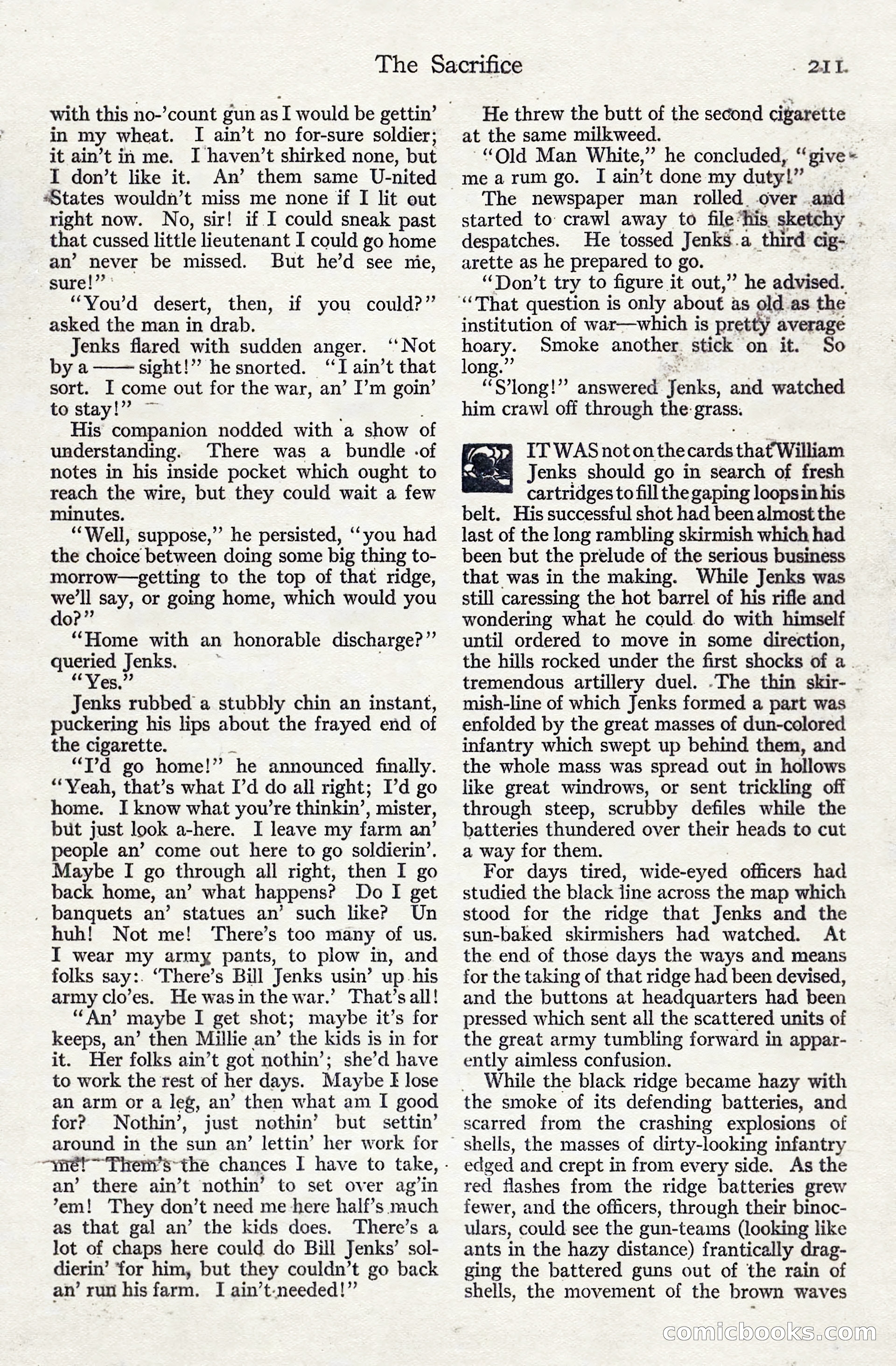
A restored page from Pulp Fiction, 1911. Page through the whole issue in the reader above.
📄 Transcribed text from this page (OCR, searchable)
Machine-transcribed from the original scan — historical spelling and the odd misread are preserved.
The Sacrifice with this no-’count gun as I would be gettin’ in my wheat. I ain’t no for-sure soldier; it ain’t in me. I haven’t shirked none, but I don’t like it. An’ them same U-nited “States wouldn’t miss me none if I lit out right now. No, sir! if I could sneak past that cussed little lieutenant I could go home an’ never be missed. But he’d see nie, sure!” “You'd desert, then, asked the man in drab. Jenks flared with sudden anger. ‘Not bya sight!’’ he snorted. vt ain’t that sort. I come out for the war, an’ I’m goin’ to stay!” ~ His companion nodded with a show of understanding. There was a bundle -of notes in his inside pocket which ought to reach the wire, but they could wait a few minutes. “Well, suppose,” he persisted, “you had the choice between doing some big thing to- morrow—getting to the top of that ridge, we'll say, or going home, which would you do?” “Home with an honorable discharge?” queried Jenks. é¢ Yes. >P) Jenks rubbed a stubbly chin an instant, puckering his lips about the frayed end of the cigarette. “T’d go home!” he announced finally. “Yeah, that’s what I’d do all right; I'd go home. I know what you’re thinkin’, mister, but just look a-here. I leave my farm an’ people an’ come out here to go soldierin’, Maybe I go through all right, then I go back home, an’ what happens? Do I get . banquets an’ statues an’ such like? Un huh! Not me! There’s too many of us. I wear my army pants, to plow in, and folks say:. ‘There’s Bill Jenks usin’ up his army clo’es. He wasin the war.’ That’s all! ‘““An’ maybe I get shot; maybe it’s for keeps, an’ then Millie an’ the kids is in for it. Her folks ain’t got nothin’; she’d have to work the rest of her days. Maybe I lose an arm or a leg, an’ then what am I good for? Nothin’, just nothin’ but settin’ around in the sun an’ lettin’ her work for if you could?” -yiét~"Them’s~the chances I have to take, - an’ there ain’t nothin’ to set over ag’in ’em! They don’t need me here half’s much as that gal an’ the kids does. There’s a lot of chaps here could do Bill Jenks’ sol- dierin’ for him, but they couldn’t go back an’ run his farm. I ain’t-needed!” - 211. He threw the butt of the second cigarette at the same milkweed. “Old Man White,” he concluded, “ gives -mearum go. I ain’t done my duty” The newspaper man rolled. over and: started to crawl away to file “his sketchy . despatches. He tossed Jenks.a third cig- arette as he prepared to go. — “Don’t try to figure it out,” he advised. “That question is only about as old.as the institution of war—which is pretty average hoary. Smoke another. stick on it. So long.” “S’long!”’? answered enks. and watched him crawl off through BIS Erase. my IT WAS notonthe Sade that’William ees Jenks should go in search of fresh cartridges to fill the gaping loopsin his belt. His successful shot had been almost the last of the long rambling skirmish which had been but the prelude of the serious business that was in the making. While Jenks was still caressing the hot barrel of his rifle and wondering what he could do with himself until ordered to move in some direction, the hills rocked under the first shocks of a . tremendous artillery duel. -The thin skir- - mish-line of which Jenks formed a part was enfolded by the great masses of dun-colored infantry which swept up behind them, and the whole mass was spread out in hollows like great windrows, or sent trickling off through steep, scrubby defiles while the batteries thundered over their heads to cut a way for them. For days tired, wide-eyed officers had studied the black jine across the map which stood for the ridge that Jenks and the sun-baked skirmishers had watched. At the end of those days the ways and means for the taking of that ridge had been devised, and the buttons at headquarters had been pressed which sent all the scattered units of the great army tumbling forward in appar- ently aimless confusion. While the black ridge became hazy with the smoke of its defending batteries, and scarred from the crashing explosions of shells, the masses of dirty-looking infantry edged and crept in from every side. As the red flashes from the ridge batteries grew fewer, and the officers, through their binoc- ulars, could see the gun-teams (looking like ants in the hazy distance) frantically drag- ging the battered guns out of the rain of shells, the movement of the brown waves COnmiclboookks. Gon