
Pulp Fiction, 1911 · page 26 of 196
Adventure, June 1911 — page 26: what you’re looking at
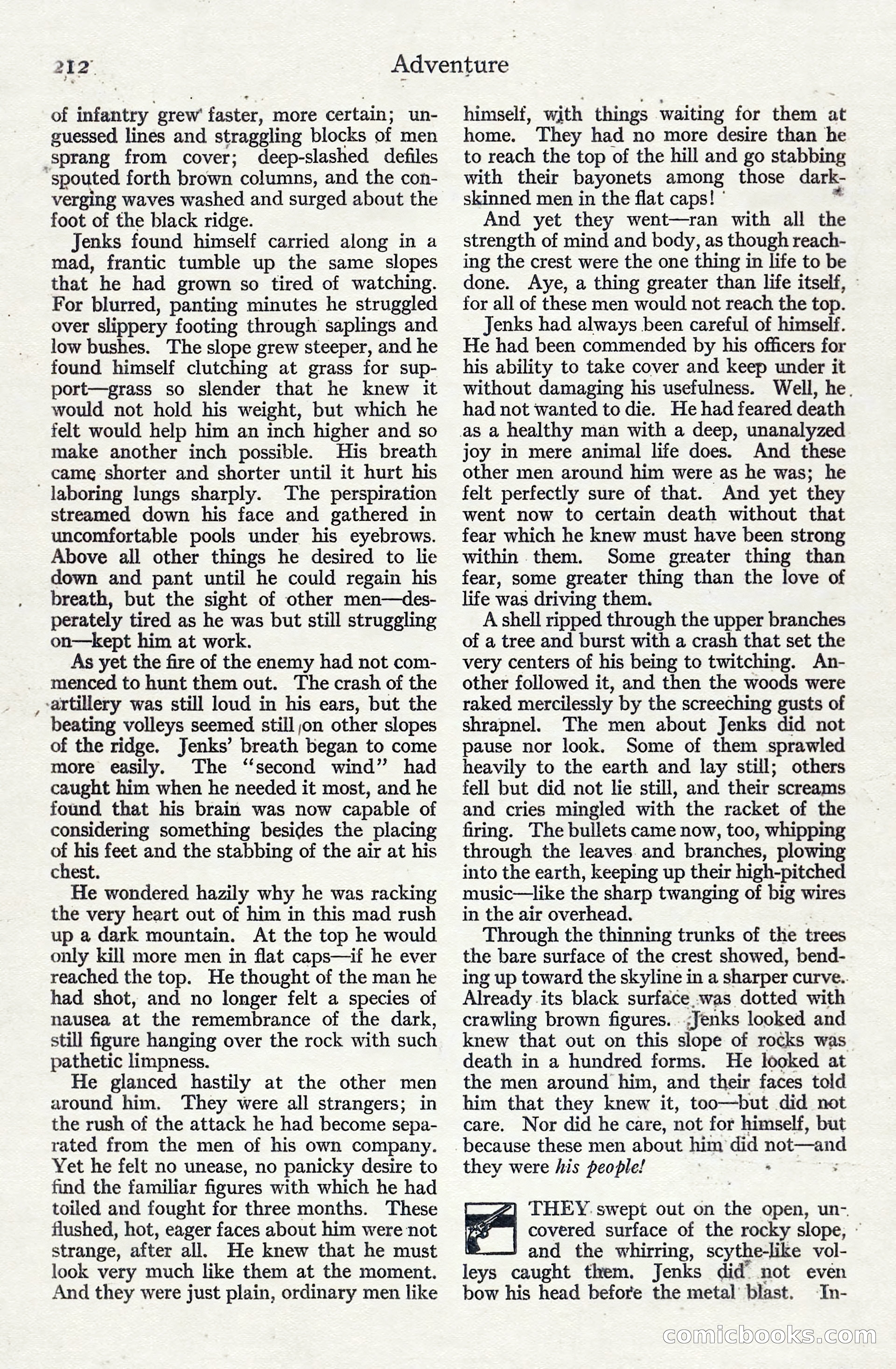
A restored page from Pulp Fiction, 1911. Page through the whole issue in the reader above.
📄 Transcribed text from this page (OCR, searchable)
Machine-transcribed from the original scan — historical spelling and the odd misread are preserved.
212° of infantry ‘grew faster, more certain: un- guessed lines and straggling blocks of men sprang from cover; deep-slashed defiles “spouted forth brown columns, and the con- verging waves washed and surged about the foot of the black ridge. Jenks found himself carried along in a mad, frantic tumble up the same slopes that he had grown so tired of watching. For blurred, panting minutes he struggled over slippery footing through saplings and low bushes. The slope grew steeper, and he found himself clutching at grass for sup- port—grass so slender that he knew it would not hold his weight, but which he felt would help him an inch higher and so make another inch possible. His breath came shorter and shorter until it hurt his laboring lungs sharply. The perspiration ~~ streamed down his face and gathered in uncomfortable pools under his eyebrows. Above all other things he desired to lie down and pant until he could regain his breath, but the sight of other men—des- perately tired as he was but still struggling on—kept him at work. As yet the fire of the enemy had not com- menced to hunt them out. The crash of the artillery was still loud in his ears, but the beating volleys seemed still;on other slopes of the ridge. Jenks’ breath began to come more easily. The “second wind” had caught him when he needed it most, and he found that his brain was now capable of considering something besides the placing of his feet and the stabbing of the air at his chest. He wondered hazily why he was racking the very heart out of him in this mad rush up a dark mountain. At the top he would only kill more men in flat caps—if he ever reached the top. He thought of the man he had shot, and no longer felt a species of nausea at the remembrance of the dark, still figure hanging over the rock with such pathetic limpness. He glanced hastily at the other men around him. They were all strangers; in the rush of the attack he had become sepa- rated from the men of his own company. Yet he felt no unease, no panicky desire to find the familiar figures with which he had toiled and fought for three months. These flushed, hot, eager faces about him were not strange, after all. He knew that he must look very much like them at the moment. And they were just plain, ordinary men like Adventure himself, with things waiting for them at home. They had no more desire than he to reach the top of the hill and go stabbing with their bayonets among those dark- skinned men in the flat caps! ' And yet they went—ran with all the strength of mind and body, as though reach- ing the crest were the one thing in life to be done. Aye, a thing greater than life itself, © for all of these men would not reach the top. Jenks had always been careful of himself. He had been commended by his officers for his ability to take cover and keep under it without damaging his usefulness. Well, he. had not wanted to die. He had feared death as a healthy man with a deep, unanalyzed joy in mere animal life does. And these other men around him were as he was; he felt perfectly sure of that. And yet they went now to certain death without that fear which he knew must have been strong within them. Some greater thing than fear, some greater thing than the love of life was driving them. A shell ripped through the upper branches of a tree and burst with a crash that set the very centers of his being to twitching. An- other followed it, and then the woods were raked mercilessly by the screeching gusts of shrapnel. The men about Jenks did not pause nor look. Some of them sprawled heavily to the earth and lay still; others fell but did not lie still, and their screams and cries mingled with the racket of the firing. The bullets came now, too, whipping through the leaves and branches, plowing into the earth, keeping up their high-pitched music—like the sharp twanging of big wires in the air overhead. | Through the thinning trunks of the trees the bare surface of the crest showed, bend- ing up toward the skyline in a sharper curve.. Already its black surface,was dotted with crawling brown figures. ..Jenks looked and knew that out on this slope of rocks was death in a hundred forms. He looked at the men around him, and their faces told him that they knew it, too—but did not care. Nor did he care, not for himself, but because these men about him did not—and they were his people! wig THEY. swept out on the open, un- ~ and the whirring, scythe-like vol- leys caught them. Jenks did’ not even bow his head before the metal blast. -In- GO DOOKS ANUC (C@ covered surface of the rocky slope, ~