
Pulp Fiction, 1911 · page 27 of 196
Adventure, June 1911 — page 27: what you’re looking at
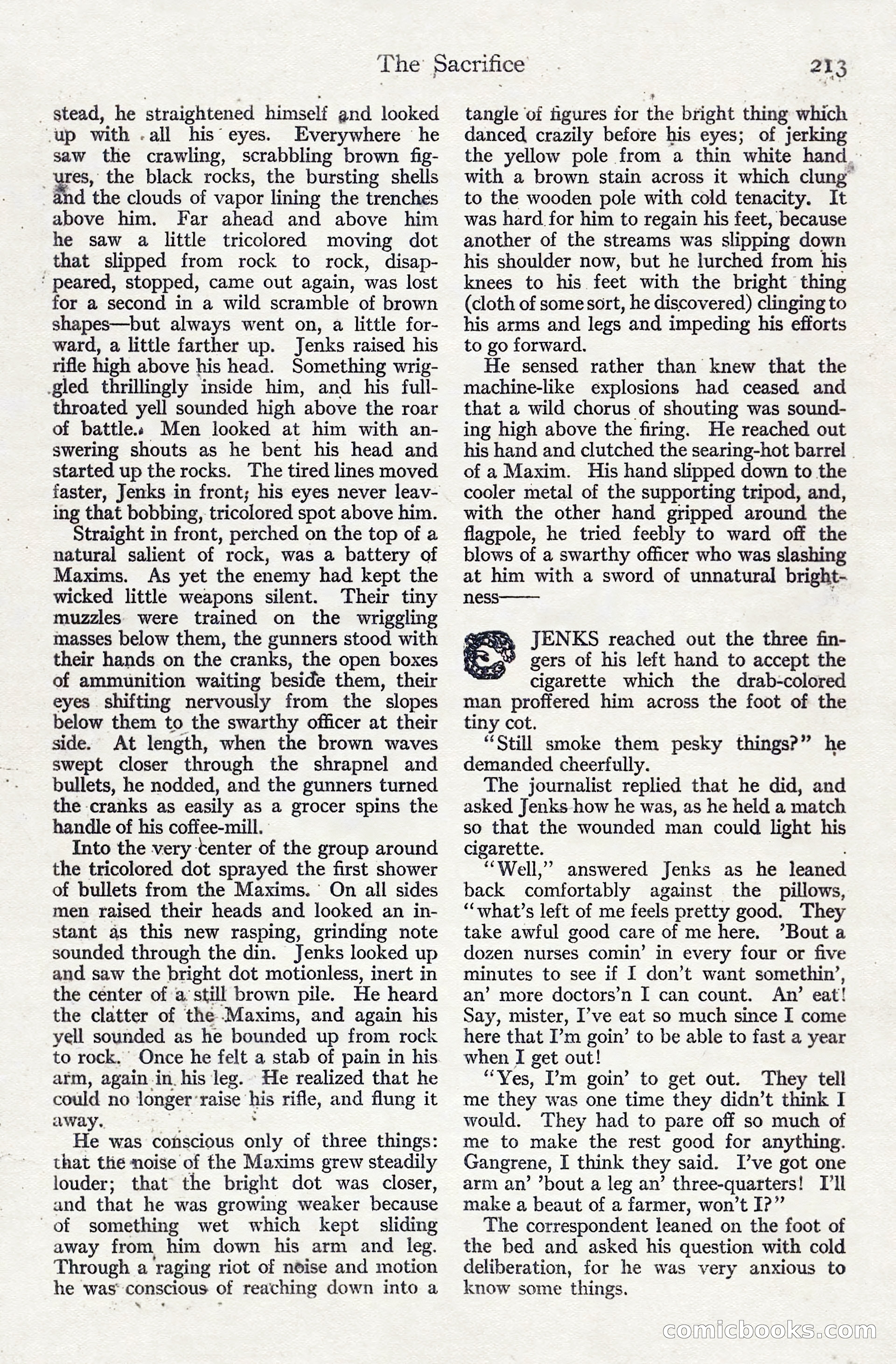
A restored page from Pulp Fiction, 1911. Page through the whole issue in the reader above.
📄 Transcribed text from this page (OCR, searchable)
Machine-transcribed from the original scan — historical spelling and the odd misread are preserved.
The Sacrifice _ stead, he straightened himself and looked .up with -.all his eyes. Everywhere he saw the crawling, scrabbling brown fig- ures, the black rocks, the bursting shells and the clouds of vapor lining the trenches above him. Far ahead and above him he saw a little tricolored moving dot that slipped from rock to rock, disap- ‘ peared, stopped, came out again, was lost for a second in a wild scramble of brown shapes—but always went on, a little for- ward, a little farther up. Jenks raised his rifle high above his head. Something wrig- gled thrillingly inside him, and his full- throated yell sounded high ‘above the roar of battle. Men looked at him with an- swering shouts as he bent his head and started up the rocks. The tired lines moved faster, Jenks in front; his eyes never leav- ing that bobbing, tricolored spot above him. Straight in front, perched on the top of a natural salient of rock, was a battery of Maxims. As yet the enemy had kept the wicked little weapons silent. Their tiny muzzles were trained on the wriggling masses below them, the gunners stood with their hands on the cranks, the open boxes of ammunition waiting beside them, their eyes shifting nervously from the slopes below them to the swarthy officer at their side. At length, when the brown waves swept closer through the shrapnel and bullets, he nodded, and the gunners turned the cranks as easily as a grocer spins the handle of his coffee-mill. Into the very tenter of the group around the tricolored dot sprayed the first shower of bullets from the Maxims.’ On all sides men raised their heads and looked an in- stant as this new rasping, grinding note sounded through the din. Jenks looked up and saw the bright dot motionless, inert in the center of a still brown pile. He heard the clatter of the Maxims, and again his yell sounded as he bounded up from rock to rock.’ Once he felt a stab of pain in his arm, again-in. his leg. He realized that he could no longer’ raise ‘bis rifle, and flung it away. He was conscious ealy of three things: that the noise of the Maxims grew steadily louder; that the bright dot was closer, and that he was srowing weaker because of something wet which kept sliding away from him down his arm and leg. Through a raging riot of noise and motion he was conscious of reaching down into a 2i3 tangle oi figures for the bright thing which — danced crazily before his eyes; of jerking the yellow pole from a thin white hand_- with a brown stain across it which clung to the wooden pole with cold tenacity. It was hard for him to regain his feet, because another of the streams was slipping down his shoulder now, but he lurched from his knees to his feet with the bright thing (cloth of some sort, he discovered) clinging to his arms and legs and impeding his efforts to go forward. He sensed rather than knew that the machine-like explosions had ceased and that a wild chorus of shouting was sound- ing high above the firing. He reached out his hand and clutched the searing-hot barrel - of a Maxim. His hand slipped down to the cooler metal of the supporting tripod, and, with the other hand gripped around the flagpole, he tried feebly to ward off the blows of a swarthy officer who was slashing at him with a sword of unnatural bright- ness m, JENKS reached out the three fin- ga’ gers of his left hand to accept the cigarette which the drab-colored man proffered him across the foot of the tiny cot. “Still smoke them pesky things?” he demanded cheerfully. The journalist replied that he did, and asked Jenks how he was, as he held a match so that the wounded man could light his cigarette. Well, ” answered Jenks as he leaned back comfortably against the pillows, “what’s left of me feels pretty good. They take awful good care of me here. ’*Bout a dozen nurses comin’ in every four or five minutes to see if I don’t want somethin’, an’ more doctors’n I can count. An’ eat! Say, mister, I’ve eat so much since I come here that I’m goin’ to be able to fast a year when I get out! “Yes, I’m goin’ to get out. They tell me they was one time they didn’t think I would. They had to pare off so much of me to make the rest good for anything. Gangrene, I think they said. I’ve got one arm an’ ’bout a leg an’ three-quarters! [ll make a beaut of a farmer, won’t I?” The correspondent leaned on the foot of the bed and asked his question with cold deliberation, for he was very anxious to know some things. Go DOOKS CO AMUC