
Pulp Fiction, 1911 · page 92 of 196
Adventure, June 1911 — page 92: what you’re looking at
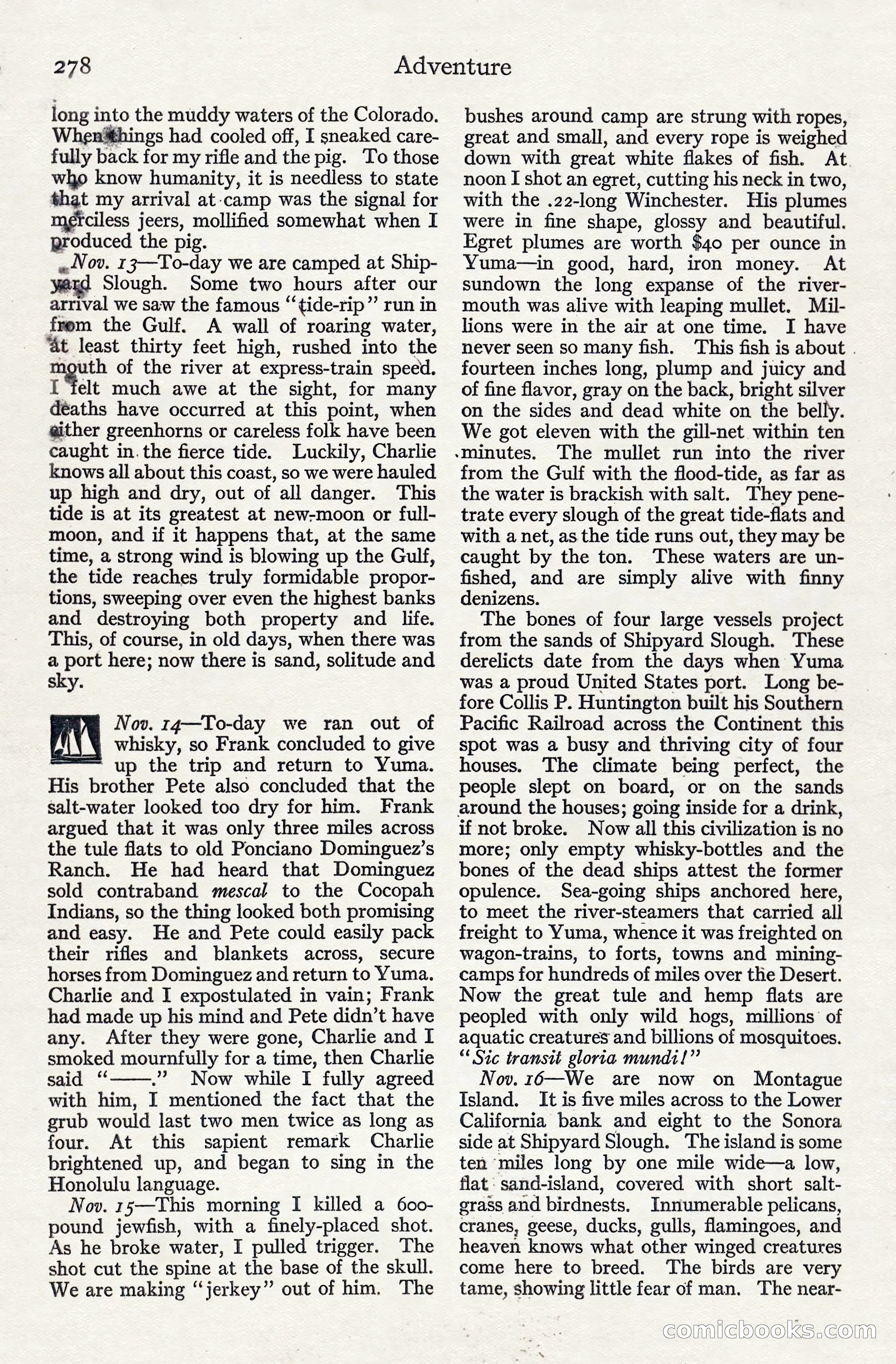
A restored page from Pulp Fiction, 1911. Page through the whole issue in the reader above.
📄 Transcribed text from this page (OCR, searchable)
Machine-transcribed from the original scan — historical spelling and the odd misread are preserved.
278 long into the muddy waters of the Colorado. Whenhings had cooled off, I sneaked care- fully back for my rifle and the pig. To those who know humanity, it is needless to state that my arrival at-camp was the signal for merciless jeers, mollified somewhat when I produced the pig. ..Vov. 13—To-day we are camped at Ship- yetd Slough. Some two hours after our arrival we saw the famous “tide-rip”’ run in fyem the Gulf. A wall of roaring water, ‘At least thirty feet high, rushed into the mouth of the river at express-train speed. I felt much awe at the sight, for many deaths have occurred at this point, when @ither greenhorns or careless folk have been caught in.the fierce tide. Luckily, Charlie knows all about this coast, so we were hauled up high and dry, out of all danger. This tide is at its greatest at new-moon or full- moon, and if it happens that, at the same time, a strong wind is blowing up the Gulf, the tide reaches truly formidable propor- tions, sweeping over even the highest banks and destroying both property and life. This, of course, in old days, when there was a port here; now there is sand, solitude and sky. Nov. r4—To-day we ran out of whisky, so Frank concluded to give ‘up the trip and return to Yuma. His brother Pete also concluded that the salt-water looked too dry for him. Frank argued that it was only three miles across the tule flats to old Ponciano Dominguez’s Ranch. He had heard that Dominguez sold contraband mescal to the Cocopah Indians, so the thing looked both promising and easy. He and Pete could easily pack their rifles and blankets across, secure horses from Dominguez and return to Yuma. Charlie and I expostulated in vain; Frank had made up his mind and Pete didn’t have any. After they were gone, Charlie and I smoked mournfully for a time, then Charlie said “ .’ Now while I fully agreed with him, I mentioned the fact that the grub would last two men twice as long as four. At this sapient remark Charlie brightened up, and began to sing in the Honolulu language. Nov. 15—This morning I killed a 600- pound jewfish, with a finely-placed shot. As he broke water, I pulled trigger. The shot cut the spine at the base of the skull. We are making “‘jerkey” out of him. The iM minutes. if not broke. Adventure bushes around camp are strung with ropes, great and small, and every rope is weighed down with great white flakes of fish. At noon I shot an egret, cutting his neck in two, with the .22-long Winchester. His plumes were in fine shape, glossy and beautiful. Egret plumes are worth $40 per ounce in Yuma—in good, hard, iron money. At sundown the long expanse of the river- mouth was alive with leaping mullet. Mil- lions were in the air at one time. I have never seen so many fish. ‘This fish is about . fourteen inches long, plump and juicy and of fine flavor, gray on the back, bright silver on the sides and dead white on the belly. We got eleven with the gill-net within ten The mullet run into the river from the Gulf with the flood-tide, as far as the water is brackish with salt. They pene- trate every slough of the great tide-flats and with a net, as the tide runs out, they may be caught by the ton. These waters are un- fished, and are simply alive with finny denizens. The bones of four large vessels project from the sands of Shipyard Slough. These derelicts date from the days when Yuma was a proud United States port. Long be- fore Collis P. Huntington built his Southern Pacific Railroad across the Continent this spot was a busy and thriving city of four houses. The climate being perfect, the people slept on board, or on the sands around the houses; going inside for a drink, Now all this civilization is no more; only empty whisky-bottles and the bones of the dead ships attest the former opulence. Sea-going ships anchored here, to meet the river-steamers that carried all freight to Yuma, whence it was freighted on wagon-trains, to forts, towns and mining- camps for hundreds of miles over the Desert. Now the great tule and hemp flats are peopled with only wild hogs, millions of aquatic creatures and billions of mosquitoes. “Sic transit gloria mundi!” Nov. 16—We are now on Montague Island. It is five miles across to the Lower California bank and eight to the Sonora side at Shipyard Slough. The island is some ten miles long by one mile wide—a low, flat: sand-island, covered with short salt- grass and birdnests. Innumerable pelicans, cranes, geese, ducks, gulls, flamingoes, and heaven knows what other winged creatures come here to breed. The birds are very tame, showing little fear of man. The near- comicoooks.c©