
Pulp Fiction, 1911 · page 93 of 196
Adventure, June 1911 — page 93: what you’re looking at
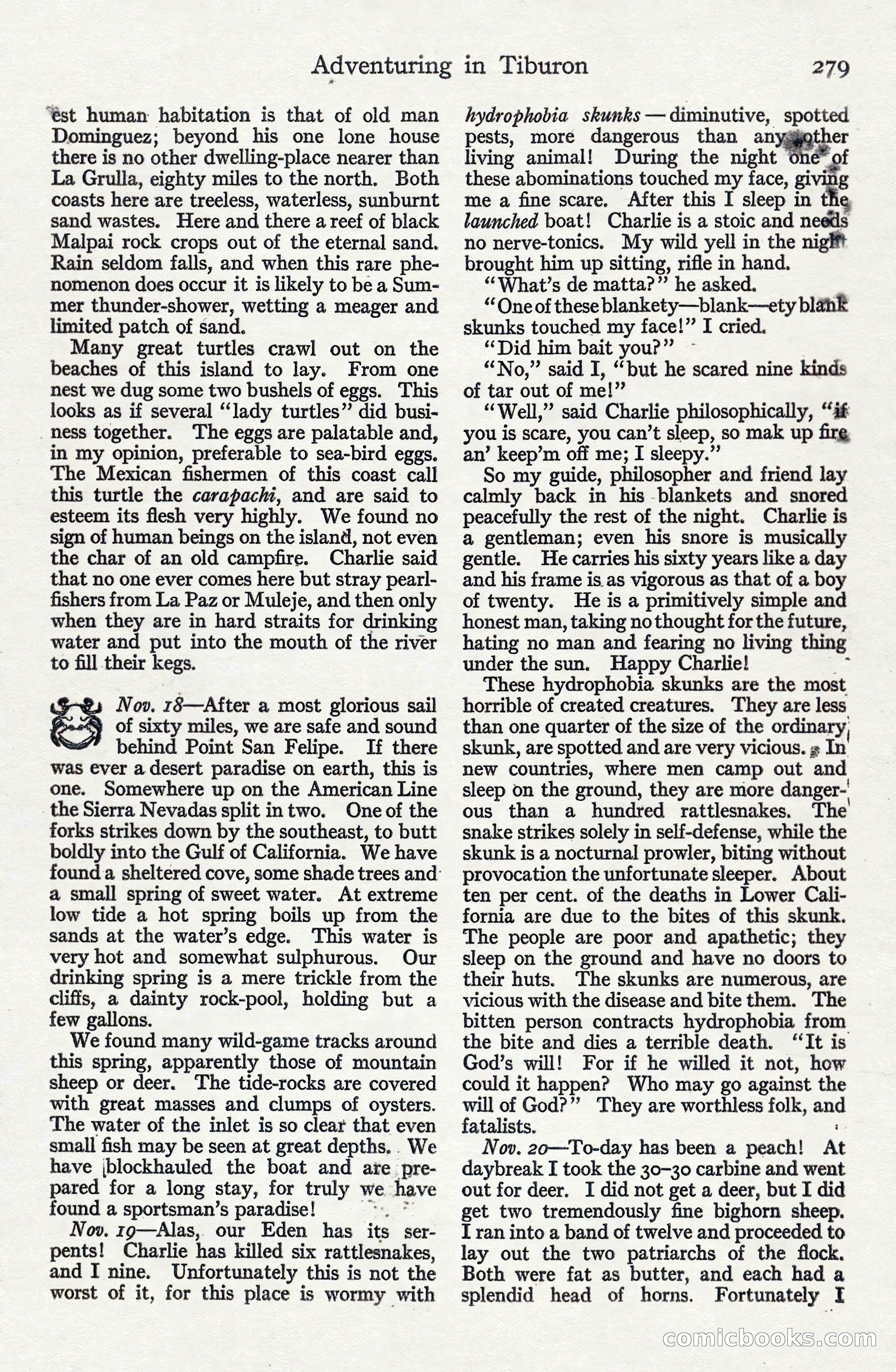
A restored page from Pulp Fiction, 1911. Page through the whole issue in the reader above.
📄 Transcribed text from this page (OCR, searchable)
Machine-transcribed from the original scan — historical spelling and the odd misread are preserved.
Adventuring in Tiburon ‘ést human habitation is that of old man Dominguez; beyond his one lone house there is no other dwelling-place nearer than La Grulla, eighty miles to the north. Both coasts here are treeless, waterless, sunburnt sand wastes. Here and there a reef of black Malpai rock crops out of the eternal sand. Rain seldom falls, and when this rare phe- nomenon does occur it is likely to be a Sum- mer thunder-shower, wetting a meager and limited patch of sand. Many great turtles crawl out on the beaches of this island to lay. From one nest we dug some two bushels of eggs. This looks as if several “lady turtles” did busi- ness together. The eggs are palatable and, in my opinion, preferable to sea-bird eggs. The Mexican fishermen of this coast call this turtle the carapachi, and are said to esteem its flesh very highly. We found no sign of human beings on the island, not even the char of an old campfire. Charlie said that no one ever comes here but stray pearl- fishers from La Paz or Muleje, and then only when they are in hard straits for drinking water and put into the mouth of the river to fill their kegs. 8 of sixty miles, we are safe and sound behind Point San Felipe. If there was ever a desert paradise on earth, this is one. Somewhere up on the American Line the Sierra Nevadas split intwo. One of the forks strikes down by the southeast, to butt boldly into the Gulf of California. We have Nov. r8—After a most glorious sail found a sheltered cove, some shade trees and: a small spring of sweet water. At extreme low tide a hot spring boils up from the sands at the water’s edge. This water is very hot and somewhat sulphurous. Our drinking spring is a mere trickle from the cliffs, a dainty rock-pool, holding but a few gallons. We found many wild-game tracks around this spring, apparently those of mountain sheep or deer. The tide-rocks are covered with great masses and clumps of oysters. The water of the inlet is so clear that even small fish may be seen at great depths... We have jblockhauled the boat and are pre- pared for a long stay, for truly we have found a sportsman’s paradise! . Nov. r9—Alas, our Eden has its ser- pents! Charlie has killed six rattlesnakes, and I nine. Unfortunately this is not the worst of it, for this place is wormy with 279 hydrophobia skunks — diminutive, spotted pests, more dangerous than an per living animal! During the night these abominations touched my face, evi me a fine scare. After this I sleep in the launched boat! Charlie is a stoic and needs no nerve-tonics. My wild yell in the night brought him up sitting, rifle in hand. ‘““What’s de matta?”’ he asked. “One of these blankety—blank—ety blahk skunks touched my face!’ I cried. “Did him bait you?” ~ “No,” said I, “but he scared nine kinds of tar out of me!” “Well,” said Charlie philosophically, “it you is scare, you can’t sleep, so mak up fire an’ keep’m off me; I sleepy.” So my guide, philosopher and friend lay calmly back in his blankets and snored peacefully the rest of the night. Charlie is a gentleman; even his snore is musically gentle. He carries his sixty years like a day and his frame is as vigorous as that of a boy of twenty. He is a primitively simple and honest man, taking no thought for the future, hating no man and fearing no living thing under the sun. Happy Charlie! These hydrophobia skunks are the most horrible of created creatures. They are less than one quarter of the size of the ordinary, skunk, are spotted and are very vicious. g Tn new countries, where men camp out and sleep on the ground, they are more danger- ous than a hundred rattlesnakes. The snake strikes solely in self-defense, while the skunk is a nocturnal prowler, biting without provocation the unfortunate sleeper. About ten per cent. of the deaths in Lower Cali- fornia are due to the bites of this skunk. The people are poor and apathetic; they sleep on the ground and have no doors to their huts. The skunks are numerous, are vicious with the disease and bite them. The bitten person contracts hydrophobia from the bite and dies a terrible death. “It is God’s will! For if he willed it not, how could it happen? Who may go against the will of God?” They are worthless folk, ad fatalists. Nov. 20—To-day has been a peach! At daybreak I took the 30-30 carbine and went out for deer. I did not get a deer, but I did get two tremendously fine bighorn sheep. I ran into a band of twelve and proceeded to lay out the two patriarchs of the flock. Both were fat as butter, and each had a splendid head of horns. Fortunately I GomicdooksEeo