
Pulp Fiction, 1911 · page 54 of 196
Adventure Magazine Cover — page 54: what you’re looking at
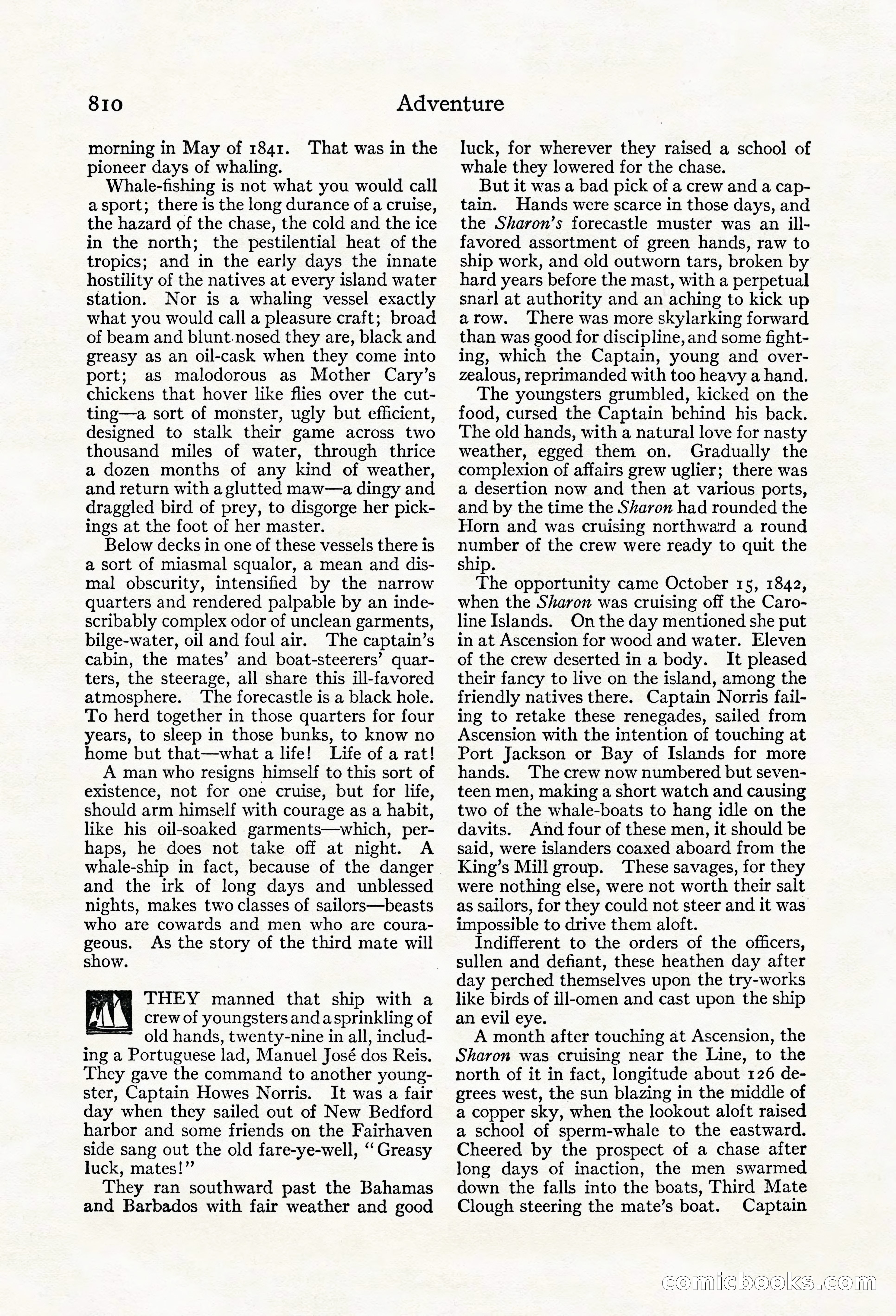
A restored page from Pulp Fiction, 1911. Page through the whole issue in the reader above.
📄 Transcribed text from this page (OCR, searchable)
Machine-transcribed from the original scan — historical spelling and the odd misread are preserved.
810 morning in May of 1841. That was in the pioneer days of whaling. Whale-fishing is not what you would call a sport; there is the long durance of a cruise, the hazard of the chase, the cold and the ice in the north; the pestilential heat of the tropics; and in the early days the innate hostility of the natives at every island water station. Nor is a whaling vessel exactly what you would call a pleasure craft; broad of beam and blunt-nosed they are, black and greasy as an oil-cask when they come into port; as malodorous as Mother Cary’s chickens that hover like flies over the cut- ting—a sort of monster, ugly but efficient, designed to stalk their game across two thousand miles of water, through thrice a dozen months of any kind of weather, and return with a glutted maw—a dingy and draggled bird of prey, to disgorge her pick- ings at the foot of her master. Below decks in one of these vessels there is a sort of miasmal squalor, a mean and dis- mal obscurity, intensified by the narrow quarters and rendered palpable by an inde- scribably complex odor of unclean garments, bilge-water, oil and foul air. The captain’s cabin, the mates’ and boat-steerers’ quar- ters, the steerage, all share this ill-favored atmosphere. ‘The forecastle is a black hole. To herd together in those quarters for four years, to sleep in those bunks, to know no home but that—what a life! Life of a rat! A man who resigns himself to this sort of existence, not for one cruise, but for life, should arm himself with courage as a habit, like his oil-soaked garments—which, per- haps, he does not take off at night. A whale-ship in fact, because of the danger and the irk of long days and unblessed nights, makes two classes of sailors—beasts who are cowards and men who are coura- geous. As the story of the third mate will show. ee THEY manned that ship with a Aj AA crew of youngsters and asprinkling of — Old hands, twenty-nine in all, includ- ing a Portuguese lad, Manuel José dos Reis. They gave the command to another young- ster, Captain Howes Norris. day when they sailed out of New Bedford harbor and some friends on the Fairhaven side sang out the old fare-ye-well, ‘‘ Greasy luck, mates!” They ran southward past the Bahamas and Barbados with fair weather and good It was a fair Adventure luck, for wherever they raised a school of whale they lowered for the chase. But it was a bad pick of a crew and a cap- tain. Hands were scarce in those days, and the Sharon’s forecastle muster was an ill- favored assortment of green hands, raw to ship work, and old outworn tars, broken by hard years before the mast, with a perpetual snarl at authority and an aching to kick up arow. ‘There was more skylarking forward than was good for discipline, and some fight- ing, which the Captain, young and over- zealous, reprimanded with too heavy a hand. The youngsters grumbled, kicked on the food, cursed the Captain behind his back. The old hands, with a natural love for nasty weather, egged them on. Gradually the complexion of affairs grew uglier; there was a desertion now and then at various ports, and by the time the Sharon had rounded the Horn and was cruising northward a round number of the crew were ready to quit the ship. The opportunity came October 15, 1842, when the Sharon was cruising off the Caro- line Islands. Onthe day mentioned she put in at Ascension for wood and water. Eleven of the crew deserted in a body. It pleased their fancy to live on the island, among the friendly natives there. Captain Norris fail- ing to retake these renegades, sailed from Ascension with the intention of touching at Port Jackson or Bay of Islands for more hands. The crew now numbered but seven- teen men, making a short watch and causing two of the whale-boats to hang idle on the davits. And four of these men, it should be said, were islanders coaxed aboard from the King’s Mill group. ‘These savages, for they were nothing else, were not worth their salt as sailors, for they could not steer and it was impossible to drive them aloft. Indifferent to the orders of the officers, sullen and defiant, these heathen day after day perched themselves upon the try-works like birds of ill-omen and cast upon the ship an evil eye. A month after touching at Ascension, the Sharon was cruising near the Line, to the north of it in fact, longitude about 126 de- grees west, the sun blazing in the middle of a copper sky, when the lookout aloft raised a school of sperm-whale to the eastward. Cheered by the prospect of a chase after long days of inaction, the men swarmed down the falls into the boats, Third Mate Clough steering the mate’s boat. Captain cComiclbooks ©