
Pulp Fiction, 1911 · page 55 of 196
Adventure Magazine Cover — page 55: what you’re looking at
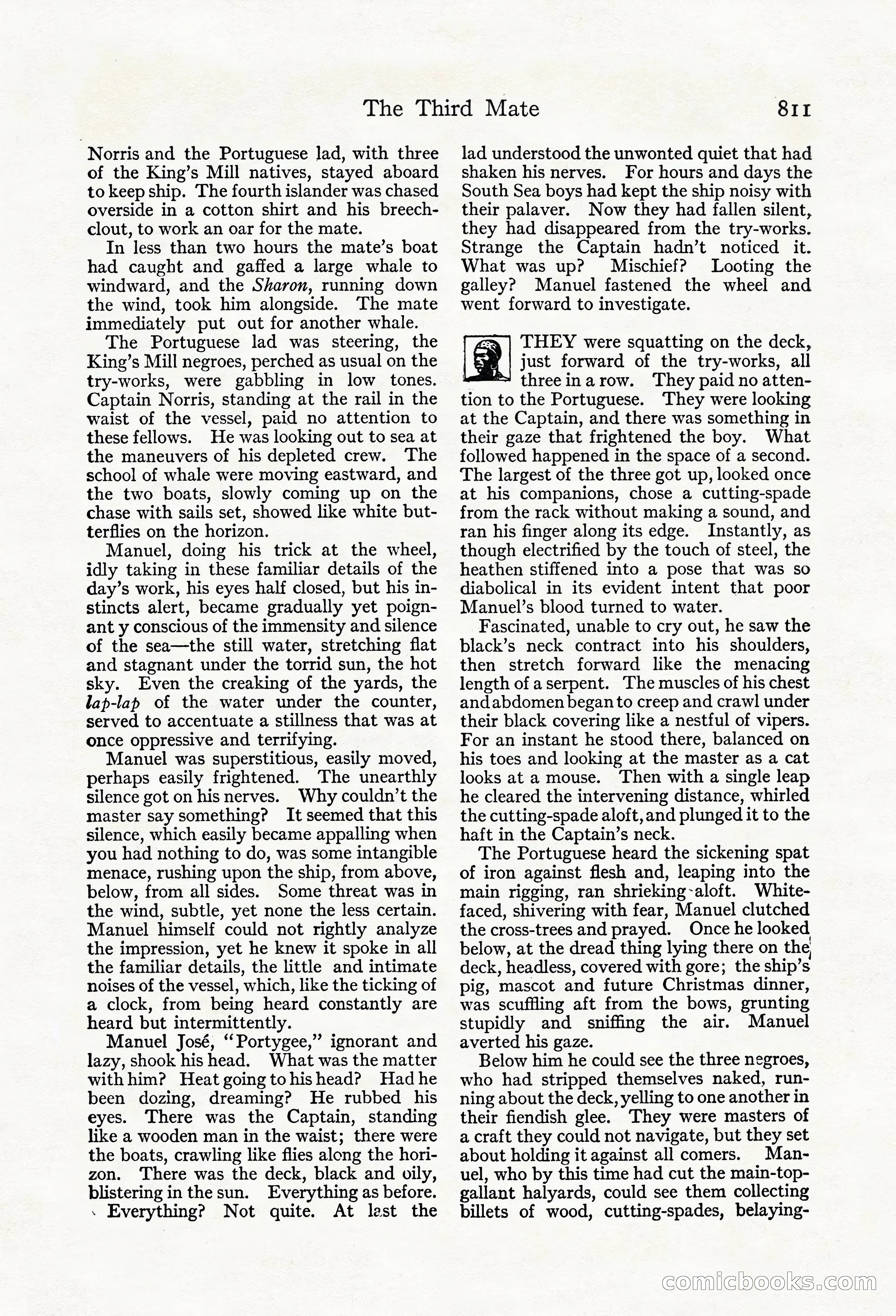
A restored page from Pulp Fiction, 1911. Page through the whole issue in the reader above.
📄 Transcribed text from this page (OCR, searchable)
Machine-transcribed from the original scan — historical spelling and the odd misread are preserved.
The Third Mate Norris and the Portuguese lad, with three of the King’s Mill natives, stayed aboard to keep ship. The fourth islander was chased overside in a cotton shirt and his breech- clout, to work an oar for the mate. In less than two hours the mate’s boat had caught and gaffed a large whale to windward, and the Sharon, running down the wind, took him alongside. The mate immediately put out for another whale. The Portuguese lad was steering, the King’s Mill negroes, perched as usual on the try-works, were gabbling in low tones. Captain Norris, standing at the rail in the waist of the vessel, paid no attention to these fellows. He was looking out to sea at the maneuvers of his depleted crew. The school of whale were moving eastward, and the two boats, slowly coming up on the chase with sails set, showed like white but- terflies on the horizon. Manuel, doing his trick at the wheel, idly taking in these familiar details of the day’s work, his eyes half closed, but his in- stincts alert, became gradually yet poign- ant y conscious of the immensity and silence of the sea—the still water, stretching flat and stagnant under the torrid sun, the hot sky. Even the creaking of the yards, the lap-lap of the water under the counter, served to accentuate a stillness that was at once oppressive and terrifying. Manuel was superstitious, easily moved, perhaps easily frightened. The unearthly silence got on his nerves. Why couldn’t the master say something? It seemed that this silence, which easily became appalling when you had nothing to do, was some intangible menace, rushing upon the ship, from above, below, from all sides. Some threat was in the wind, subtle, yet none the less certain. Manuel himself could not rightly analyze the impression, yet he knew it spoke in all the familiar details, the little and intimate noises of the vessel, which, like the ticking of a clock, from being heard constantly are heard but intermittently. Manuel José, ‘‘Portygee,” ignorant and lazy, shook his head. What was the matter with him? Heat goingtohishead? Hadhe been dozing, dreaming? He rubbed his eyes. There was the Captain, standing like a wooden man in the waist; there were the boats, crawling like flies along the hori- zon. ‘There was the deck, black and oily, blistering in the sun. Everything as before. . Everything? Not quite. At last the Pd SII lad understood the unwonted quiet that had shaken his nerves. For hours and days the South Sea boys had kept the ship noisy with their palaver. Now they had fallen silent, they had disappeared from the try-works. Strange the Captain hadn’t noticed it. What was up? Mischief? Looting the galley? Manuel fastened the wheel and went forward to investigate. THEY were squatting on the deck, just forward of the try-works, all “ threeinarow. They paid no atten- tion to the Portuguese. They were looking at the Captain, and there was something in their gaze that frightened the boy. What followed happened in the space of a second. The largest of the three got up, looked once at his companions, chose a cutting-spade from the rack without making a sound, and ran his finger along its edge. Instantly, as though electrified by the touch of steel, the heathen stiffened into a pose that was so diabolical in its evident intent that poor Manuel’s blood turned to water. Fascinated, unable to cry out, he saw the black’s neck contract into his shoulders, then stretch forward like the menacing length of aserpent. The muscles of his chest and abdomen began to creep and crawl under their black covering like a nestful of vipers. For an instant he stood there, balanced on his toes and looking at the master as a cat looks at a mouse. Then with a single leap he cleared the intervening distance, whirled the cutting-spade aloft, and plunged it to the haft in the Captain’s neck. The Portuguese heard the sickening spat of iron against flesh and, leaping into the main rigging, ran shrieking-aloft. White- faced, shivering with fear, Manuel clutched the cross-trees and prayed. Once he looked below, at the dread thing lying there on the deck, headless, covered with gore; the ship’s pig, mascot and future Christmas dinner, was scuffling aft from the bows, grunting stupidly and sniffing the air. Manuel averted his gaze. Below him he could see the three negroes, who had stripped themselves naked, run- ning about the deck, yelling to one another in their fiendish glee. They were masters of a craft they could not navigate, but they set about holding it against all comers. Man- uel, who by this time had cut the main-top- gallant halyards, could see them collecting billets of wood, cutting-spades, belaying- CoMmicbook C©