
Pulp Fiction, 1911 · page 69 of 196
Adventure Magazine Cover — page 69: what you’re looking at
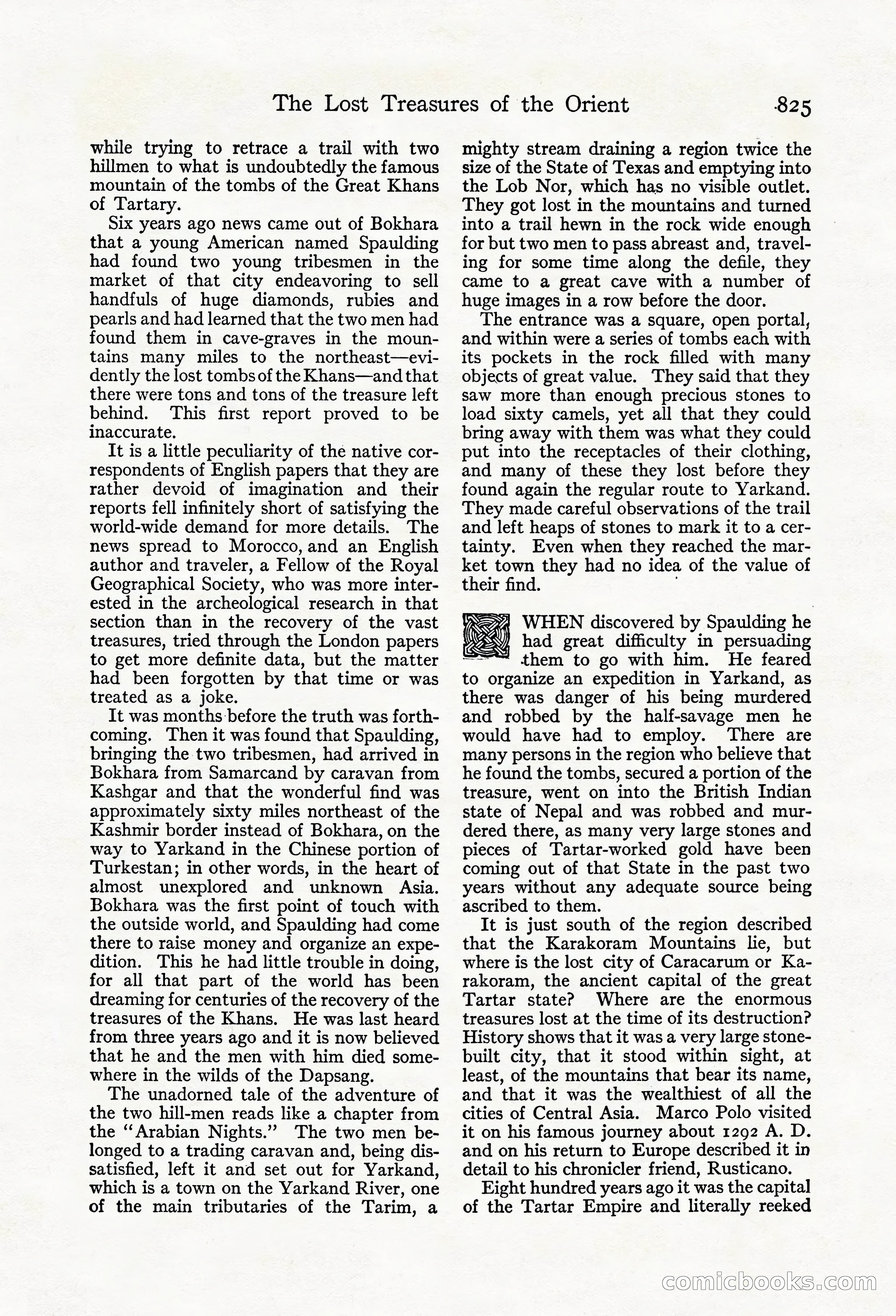
A restored page from Pulp Fiction, 1911. Page through the whole issue in the reader above.
📄 Transcribed text from this page (OCR, searchable)
Machine-transcribed from the original scan — historical spelling and the odd misread are preserved.
The Lost Treasures of the Orient while trying to retrace a trail with two hillmen to what is undoubtedly the famous mountain of the tombs of the Great Khans of Tartary. Six years ago news came out of Bokhara that a young American named Spaulding had found two young tribesmen in the market of that city endeavoring to sell handfuls of huge diamonds, rubies and pearls and had learned that the two men had found them in cave-graves in the moun- tains many miles to the northeast—evi- dently the lost tombs of the Khans—and that there were tons and tons of the treasure left behind. This first report proved to be inaccurate. It is a little peculiarity of the native cor- respondents of English papers that they are rather devoid of imagination and their reports fell infinitely short of satisfying the world-wide demand for more details. The news spread to Morocco, and an English author and traveler, a Fellow of the Royal Geographical Society, who was more inter- ested in the archeological research in that section than in the recovery of the vast treasures, tried through the London papers to get more definite data, but the matter had been forgotten by that time or was treated as a joke. It was months before the truth was forth- coming. Then it was found that Spaulding, bringing the two tribesmen, had arrived in Bokhara from Samarcand by caravan from Kashgar and that the wonderful find was approximately sixty miles northeast of the Kashmir border instead of Bokhara, on the way to Yarkand in the Chinese portion of Turkestan; in other words, in the heart of almost unexplored and unknown Asia. Bokhara was the first point of touch with the outside world, and Spaulding had come there to raise money and organize an expe- dition. This he had little trouble in doing, for all that part of the world has been dreaming for centuries of the recovery of the treasures of the Khans. He was last heard from three years ago and it is now believed that he and the men with him died some- where in the wilds of the Dapsang. The unadorned tale of the adventure of the two hill-men reads like a chapter from the “Arabian Nights.”” The two men be- longed to a trading caravan and, being dis- satisfied, left it and set out for Yarkand, which is a town on the Yarkand River, one of the main tributaries of the Tarim, a 825 mighty stream draining a region twice the size of the State of Texas and emptying into the Lob Nor, which has no visible outlet. They got lost in the mountains and turned into a trail hewn in the rock wide enough for but two men to pass abreast and, travel- ing for some time along the defile, they came to a great cave with a number of huge images in a row before the door. The entrance was a square, open portal, and within were a series of tombs each with its pockets in the rock filled with many objects of great value. They said that they saw more than enough precious stones to load sixty camels, yet all that they could bring away with them was what they could put into the receptacles of their clothing, and many of these they lost before they found again the regular route to Yarkand. They made careful observations of the trail and left heaps of stones to mark it to a cer- tainty. Even when they reached the mar- ket town they had no idea of the value of their find. Nay, WHEN discovered by Spaulding he VY, had great difficulty in persuading them to go with him. He feared to organize an expedition in Yarkand, as there was danger of his being murdered and robbed by the half-savage men he would have had to employ. There are many persons in the region who believe that he found the tombs, secured a portion of the treasure, went on into the British Indian state of Nepal and was robbed and mur- dered there, as many very large stones and pieces of Tartar-worked gold have been coming out of that State in the past two years without any adequate source being ascribed to them. It is just south of the region described that the Karakoram Mountains le, but where is the lost city of Caracarum or Ka- rakoram, the ancient capital of the great Tartar state? Where are the enormous treasures lost at the time of its destruction? History shows that it was a very large stone- built city, that it stood within sight, at least, of the mountains that bear its name, and that it was the wealthiest of all the cities of Central Asia. Marco Polo visited it on his famous journey about 1292 A. D. and on his return to Europe described it in detail to his chronicler friend, Rusticano. Eight hundred years ago it was the capital of the Tartar Empire and literally reeked cCoMmicbook CO