
Pulp Fiction, 1911 · page 70 of 196
Adventure Magazine Cover — page 70: what you’re looking at
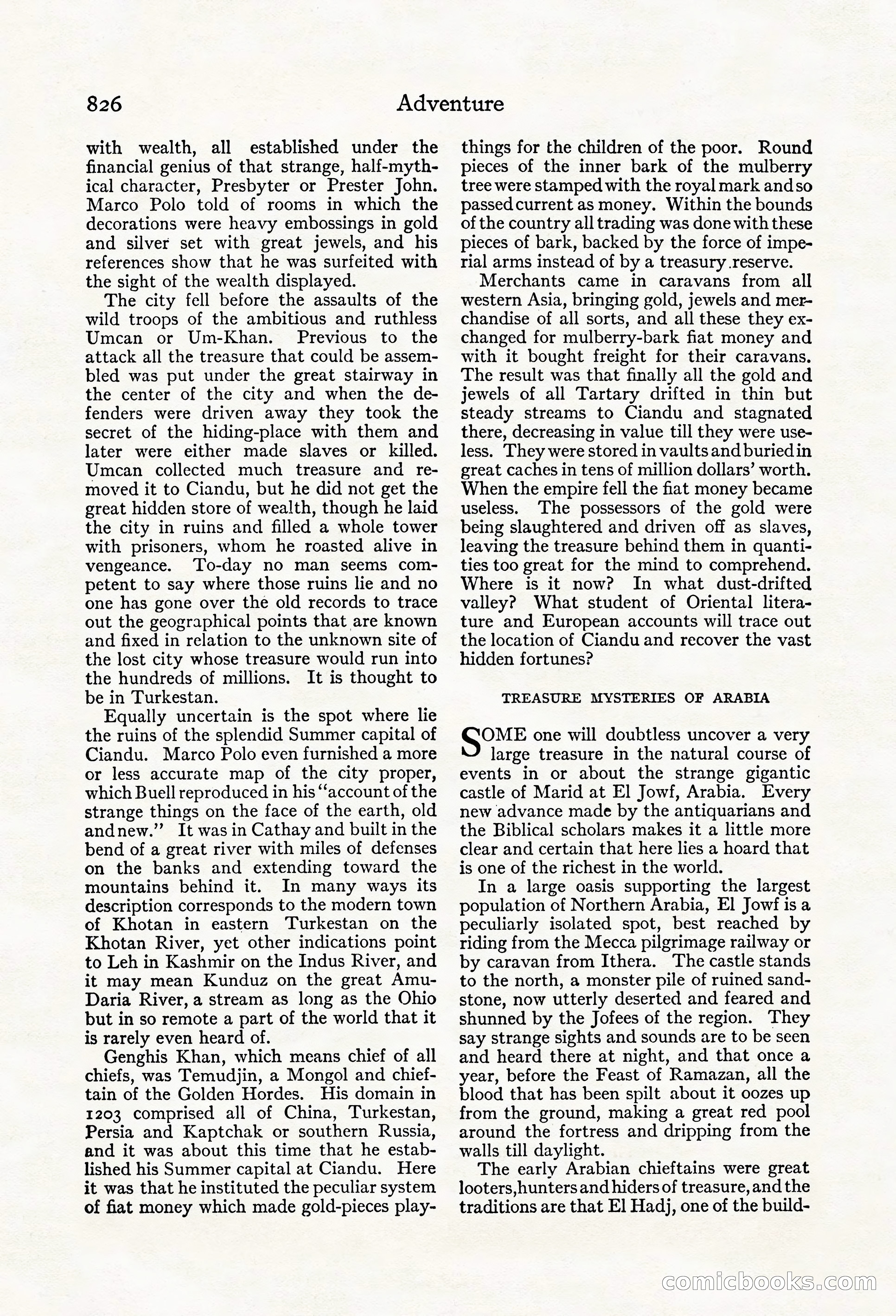
A restored page from Pulp Fiction, 1911. Page through the whole issue in the reader above.
📄 Transcribed text from this page (OCR, searchable)
Machine-transcribed from the original scan — historical spelling and the odd misread are preserved.
826 with wealth, all established under the financial genius of that strange, half-myth- ical character, Presbyter or Prester John. Marco Polo told of rooms in which the decorations were heavy embossings in gold and silver set with great jewels, and his references show that he was surfeited with the sight of the wealth displayed. The city fell before the assaults of the wild troops of the ambitious and ruthless Umcan or Um-Khan. Previous to the attack all the treasure that could be assem- bled was put under the great stairway in the center of the city and when the de- fenders were driven away they took the secret of the hiding-place with them and later were either made slaves or killed. Umcan collected much treasure and re- moved it to Ciandu, but he did not get the great hidden store of wealth, though he laid the city in ruins and filled a whole tower with prisoners, whom he roasted alive in vengeance. To-day no man seems com- petent to say where those ruins lie and no one has gone over the old records to trace out the geographical points that are known and fixed in relation to the unknown site of the lost city whose treasure would run into the hundreds of millions. It is thought to be in Turkestan. Equally uncertain is the spot where lie the ruins of the splendid Summer capital of Ciandu. Marco Polo even furnished a more or less accurate map of the city proper, which Buell reproduced in his ‘‘account of the strange things on the face of the earth, old andnew.” It was in Cathay and built in the bend of a great river with miles of defenses on the banks and extending toward the mountains behind it. In many ways its description corresponds to the modern town of Khotan in eastern Turkestan on the Khotan River, yet other indications point to Leh in Kashmir on the Indus River, and it may mean Kunduz on the great Amu- Daria River, a stream as long as the Ohio but in so remote a part of the world that it is rarely even heard of. Genghis Khan, which means chief of all chiefs, was Temudjin, a Mongol and chief- tain of the Golden Hordes. His domain in 1203 comprised all of China, Turkestan, Persia and Kaptchak or southern Russia, and it was about this time that he estab- lished his Summer capital at Ciandu. Here it was that he instituted the peculiar system of fiat money which made gold-pieces play- Adventure things for the children of the poor. Round pieces of the inner bark of the mulberry tree were stamped with the royal mark andso passed current as money. Within the bounds of the country all trading was done with these pieces of bark, backed by the force of impe- rial arms instead of by a treasury reserve. Merchants came in caravans from all western Asia, bringing gold, jewels and mer- chandise of all sorts, and all these they ex- changed for mulberry-bark fiat money and with it bought freight for their caravans. The result was that finally all the gold and jewels of all Tartary drifted in thin but steady streams to Ciandu and stagnated there, decreasing in value till they were use- less. They were stored in vaults and buriedin great caches in tens of million dollars’ worth. When the empire fell the fat money became useless. ‘The possessors of the gold were being slaughtered and driven off as slaves, leaving the treasure behind them in quanti- ties too great for the mind to comprehend. Where is it now? In what dust-drifted valley? What student of Oriental litera- ture and European accounts will trace out the location of Ciandu and recover the vast hidden fortunes? TREASURE MYSTERIES OF ARABIA COME one will doubtless uncover a very large treasure in the natural course of events in or about the strange gigantic castle of Marid at El Jowf, Arabia. Every new advance made by the antiquarians and the Biblical scholars makes it a little more clear and certain that here lies a hoard that is one of the richest in the world. In a large oasis supporting the largest population of Northern Arabia, El Jowf isa peculiarly isolated spot, best reached by riding from the Mecca pilgrimage railway or by caravan from Ithera. The castle stands to the north, a monster pile of ruined sand- stone, now utterly deserted and feared and shunned by the Jofees of the region. They say strange sights and sounds are to be seen and heard there at night, and that once a year, before the Feast of Ramazan, all the blood that has been spilt about it oozes up from the ground, making a great red pool around the fortress and dripping from the walls till daylight. The early Arabian chieftains were great looters,hunters and hiders of treasure, and the traditions are that El Hadj, one of the build- CO MICLOOKS (©