
Pulp Fiction, 1911 · page 83 of 196
Adventure Magazine Cover, October 1911 — page 83: what you’re looking at
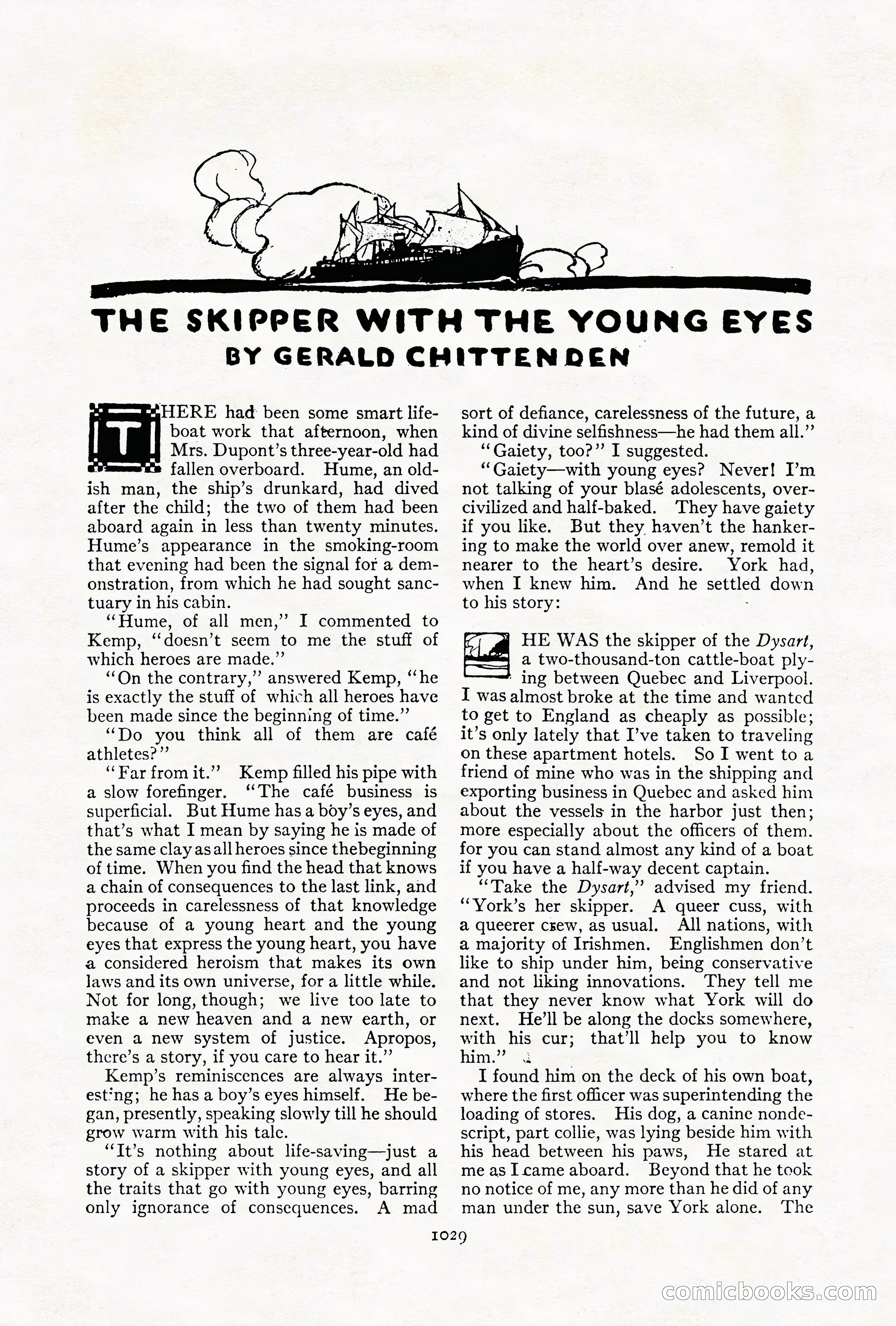
A restored page from Pulp Fiction, 1911. Page through the whole issue in the reader above.
📄 Transcribed text from this page (OCR, searchable)
Machine-transcribed from the original scan — historical spelling and the odd misread are preserved.
THE SKIPPER WITH THE YOUNG EYES BY GERALD CHITTENDEN HERE had been some smart life- boat work that afternoon, when Mrs. Dupont’s three-year-old had fallen overboard. Hume, an old- ish man, the ship’s drunkard, had dived after the child; the two of them had been aboard again in less than twenty minutes. Hume’s appearance in the smoking-room that evening had been the signal for a dem- onstration, from which he had sought sanc- tuary in his cabin. “Hume, of all men,’ I commented to Kemp, ‘“‘doesn’t seem to me the stuff of which heroes are made.” ‘“‘On the contrary,” answered Kemp, “‘he is exactly the stuff of which all heroes have been made since the beginning of time.” “Do you think all of them are café athletes?”’ “Far from it.’”’ Kemp filled his pipe with a slow forefinger. ‘“‘The café business is superficial. But Hume has a boy’s eyes, and that’s what I mean by saying he is made of the same clay asall heroes since thebeginning of time. When you find the head that knows a chain of consequences to the last link, and proceeds in carelessness of that knowledge because of a young heart and the young eyes that express the young heart, you have a considered heroism that makes its own laws and its own universe, for a little while. Not for long, though; we live too late to make a new heaven and a new earth, or even a new system of justice. Apropos, there’s a story, if you care to hear it.” Kemp’s reminiscences are always inter- est'ng; he has a boy’s eyes himself. He be- gan, presently, speaking slowly till he should grow warm with his tale. “It’s nothing about life-saving—just a story of a skipper with young eyes, and all the traits that go with young eyes, barring only ignorance of consequences. A mad sort of defiance, carelessness of the future, a kind of divine selfishness—he had them all.” “Gaiety, too?” I suggested. ““Gaiety—with young eyes? Never! I’m not talking of your blasé adolescents, over- civilized and half-baked. They have gaiety if you like. But they haven’t the hanker- ing to make the world over anew, remold it nearer to the heart’s desire. York had, when I knew him. And he settled down to his story: a. HE WAS the skipper of the Dysart, paaies a two-thousand-ton cattle-boat ply- - Ing between Quebec and Liverpool. nea was almost broke at the time and wanted to get to England as cheaply as possible; it’s only lately that I’ve taken to traveling on these apartment hotels. So I went toa friend of mine who was in the shipping and exporting business in Quebec and asked him about the vessels in the harbor just then; more especially about the officers of them. for you can stand almost any kind of a boat if you have a half-way decent captain. “Take the Dysart,” advised my friend. “York’s her skipper. A queer cuss, with a queerer crew, as usual. All nations, with a majority of Irishmen. Englishmen don’t like to ship under him, being conservative and not liking innovations. They tell me that they never know what York will do next. He'll be along the docks somewhere, with his cur; that’ll help you to know him.” 3 I found him on the deck of his own boat, where the first officer was superintending the loading of stores. His dog, a canine nonde- script, part collie, was lying beside him with his head between his paws, He stared at me as I came aboard. Beyond that he took no notice of me, any more than he did of any man under the sun, save York alone. ‘The 1029 cComicloooks C©