
Pulp Fiction, 1911 · page 84 of 196
Adventure Magazine Cover, October 1911 — page 84: what you’re looking at
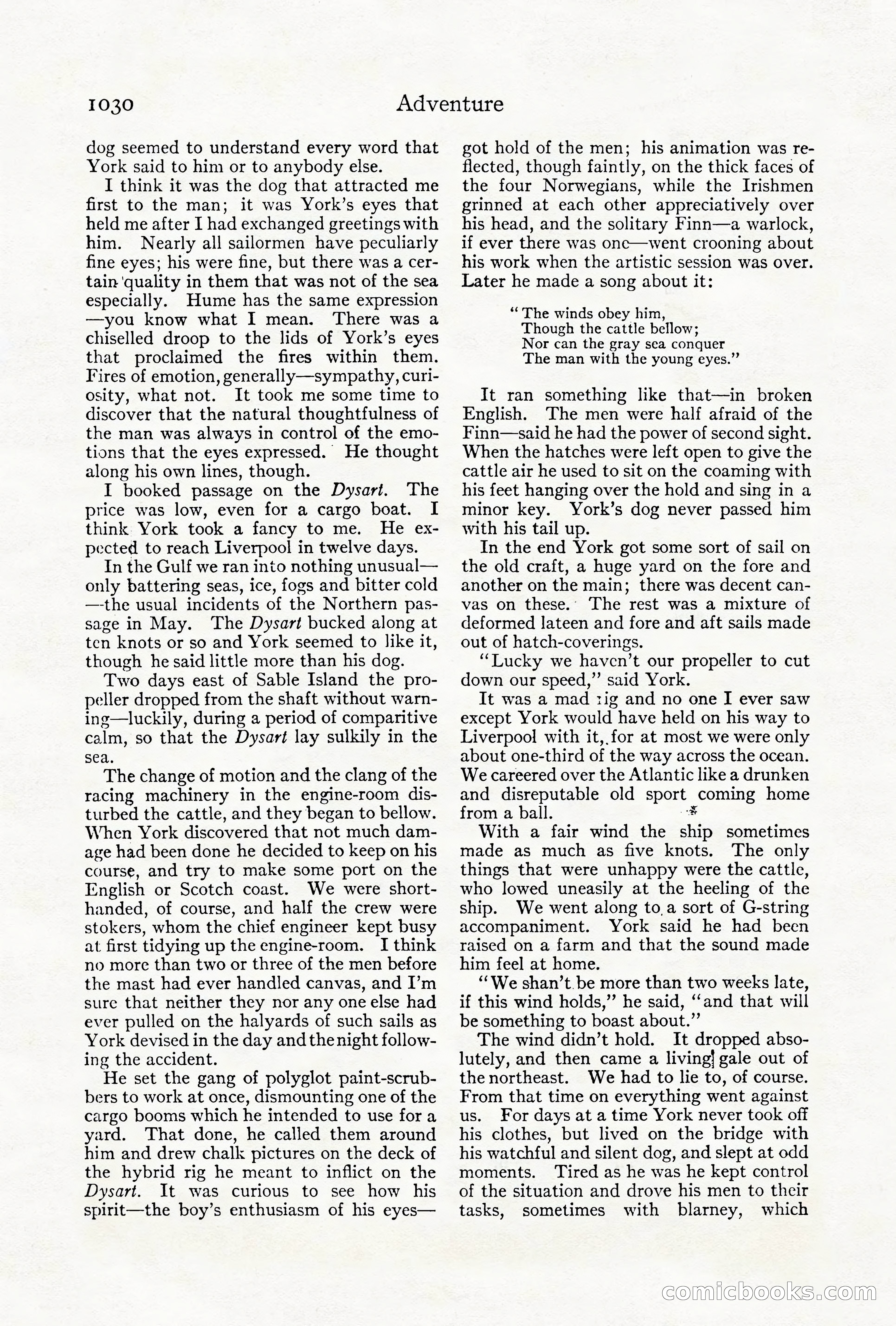
A restored page from Pulp Fiction, 1911. Page through the whole issue in the reader above.
📄 Transcribed text from this page (OCR, searchable)
Machine-transcribed from the original scan — historical spelling and the odd misread are preserved.
1030 dog seemed to understand every word that York said to him or to anybody else. I think it was the dog that attracted me first to the man; it was York’s eyes that held me after I had exchanged greetings with him. Nearly all sailormen have peculiarly fine eyes; his were fine, but there was a cer- tain ‘quality in them that was not of the sea especially. Hume has the same expression —you know what I mean. There was a chiselled droop to the lids of York’s eyes that proclaimed the fires within them. Fires of emotion, generally—sympathy, curi- osity, what not. It took me some time to discover that the natural thoughtfulness of the man was always in control of the emo- tions that the eyes expressed. He thought along his own lines, though. I booked passage on the Dysart. The price was low, even for a cargo boat. I think York took a fancy to me. He ex- pected to reach Liverpool in twelve days. In the Gulf we ran into nothing unusual— only battering seas, ice, fogs and bitter cold —-the usual incidents of the Northern pas- sage in May. The Dysart bucked along at ten knots or so and York seemed to like it, though he said little more than his dog. Two days east of Sable Island the pro- peller dropped from the shaft without warn- ing—luckily, during a period of comparitive calm, so that the Dysart lay sulkily in the sea. The change of motion and the clang of the racing machinery in the engine-room dis- turbed the cattle, and they began to bellow. When York discovered that not much dam- age had been done he decided to keep on his course, and try to make some port on the English or Scotch coast. We were short- handed, of course, and half the crew were stokers, whom the chief engineer kept busy at first tidying up the engine-room. I think no more than two or three of the men before the mast had ever handled canvas, and I’m sure that neither they nor any one else had ever pulled on the halyards of such sails as York devised in the day and thenight follow- ing the accident. He set the gang of polyglot paint-scrub- bers to work at once, dismounting one of the cargo booms which he intended to use for a yard. That done, he called them around him and drew chalk pictures on the deck of the hybrid rig he meant to inflict on the Dysart. It was curious to see how his spirit—the boy’s enthusiasm of his eyes— Adventure got hold of the men; his animation was re- flected, though faintly, on the thick faces of the four Norwegians, while the Irishmen grinned at each other appreciatively over his head, and the solitary Finn—a warlock, if ever there was onc—went crooning about his work when the artistic session was over. Later he made a song about it: “The winds obey him, Though the cattle bellow; Nor can the gray sea conquer The man with the young eyes.”’ It ran something like that—in broken English. ‘The men were half afraid of the Finn—said he had the power of second sight. When the hatches were left open to give the cattle air he used to sit on the coaming with his feet hanging over the hold and sing in a minor key. York’s dog never passed him with his tail up. In the end York got some sort of sail on the old craft, a huge yard on the fore and another on the main; there was decent can- vas on these.’ The rest was a mixture of deformed Jateen and fore and aft sails made out of hatch-coverings. ‘‘Lucky we haven’t our propeller to cut down our speed,” said York. It was a mad tig and no one [ ever saw except York would have held on his way to Liverpool with it, for at most we were only about one-third of the way across the ocean. We careered over the Atlantic like a drunken and disreputable old sport coming home from a ball. & With a fair wind the ship sometimes made as much as five knots. The only things that were unhappy were the cattle, who lowed uneasily at the heeling of the ship. We went along to,a sort of G-string accompaniment. York said he had been raised on a farm and that the sound made him feel at home. ‘“We shan’t.be more than two weeks late, if this wind holds,” he said, “and that will be something to boast about.” The wind didn’t hold. It dropped abso- lutely, and then came a living! gale out of the northeast. We had to lie to, of course. From that time on everything went against us. For days at a time York never took off his clothes, but lived on the bridge with his watchful and silent dog, and slept at odd moments. ‘Tired as he was he kept control of the situation and drove his men to their tasks, sometimes with blarney, which C© MICLOOKS (©