
Pulp Fiction, 1914 · page 178 of 228
Adventure, December 1914 — page 178: what you’re looking at
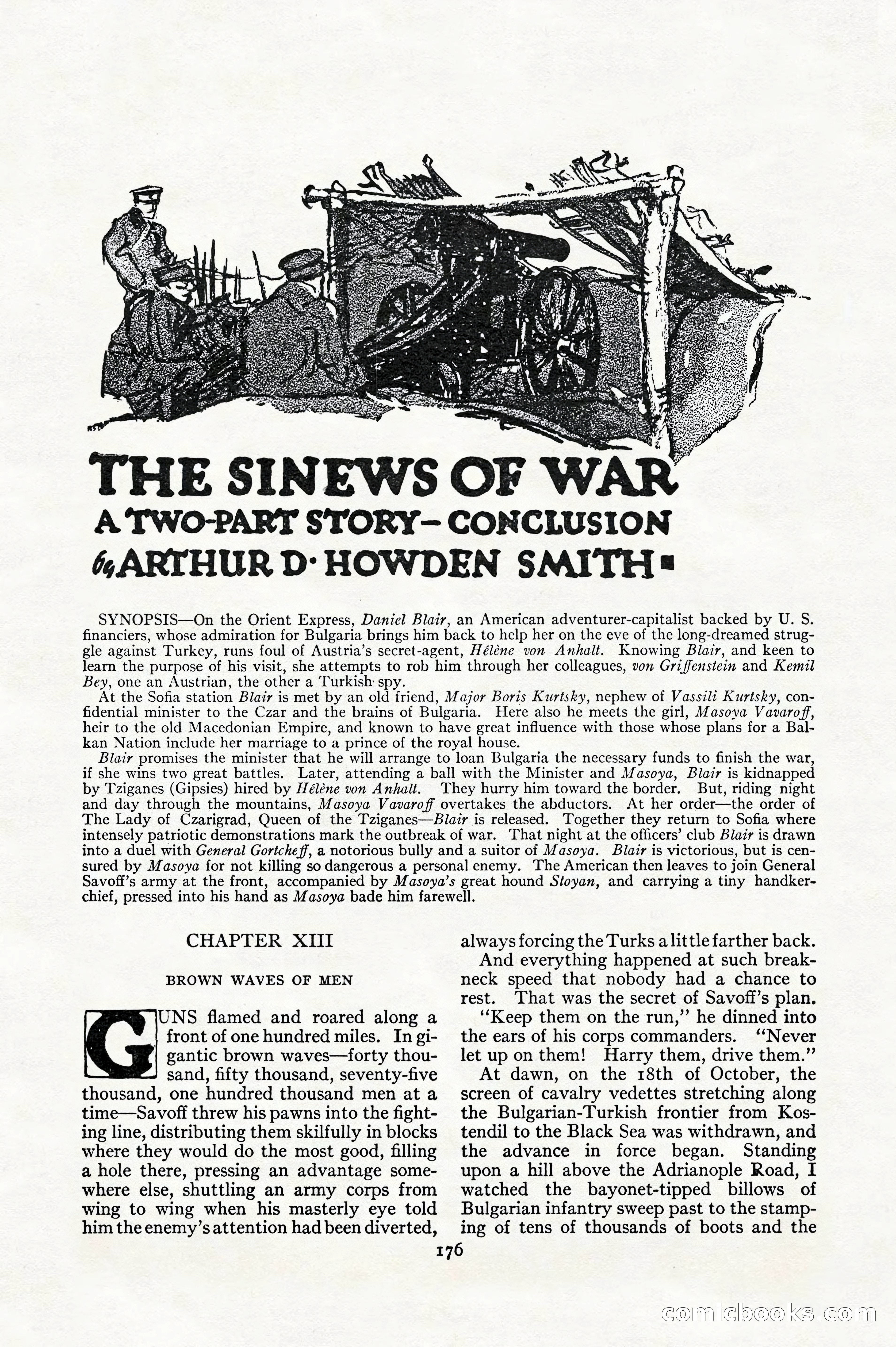
A restored page from Pulp Fiction, 1914. Page through the whole issue in the reader above.
📄 Transcribed text from this page (OCR, searchable)
Machine-transcribed from the original scan — historical spelling and the odd misread are preserved.
ee oe THE SINEWS OF 3 = ‘ - Ye eo Nyisk Ke WAR A TWO-PART STORY— CONCLUSION &4 ARTHUR D-HOWDEN SMITH= SYNOPSIS—On the Orient Express, Daniel Blair, an American adventurer-capitalist backed by U. S. financiers, whose admiration for Bulgaria brings him back to help her on the eve of the long-dreamed strug- gle against Turkey, runs foul of Austria’s secret-agent, Héléne von Anhalt. Knowing Blair, and keen to learn the purpose of his visit, she attempts to rob him through her colleagues, von Griffenstein and Kemil Bey, one an Austrian, the other a Turkish spy. At the Sofia station Blaiy is met by an old friend, Major Boris Kurtsky, nephew of Vassili Kurtsky, con- fidential minister to the Czar and the brains of Bulgaria. Here also he meets the girl, Masova Vavarof,, heir to the old Macedonian Empire, and known to have great influence with those whose plans for a Bal- kan Nation include her marriage to a prince of the royal house. Blair promises the minister that he will arrange to loan Bulgaria the necessary funds to finish the war, if she wins two great battles. Later, attending a ball with the Minister and Masoya, Blair is kidnapped by Tziganes (Gipsies) hired by Héléne von Anhalt. They hurry him toward the border. But, riding night and day through the mountains, Masoya Vavaroff overtakes the abductors. At her order—the order of The Lady of Czarigrad, Queen of the Tziganes—Blair is released. Together they return to Sofia where intensely patriotic demonstrations mark the outbreak of war. That night at the officers’ club Blair is drawn into a duel with General Gortcheff, a notorious bully and a suitor of Masoya. Blair is victorious, but is cen- sured by Masoya for not killing so dangerous a personal enemy. The American then leaves to join General Savofi’s army at the front, accompanied by Masoya’s great hound Stoyan, and carrying a tiny handker- chief, pressed into his hand as Masoya bade him farewell. CHAPTER XIII BROWN WAVES OF MEN UNS flamed and roared along a front of one hundred miles. In gi- gantic brown waves—forty thou- sand, fifty thousand, seventy-five thousand, one hundred thousand men at a time—Savoff threw his pawns into the fight- ing line, distributing them skilfully in blocks where they would do the most good, filling a hole there, pressing an advantage some- where else, shuttling an army corps from wing to wing when his masterly eye told him the enemy’s attention had been diverted, always forcing the Turks alittle farther back. And everything happened at such break- neck speed that nobody had a chance to rest. That was the secret of Savoff’s plan. ‘“‘Keep them on the run,” he dinned into the ears of his corps commanders. ‘‘Never let up on them! Harry them, drive them.”’ At dawn, on the 18th of October, the screen of cavalry vedettes stretching along the Bulgarian-Turkish frontier from Kos- tendil to the Black Sea was withdrawn, and the advance in force began. Standing upon a hill above the Adrianople Road, I watched the bayonet-tipped billows of Bulgarian infantry sweep past to the stamp- ing of tens of thousands of boots and the 176 Co DOO) C@