
Pulp Fiction, 1914 · page 179 of 228
Adventure, December 1914 — page 179: what you’re looking at
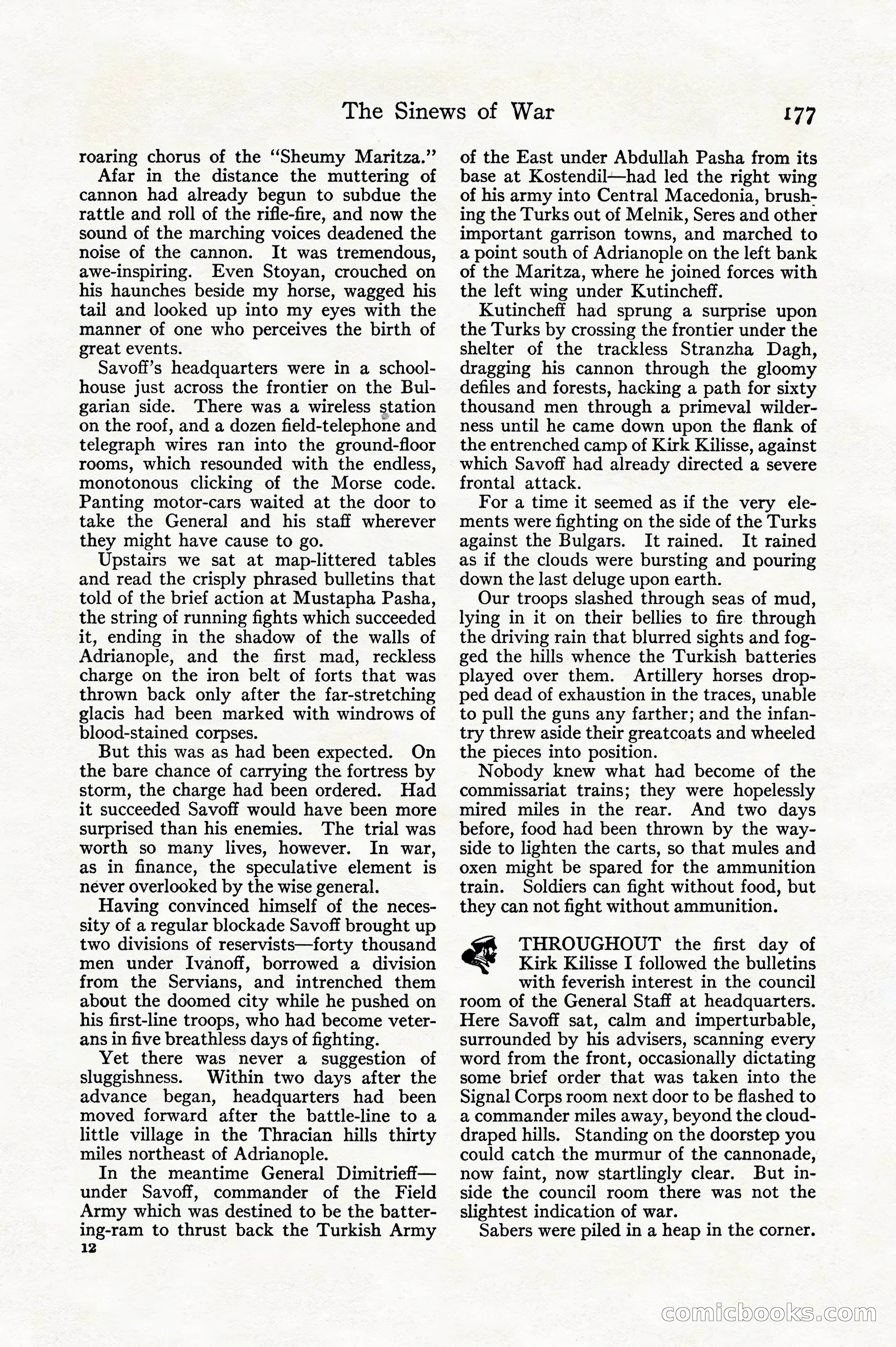
A restored page from Pulp Fiction, 1914. Page through the whole issue in the reader above.
📄 Transcribed text from this page (OCR, searchable)
Machine-transcribed from the original scan — historical spelling and the odd misread are preserved.
The Sinews of War roaring chorus of the ‘‘Sheumy Maritza.” Afar in the distance the muttering of cannon had already begun to subdue the rattle and roll of the rifle-fire, and now the sound of the marching voices deadened the noise of the cannon. It was tremendous, awe-inspiring. Even Stoyan, crouched on his haunches beside my horse, wagged his tail and looked up into my eyes with the manner of one who perceives the birth of great events. Savoff’s headquarters were in a school- house just across the frontier on the Bul- garian side. There was a wireless station on the roof, and a dozen field-telephone and telegraph wires ran into the ground-floor rooms, which resounded with the endless, monotonous clicking of the Morse code. Panting motor-cars waited at the door to take the General and his staff wherever they might have cause to go. Upstairs we sat at map-littered tables and read the crisply phrased bulletins that told of the brief action at Mustapha Pasha, the string of running fights which succeeded it, ending in the shadow of the walls of Adrianople, and the first mad, reckless charge on the iron belt of forts that was thrown back only after the far-stretching glacis had been marked with windrows of blood-stained corpses. But this was as had been expected. On the bare chance of carrying the fortress by storm, the charge had been ordered. Had it succeeded Savoff would have been more surprised than his enemies. The trial was worth so many lives, however. In war, as in finance, the speculative element is never overlooked by the wise general. Having convinced himself of the neces- sity of a regular blockade Savoff brought up two divisions of reservists—forty thousand men under Ivanoff, borrowed a division from the Servians, and intrenched them about the doomed city while he pushed on his first-line troops, who had become veter- ans in five breathless days of fighting. Yet there was never a suggestion of sluggishness. Within two days after the advance began, headquarters had been moved forward after the battle-line to a little village in the Thracian hills thirty miles northeast of Adrianople. In the meantime General Dimitrieff— under Savoff, commander of the Field Army which was destined to be the batter- ing-ram to thrust back the Turkish Army 12 177 of the East under Abdullah Pasha from its base at Kostendil—had led the right wing of his army into Central Macedonia, brush- ing the Turks out of Melnik, Seres and other important garrison towns, and marched to a point south of Adrianople on the left bank of the Maritza, where he joined forces with the left wing under Kutincheff. Kutincheff had sprung a surprise upon the Turks by crossing the frontier under the shelter of the trackless Stranzha Dagh, dragging his cannon through the gloomy defiles and forests, hacking a path for sixty thousand men through a primeval wilder- ness until he came down upon the flank of the entrenched camp of Kirk Kilisse, against which Savoff had already directed a severe frontal attack. For a time it seemed as if the very ele- ments were fighting on the side of the Turks against the Bulgars. It rained. It rained as if the clouds were bursting and pouring down the last deluge upon earth. Our troops slashed through seas of mud, lying in it on their bellies to fire through the driving rain that blurred sights and fog- ged the hills whence the Turkish batteries played over them. Artillery horses drop- ped dead of exhaustion in the traces, unable to pull the guns any farther; and the infan- try threw aside their greatcoats and wheeled the pieces into position. Nobody knew what had become of the commissariat trains; they were hopelessly mired miles in the rear. And two days before, food had been thrown by the way- side to lighten the carts, so that mules and oxen might be spared for the ammunition train. Soldiers can fight without food, but they can not fight without ammunition. THROUGHOUT the first day of Kirk Kilisse I followed the bulletins with feverish interest in the council room of the General Staff at headquarters. Here Savoff sat, calm and imperturbable, surrounded by his advisers, scanning every word from the front, occasionally dictating some brief order that was taken into the Signal Corps room next door to be flashed to a commander miles away, beyond the cloud- draped hills. Standing on the doorstep you could catch the murmur of the cannonade, now faint, now startlingly clear. But in- side the council room there was not the slightest indication of war. Sabers were piled in a heap in the corner. NOOK C©