
Pulp Fiction, 1914 · page 188 of 228
Adventure, December 1914 — page 188: what you’re looking at
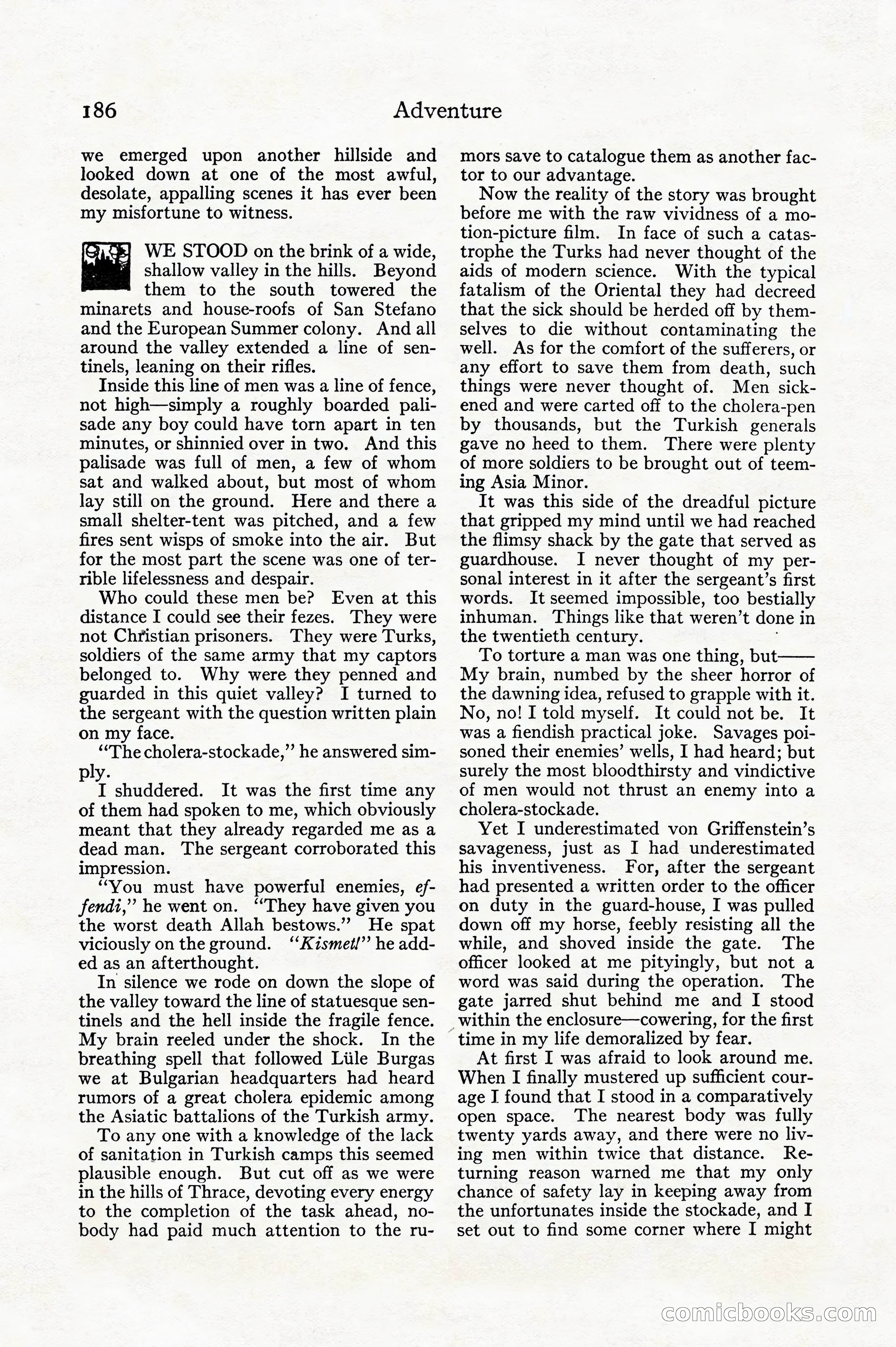
A restored page from Pulp Fiction, 1914. Page through the whole issue in the reader above.
📄 Transcribed text from this page (OCR, searchable)
Machine-transcribed from the original scan — historical spelling and the odd misread are preserved.
186 we emerged upon another hillside and looked down at one of the most awful, desolate, appalling scenes it has ever been my misfortune to witness. ella: WE STOOD on the brink of a wide, shallow valley in the hills. Beyond them to the south towered the minarets and house-roofs of San Stefano and the European Summer colony. And all around the valley extended a line of sen- tinels, leaning on their rifles. Inside this line of men was a line of fence, not high—simply a roughly boarded pali- sade any boy could have torn apart in ten minutes, or shinnied over in two. And this palisade was full of men, a few of whom sat and walked about, but most of whom lay still on the ground. Here and there a small shelter-tent was pitched, and a few fires sent wisps of smoke into the air. But for the most part the scene was one of ter- rible lifelessness and despair. Who could these men be? Even at this distance I could see their fezes. They were not Christian prisoners. They were Turks, soldiers of the same army that my captors belonged to. Why were they penned and guarded in this quiet valley? I turned to the sergeant with the question written plain on my face. ‘The cholera-stockade,”’ he answered sim- ly. I shuddered. It was the first time any of them had spoken to me, which obviously meant that they already regarded me as a dead man. The sergeant corroborated this impression. “You must have powerful enemies, ef- fendi,” he went on. “They have given you the worst death Allah bestows.” He spat viciously on the ground. ‘“‘Kismetl’’ he add- ed as an afterthought. In silence we rode on down the slope of the valley toward the line of statuesque sen- tinels and the hell inside the fragile fence. My brain reeled under the shock. In the breathing spell that followed Lile Burgas we at Bulgarian headquarters had heard rumors of a great cholera epidemic among the Asiatic battalions of the Turkish army. To any one with a knowledge of the lack of sanitation in Turkish camps this seemed plausible enough. But cut off as we were in the hills of Thrace, devoting every energy to the completion of the task ahead, no- body had paid much attention to the ru- Adventure mors save to catalogue them as another fac- tor to our advantage. Now the reality of the story was brought before me with the raw vividness of a mo- tion-picture film. In face of such a catas- trophe the Turks had never thought of the aids of modern science. With the typical fatalism of the Oriental they had decreed that the sick should be herded off by them- selves to die without contaminating the well. As for the comfort of the sufferers, or any effort to save them from death, such things were never thought of. Men sick- ened and were carted off to the cholera-pen by thousands, but the Turkish generals gave no heed to them. There were plenty of more soldiers to be brought out of teem- ing Asia Minor. It was this side of the dreadful picture that gripped my mind until we had reached the flimsy shack by the gate that served as guardhouse. I never thought of my per- sonal interest in it after the sergeant’s first words. It seemed impossible, too bestially inhuman. Things like that weren’t done 1 in the twentieth century. To torture a man was one thing, but—— My brain, numbed by the sheer horror of the dawning idea, refused to grapple with it. No, no! I told myself. It could not be. It was a fiendish practical joke. Savages poi- soned their enemies’ wells, I had heard; but surely the most bloodthirsty and vindictive of men would not thrust an enemy into a cholera-stockade. Yet I underestimated von Griffenstein’s savageness, just as I had underestimated his inventiveness. For, after the sergeant had presented a written order to the officer on duty in the guard-house, I was pulled down off my horse, feebly resisting all the while, and shoved inside the gate. The officer looked at me pityingly, but not a word was said during the operation. The gate jarred shut behind me and I stood _within the enclosure—cowering, for the first time in my life demoralized by fear. At first I was afraid to look around me. When I finally mustered up sufficient cour- age I found that I stood in a comparatively open space. The nearest body was fully twenty yards away, and there were no liv- ing men within twice that distance. Re- turning reason warned me that my only chance of safety lay in keeping away from the unfortunates inside the stockade, and I set out to find some corner where I might MICLOOOK C©@ inn