
Pulp Fiction, 1914 · page 189 of 228
Adventure, December 1914 — page 189: what you’re looking at
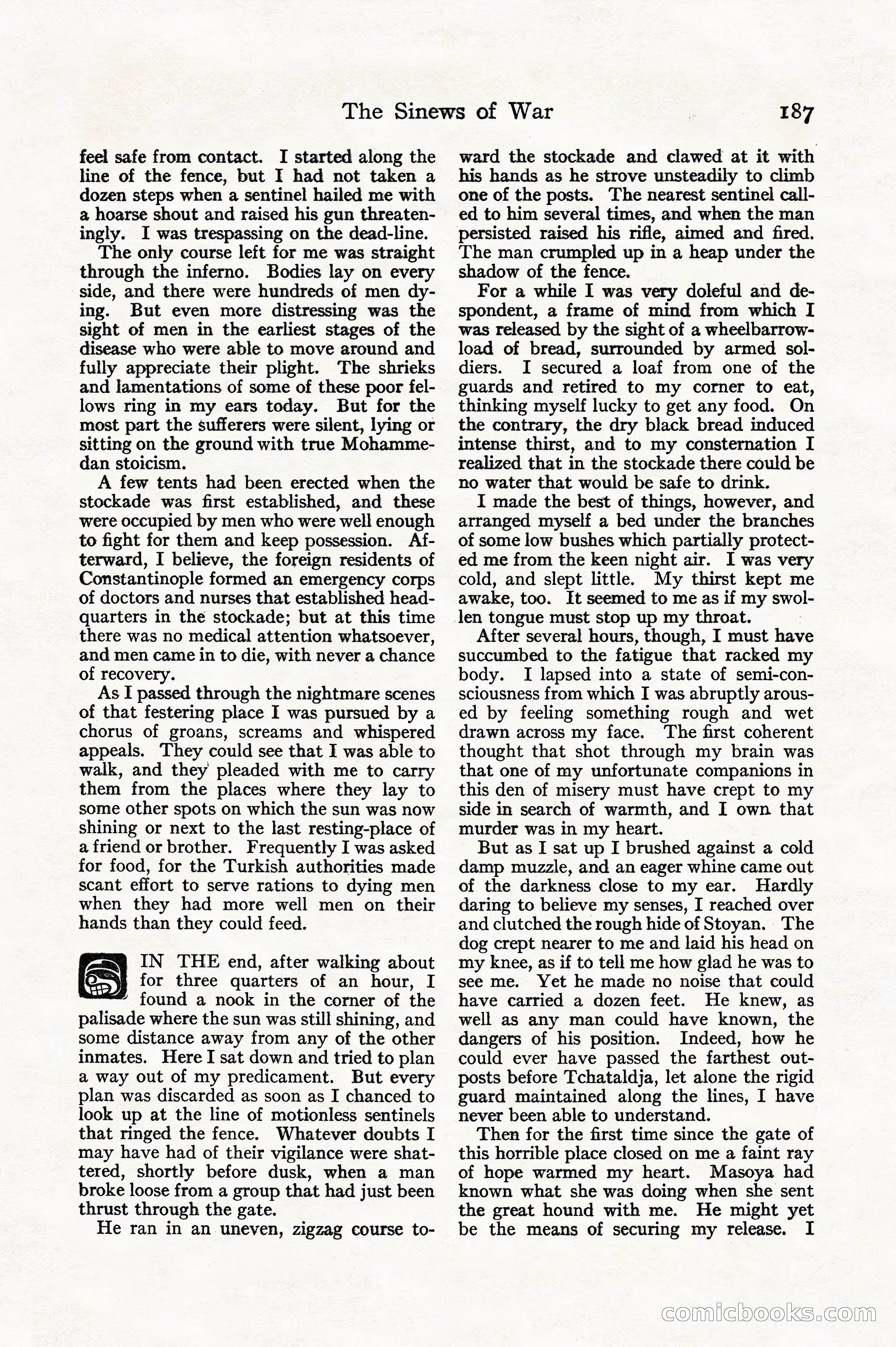
A restored page from Pulp Fiction, 1914. Page through the whole issue in the reader above.
📄 Transcribed text from this page (OCR, searchable)
Machine-transcribed from the original scan — historical spelling and the odd misread are preserved.
The Sinews of War feel safe from contact. I started along the line of the fence, but I had not taken a dozen steps when a sentinel hailed me with a hoarse shout and raised his gun threaten- ingly. I was trespassing on the dead-line. The only course left for me was straight through the inferno. Bodies lay on every side, and there were hundreds of men dy- ing. But even more distressing was the sight of men in the earliest stages of the disease who were able to move around and fully appreciate their plight. The shrieks and lamentations of some of these poor fel- lows ring in my ears today. But for the most part the sufferers were silent, lying or sitting on the ground with true Mohamme- dan stoicism. A few tents had been erected when the stockade was first established, and these were occupied by men who were well enough to fight for them and keep possession. Af- terward, I believe, the foreign residents of Constantinople formed an emergency corps of doctors and nurses that established head- quarters in the stockade; but at this time there was no medical attention whatsoever, and men came in to die, with never a chance of recovery. As I passed through the nightmare scenes of that festering place I was pursued by a chorus of groans, screams and whispered appeals. They could see that I was able to walk, and they pleaded with me to carry them from the places where they lay to some other spots on which the sun was now shining or next to the last resting-place of a friend or brother. Frequently I was asked for food, for the Turkish authorities made scant effort to serve rations to dying men when they had more well men on their hands than they could feed. IN THE end, after walking about sya for three quarters of an hour, I found a nook in the corner of the palisade where the sun was still shining, and some distance away from any of the other inmates. Here I sat down and tried to plan a way out of my predicament. But every plan was discarded as soon as I chanced to look up at the line of motionless sentinels that ringed the fence. Whatever doubts I may have had of their vigilance were shat- tered, shortly before dusk, when a man broke loose from a group that had just been thrust through the gate. He ran in an uneven, zigzag course to- 187 ward the stockade and clawed at it with his hands as he strove unsteadily to climb one of the posts. The nearest sentinel call- ed to him several times, and when the man persisted raised his rifle, aimed and fired. The man crumpled up in a heap under the shadow of the fence. For a while I was very doleful and de- spondent, a frame of mind from which I was released by the sight of a wheelbarrow- load of bread, surrounded by armed sol- diers. I secured a loaf from one of the guards and retired to my corner to eat, thinking myself lucky to get any food. On the contrary, the dry black bread induced intense thirst, and to my consternation I realized that in the stockade there could be no water that would be safe to drink. I made the best of things, however, and arranged myself a bed under the branches of some low bushes which partially protect- ed me from the keen night air. I was very cold, and slept little. My thirst kept me awake, too. It seemed to me as if my swol- len tongue must stop up my throat. After several hours, though, I must have succumbed to the fatigue that racked my body. I lapsed into a state of semi-con- sciousness from which I was abruptly arous- ed by feeling something rough and wet drawn across my face. The first coherent thought that shot through my brain was that one of my unfortunate companions in this den of misery must have crept to my side in search of warmth, and I own that murder was in my heart. But as I sat up I brushed against a cold damp muzzle, and an eager whine came out of the darkness close to my ear. Hardly daring to believe my senses, I reached over and clutched the rough hide of Stoyan. The dog crept nearer to me and laid his head on my knee, as if to tell me how glad he was to see me. Yet he made no noise that could have carried a dozen feet. He knew, as well as any man could have known, the dangers of his position. Indeed, how he could ever have passed the farthest out- posts before Tchataldja, let alone the rigid guard maintained along the lines, I have never been able to understand. Then for the first time since the gate of this horrible place closed on me a faint ray of hope warmed my heart. Masoya had known what she was doing when she sent the great hound with me. He might yet be the means of securing my release. I DOOK C©