
Pulp Fiction, 1914 · page 221 of 228
Adventure, December 1914 — page 221: what you’re looking at
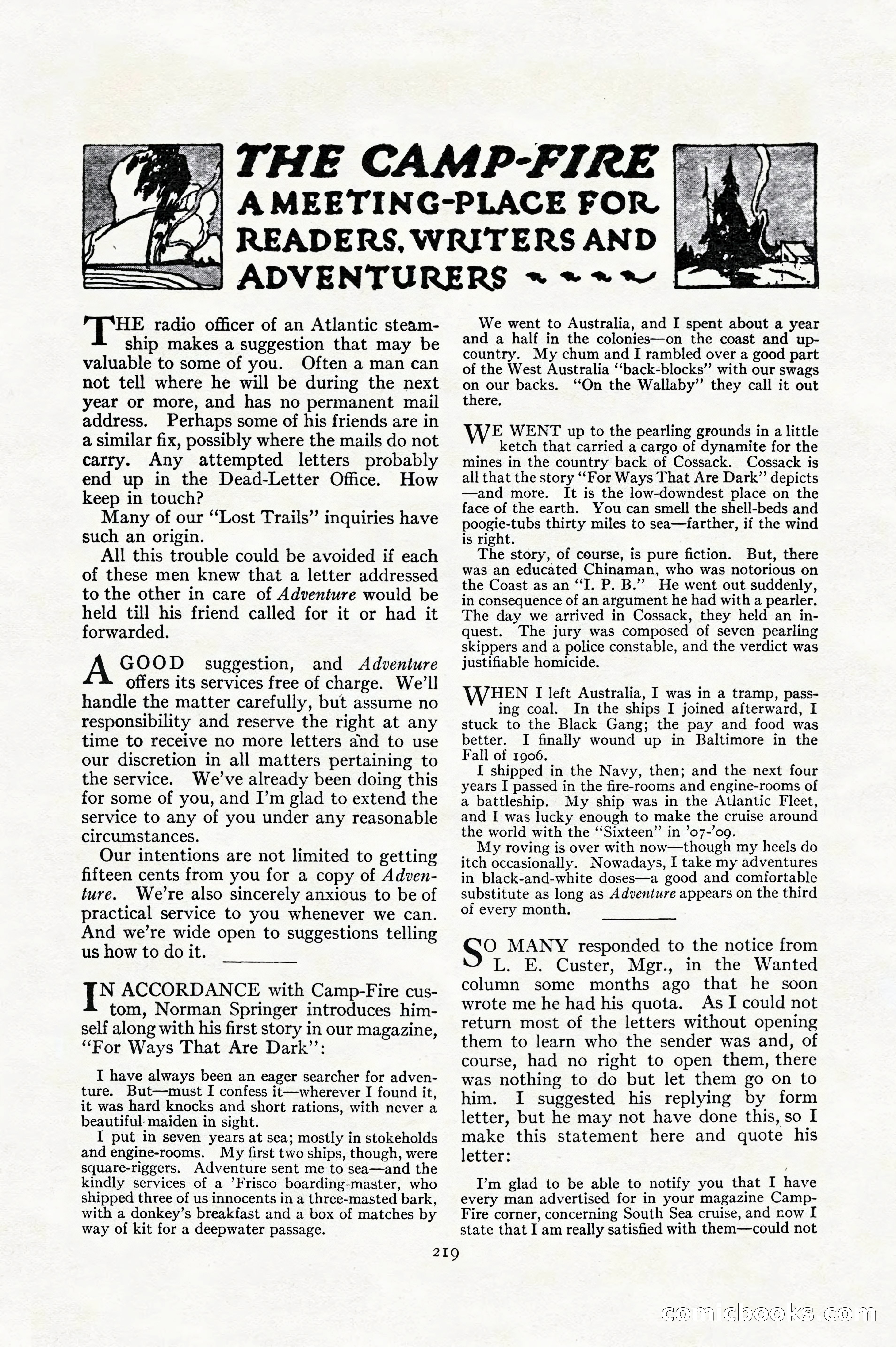
A restored page from Pulp Fiction, 1914. Page through the whole issue in the reader above.
📄 Transcribed text from this page (OCR, searchable)
Machine-transcribed from the original scan — historical spelling and the odd misread are preserved.
HE radio officer of an Atlantic steam- ship makes a suggestion that may be valuable to some of you. Often a man can not tell where he will be during the next year or more, and has no permanent mail address. Perhaps some of his friends are in a similar fix, possibly where the mails do not carry. Any attempted letters probably end up in the Dead-Letter Office. How keep in touch? Many of our “Lost Trails” inquiries have such an origin. All this trouble could be avoided if each of these men knew that a letter addressed to the other in care of Adventure would be held till his friend called for it or had it forwarded. GOOD $s suggestion, and Adventure offers its services free of charge. We'll handle the matter carefully, but assume no responsibility and reserve the right at any time to receive no more letters and to use our discretion in all matters pertaining to the service. We’ve already been doing this for some of you, and I’m glad to extend the service to any of you under any reasonable circumstances. Our intentions are not limited to getting fifteen cents from you for a copy of Adven- ture. We're also sincerely anxious to be of practical service to you whenever we can. And we’re wide open to suggestions telling us how to do it. I’ ACCORDANCE with Camp-Fire cus- tom, Norman Springer introduces him- self along with his first story in our magazine, “For Ways That Are Dark’’: I have always been an eager searcher for adven- ture. But—must I confess it—wherever I found it, it was hard knocks and short rations, with never a beautiful maiden in sight. I put in seven years at sea; mostly in stokeholds and engine-rooms. My first two ships, though, were square-riggers. Adventure sent me to sea—and the kindly services of a ’Frisco -boarding-master, who shipped three of us innocents in a three- masted bark, with a donkey’s breakfast and a box of matches by way of kit for a deepwater passage. 219 a pi) A MEETING-PLACE FOR. Cle READERS, WRITERS AND ADVENTURERS ~*~ *2* 3 <n. We went to Australia, and I spent about a year and a half in the colonies—on the coast and up- country. My chum and I rambled over a good part of the West Australia ‘‘back-blocks” with our swags on our backs. “On the Wallaby” they call it out there. WE WENT up to the pearling grounds in a little ketch that carried a cargo of dynamite for the mines in the country back of Cossack. Cossack is all that the story “For Ways That Are Dark”’ depicts —and more. It is the low-downdest place on the face of the earth. You can smell the shell-beds and poogie-tubs thirty miles to sea—farther, if the wind is right. The story, of course, is pure fiction. But, there was an educated Chinaman, who was notorious on the Coast as an “I. P. B.”’ He went out suddenly, in consequence of an argument he had with a pearler. The day we arrived in Cossack, they held an in- quest. The jury was composed of seven pearling skippers and a police constable, and the verdict was justifiable homicide. WHEN I left Australia, I was in a tramp, pass- ing coal. In the ships I joined afterward, I stuck to the Black Gang; the pay and food was better. I finally wound up in Baltimore in the Fall of 1906. I shipped in the Navy, then; and the next four years I passed in the fire-rooms and engine-rooms of a battleship. My ship was in the Atlantic Fleet, and I was lucky enough to make the cruise around the world with the ‘“‘Sixteen”’ in ’07-’09. My roving is over with now—though my heels do itch occasionally. Nowadays, I take my adventures in black-and-white doses—a good and comfortable substitute as long as Adventure appears on the third of every month. O MANY responded to the notice from L. E. Custer, Mgr., in the Wanted column some months ago that he soon wrote me he had his quota. As I could not return most of the letters without opening them to learn who the sender was and, of course, had no right to open them, there was nothing to do but let them go on to him. I suggested his replying by form letter, but he may not have done this, so I make this statement here and quote his letter: I’m glad to be able to notify you that I have every man advertised for in your magazine Camp- Fire corner, concerning South Sea cruise, and row I state that Iam really satisfied with them—could not DOO C©