
Pulp Fiction, 1914 · page 222 of 228
Adventure, December 1914 — page 222: what you’re looking at
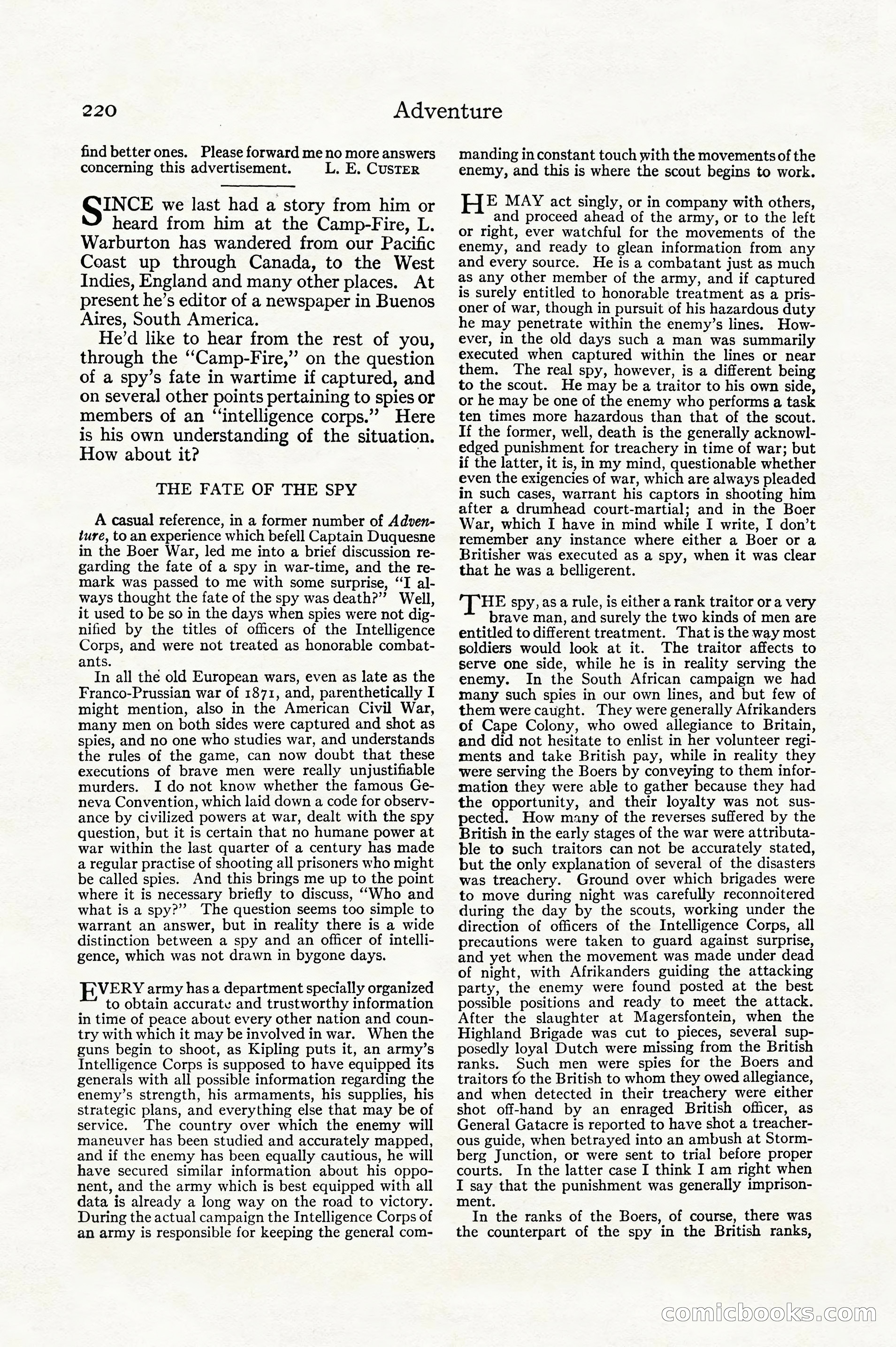
A restored page from Pulp Fiction, 1914. Page through the whole issue in the reader above.
📄 Transcribed text from this page (OCR, searchable)
Machine-transcribed from the original scan — historical spelling and the odd misread are preserved.
220 find better ones. Please forward me no more answers concerning this advertisement. L. E, CusTER SIN CE we last had a story from him or heard from him at the Camp-Fire, L. Warburton has wandered from our Pacific Coast up through Canada, to the West Indies, England and many other places. At present he’s editor of a newspaper in Buenos Aires, South America. He’d like to hear from the rest of you, through the ‘“Camp-Fire,”’ on the question of a spy’s fate in wartime if captured, and on several other points pertaining to spies or members of an “intelligence corps.”” Here is his own understanding of the situation. How about it? 7 THE FATE OF THE SPY A casual reference, in a former number of Adven- lure, to an experience which befell Captain Duquesne in the Boer War, led me into a brief discussion re- garding the fate of a spy in war-time, and the re- mark was passed to me with some surprise, “I al- ways thought the fate of the spy was death?” Well, it used to be so in the days when spies were not dig- nified by the titles of officers of the Intelligence Corps, and were not treated as honorable combat- ts. In all the old European wars, even as late as the Franco-Prussian war of 1871, and, parenthetically I might mention, also in the American Civil War, many men on both sides were captured and shot as spies, and no one who studies war, and understands the rules of the game, can now doubt that these executions of brave men were really unjustifiable murders. I do not know whether the famous Ge- neva Convention, which laid down a code for observ- ance by civilized powers at war, dealt with the spy question, but it is certain that no humane power at war within the last quarter of a century has made a regular practise of shooting all prisoners who might be called spies. And this brings me up to the point where it is necessary briefly to discuss, ““‘Who and what is a spy?” The question seems too simple to warrant an answer, but in reality there is a wide distinction between a spy and an officer of intelli- gence, which was not drawn in bygone days. HVERY army has a department specially organized to obtain accurate and trustworthy information in time of peace about every other nation and coun- try with which it may be involved in war. When the guns begin to shoot, as Kipling puts it, an army’s Intelligence Corps is supposed to have equipped its generals with all possible information regarding the enemy’s strength, his armaments, his supplies, his strategic plans, and everything else that may be of service. The country over which the enemy will maneuver has been studied and accurately mapped, and if the enemy has been equally cautious, he will have secured similar information about his oppo- nent, and the army which is best equipped with all data is already a long way on the road to victory. During the actual campaign the Intelligence Corps of an army is responsible for keeping the general com- Adventure manding in constant touch with the movements of the enemy, and this is where the scout begins to work. E MAY act singly, or in company with others, and proceed ahead of the army, or to the left or right, ever watchful for the movements of the enemy, and ready to glean information from any and every source. He is a combatant just as much as any other member of the army, and if captured is surely entitled to honorable treatment as a pris- oner of war, though in pursuit of his hazardous duty he may penetrate within the enemy’s lines. How- ever, in the old days such a man was summarily executed when captured within the lines or near them. The real spy, however, is a different being to the scout. He may be a traitor to his own side, or he may be one of the enemy who performs a task ten times more hazardous than that of the scout. If the former, well, death is the generally acknowl- edged punishment for treachery in time of war; but if the latter, it is, in my mind, questionable whether even the exigencies of war, which are always pleaded in such cases, warrant his captors in shooting him after a drumhead court-martial; and in the Boer War, which I have in mind while I write, I don’t remember any instance where either a Boer or a Britisher was executed as a spy, when it was clear that he was a belligerent. HE spy, asa rule, is either a rank traitor or a very brave man, and surely the two kinds of men are entitled to different treatment. That is the way most soldiers would look at it. The traitor affects to serve one side, while he is in reality serving the enemy. In the South African campaign we had many such spies in our own lines, and but few of them were caught. They were generally Afrikanders of Cape Colony, who owed allegiance to Britain, and did not hesitate to enlist in her volunteer regi- ments and take British pay, while in reality they were serving the Boers by conveying to them infor- mation they were able to gather because they had the opportunity, and their loyalty was not sus- pected. How many of the reverses suffered by the British in the early stages of the war were attributa- ble to such traitors can not be accurately stated, but the only explanation of several of the disasters was treachery. Ground over which brigades were to move during night was carefully reconnoitered during the day by the scouts, working under the direction of officers of the Intelligence Corps, all precautions were taken to guard against surprise, and yet when the movement was made under dead of night, with Afrikanders guiding the attacking party, the enemy were found posted at the best possible positions and ready to meet the attack. After the slaughter at Magersfontein, when the Highland Brigade was cut to pieces, several sup- posedly loyal Dutch were missing from the British ranks. Such men were spies for the Boers and traitors fo the British to whom they owed allegiance, and when detected in their treachery were either shot off-hand by an enraged British officer, as General Gatacre is reported to have shot a treacher- ous guide, when betrayed into an ambush at Storm- berg Junction, or were sent to trial before proper courts. In the latter case I think I am right when I say that the punishment was generally imprison- ment. In the ranks of the Boers, of course, there was the counterpart of the spy in the British ranks, COMmiclboo C©