
Pulp Fiction, 1914 · page 61 of 228
Adventure, December 1914 — page 61: what you’re looking at
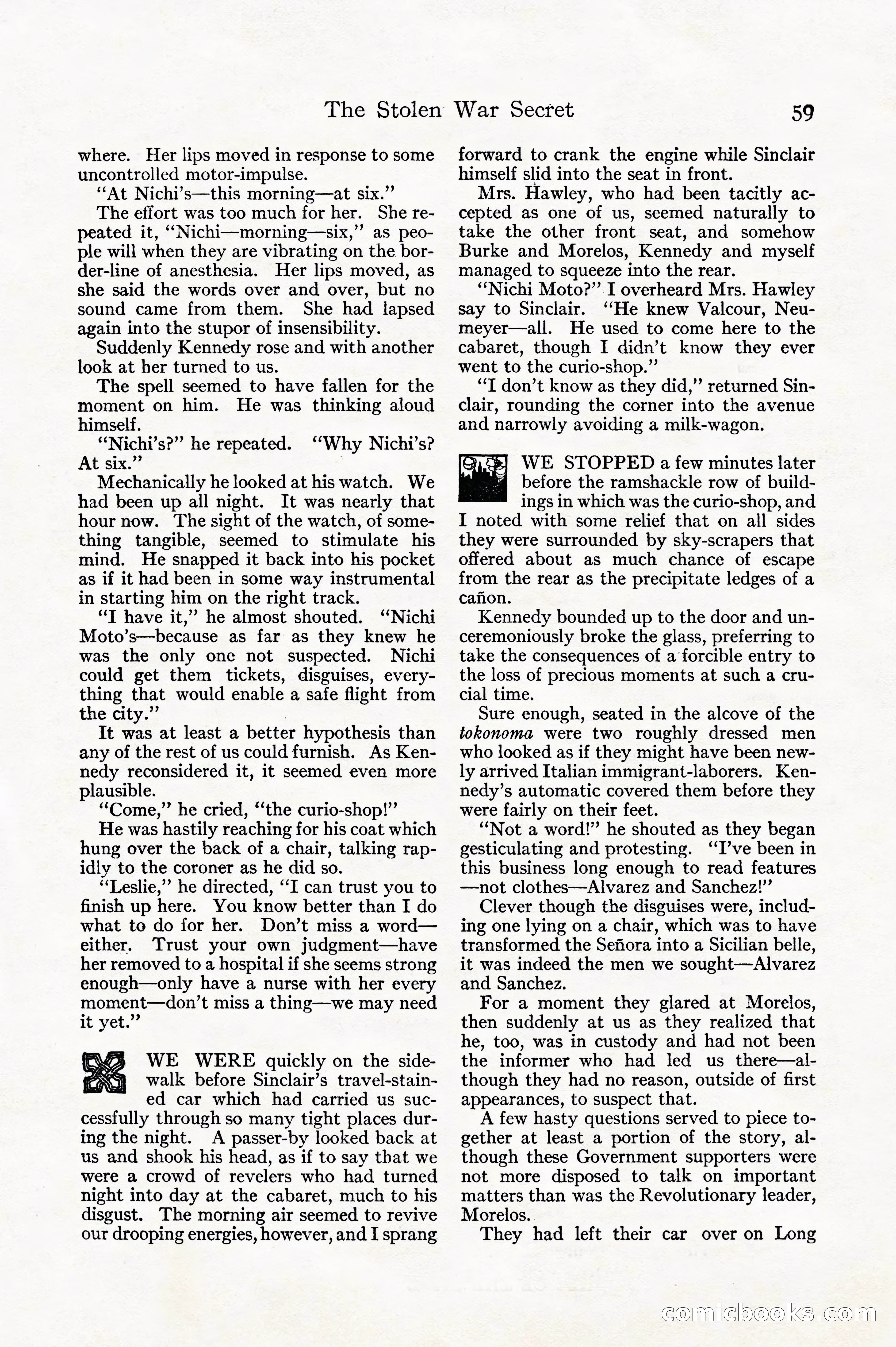
A restored page from Pulp Fiction, 1914. Page through the whole issue in the reader above.
📄 Transcribed text from this page (OCR, searchable)
Machine-transcribed from the original scan — historical spelling and the odd misread are preserved.
The Stolen War Secret where. Her lips moved in response to some uncontrolled motor-impulse. “At Nichi’s—this morning—at six.” The effort was too much for her. She re- peated it, ““Nichi—morning—six,”’ as peo- ple will when they are vibrating on the bor- der-line of anesthesia. Her lips moved, as she said the words over and over, but no sound came from them. She had lapsed again into the stupor of insensibility. Suddenly Kennedy rose and with another look at her turned to us. The spell seemed to have fallen for the moment on him. He was thinking aloud himself. ““Nichi’s?”’ he repeated. At six.” Mechanically he looked at his watch. We had been up all night. It was nearly that hour now. The sight of the watch, of some- thing tangible, seemed to stimulate his mind. He snapped it back into his pocket as if it had been in some way instrumental in starting him on the right track. “T have it,” he almost shouted. ‘Nichi Moto’s—because as far as they knew he was the only one not suspected. Nichi could get them tickets, disguises, every- thing that would enable a safe flight from the city.” It was at least a better hypothesis than any of the rest of us could furnish. As Ken- nedy reconsidered it, it seemed even more plausible. “Come,” he cried, “‘the curio-shop!”’ He was hastily reaching for his coat which hung over the back of a chair, talking rap- idly to the coroner as he did so. “Leslie,” he directed, “‘I can trust you to finish up here. You know better than I do what to do for her. Don’t miss a word— either. Trust your own judgment—have her removed to a hospital if she seems strong enough—only have a nurse with her every moment—don’t miss a thing—we may need it yet.” “Why Nichi’s? WE WERE quickly on the side- walk before Sinclair’s travel-stain- ed car which had carried us suc- cessfully through so many tight places dur- ing the night. A passer-by looked back at us and shook his head, as if to say that we were a crowd of revelers who had turned night into day at the cabaret, much to his disgust. The morning air seemed to revive our drooping energies, however, and I sprang 59 forward to crank the engine while Sinclair himself slid into the seat in front. Mrs. Hawley, who had been tacitly ac- cepted as one of us, seemed naturally to take the other front seat, and somehow Burke and Morelos, Kennedy and myself managed to squeeze into the rear. ‘Nichi Moto?” I overheard Mrs. Hawley say to Sinclair. ‘‘He knew Valcour, Neu- meyer—all. He used to come here to the cabaret, though I didn’t know they ever went to the curio-shop.”’ “T don’t know as they did,” returned Sin- clair, rounding the corner into the avenue and narrowly avoiding a milk-wagon. wink WE STOPPED a few minutes later bs before the ramshackle row of build- ings in which was the curio-shop, and I noted with some relief that on all sides they were surrounded by sky-scrapers that offered about as much chance of escape from the rear as the precipitate ledges of a canon. Kennedy bounded up to the door and un- ceremoniously broke the glass, preferring to take the consequences of a forcible entry to the loss of precious moments at such a cru- cial time. Sure enough, seated in the alcove of the tokonoma were two roughly dressed men who looked as if they might have been new- ly arrived Italian immigrant-laborers. Ken- nedy’s automatic covered them before they were fairly on their feet. ‘“‘Not a word!” he shouted as they began gesticulating and protesting. ‘I’ve been in this business long enough to read features —not clothes—Alvarez and Sanchez!’ Clever though the disguises were, includ- ing one lying on a chair, which was to have transformed the Sefiora into a Sicilian belle, it was indeed the men we sought-——Alvarez and Sanchez. For a moment they glared at Morelos, then suddenly at us as they realized that he, too, was in custody and had not been the informer who had led us there—al- though they had no reason, outside of first appearances, to suspect that. A few hasty questions served to piece to- gether at least a portion of the story, al- though these Government supporters were not more disposed to talk on important matters than was the Revolutionary leader, Morelos. They had left their car over on Long MICLOOOK (C@