
Pulp Fiction, 1914 · page 62 of 228
Adventure, December 1914 — page 62: what you’re looking at
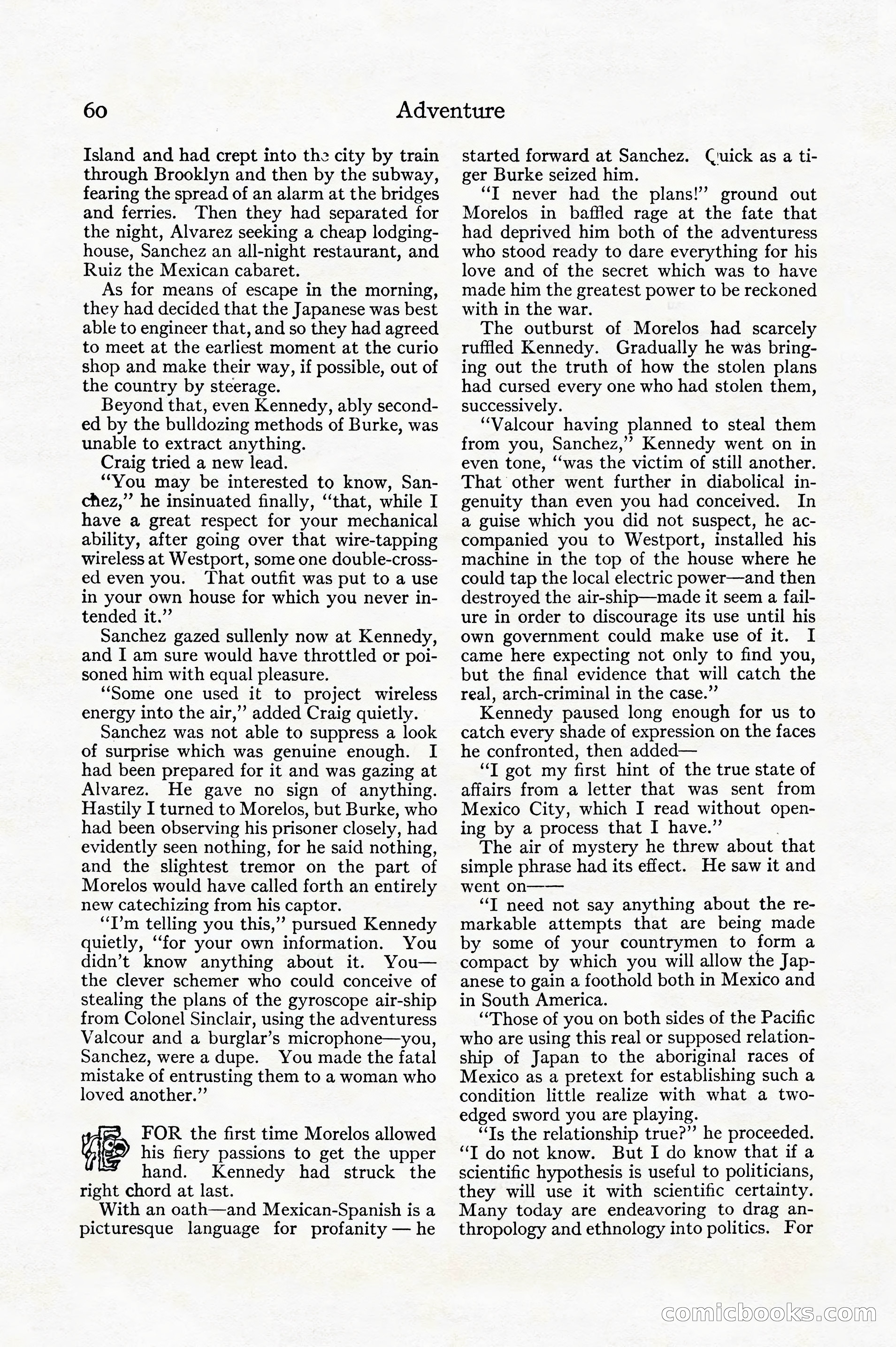
A restored page from Pulp Fiction, 1914. Page through the whole issue in the reader above.
📄 Transcribed text from this page (OCR, searchable)
Machine-transcribed from the original scan — historical spelling and the odd misread are preserved.
60 Island and had crept into the city by train through Brooklyn and then by the subway, fearing the spread of an alarm at the bridges and ferries. Then they had separated for the night, Alvarez seeking a cheap lodging- house, Sanchez an all-night restaurant, and Ruiz the Mexican cabaret. As for means of escape in the morning, they had decided that the Japanese was best able to engineer that, and so they had agreed to meet at the earliest moment at the curio shop and make their way, if possible, out of the country by steerage. Beyond that, even Kennedy, ably second- ed by the bulldozing methods of Burke, was unable to extract anything. Craig tried a new lead. “You may be interested to know, San- chez,” he insinuated finally, “that, while I have a great respect for your mechanical ability, after going over that wire-tapping wireless at Westport, some one double-cross- ed even you. That outfit was put to a use in your own house for which you never in- tended it.” Sanchez gazed sullenly now at Kennedy, and I am sure would have throttled or poi- soned him with equal pleasure. ‘Some one used it to project wireless energy into the air,” added Craig quietly. Sanchez was not able to suppress a look of surprise which was genuine enough. I had been prepared for it and was gazing at Alvarez. He gave no sign of anything. Hastily I turned to Morelos, but Burke, who had been observing his prisoner closely, had evidently seen nothing, for he said nothing, and the slightest tremor on the part of Morelos would have called forth an entirely new catechizing from his captor. “T’m telling you this,”’ pursued Kennedy quietly, “for your own information. You didn’t know anything about it. You— the clever schemer who could conceive of stealing the plans of the gyroscope air-ship from Colonel Sinclair, using the adventuress Valcour and a burglar’s microphone—you, Sanchez, were a dupe. You made the fatal mistake of entrusting them to a woman who loved another.” Ae his fiery passions to get the upper hand. Kennedy had struck the right chord at last. With an oath—and Mexican-Spanish is a picturesque language for profanity — he FOR the first time Morelos allowed Adventure started forward at Sanchez. Cuick as a ti- ger Burke seized him. “T never had the plans!” ground out Morelos in baffled rage at the fate that had deprived him both of the adventuress who stood ready to dare everything for his love and of the secret which was to have made him the greatest power to be reckoned with in the war. The outburst of Morelos had scarcely ruffled Kennedy. Gradually he was bring- ing out the truth of how the stolen plans had cursed every one who had stolen them, successively. “Valcour having planned to steal them from you, Sanchez,’ Kennedy went on in even tone, ‘‘was the victim of still another. That other went further in diabolical in- genuity than even you had conceived. In a guise which you did not suspect, he ac- companied you to Westport, installed his machine in the top of the house where he could tap the local electric power—and then destroyed the air-ship—made it seem a fail- ure in order to discourage its use until his own government could make use of it. I came here expecting not only to find you, but the final evidence that will catch the real, arch-criminal in the case.”’ Kennedy paused long enough for us to catch every shade of expression on the faces he confronted, then added— “T got my first hint of the true state of affairs from a letter that was sent from Mexico City, which I read without open- ing by a process that I have.” | The air of mystery he threw about that simple phrase had its effect. He saw it and went on—— “T need not say anything about the re- markable attempts that are being made by some of your countrymen to form a compact by which you will allow the Jap- anese to gain a foothold both in Mexico and in South America. ‘“‘Those of you on both sides of the Pacific who are using this real or supposed relation- ship of Japan to the aboriginal races of Mexico as a pretext for establishing such a condition little realize with what a two- edged sword you are playing. “Ts the relationship true?”’ he proceeded. “T do not know. But I do know that if a scientific hypothesis is useful to politicians, they will use it with scientific certainty. Many today are endeavoring to drag an- thropology and ethnology into politics. For Gomiicovdook C@