
Pulp Fiction, 1916 · page 221 of 228
Adventure Magazine Cover, April 1916 — page 221: what you’re looking at
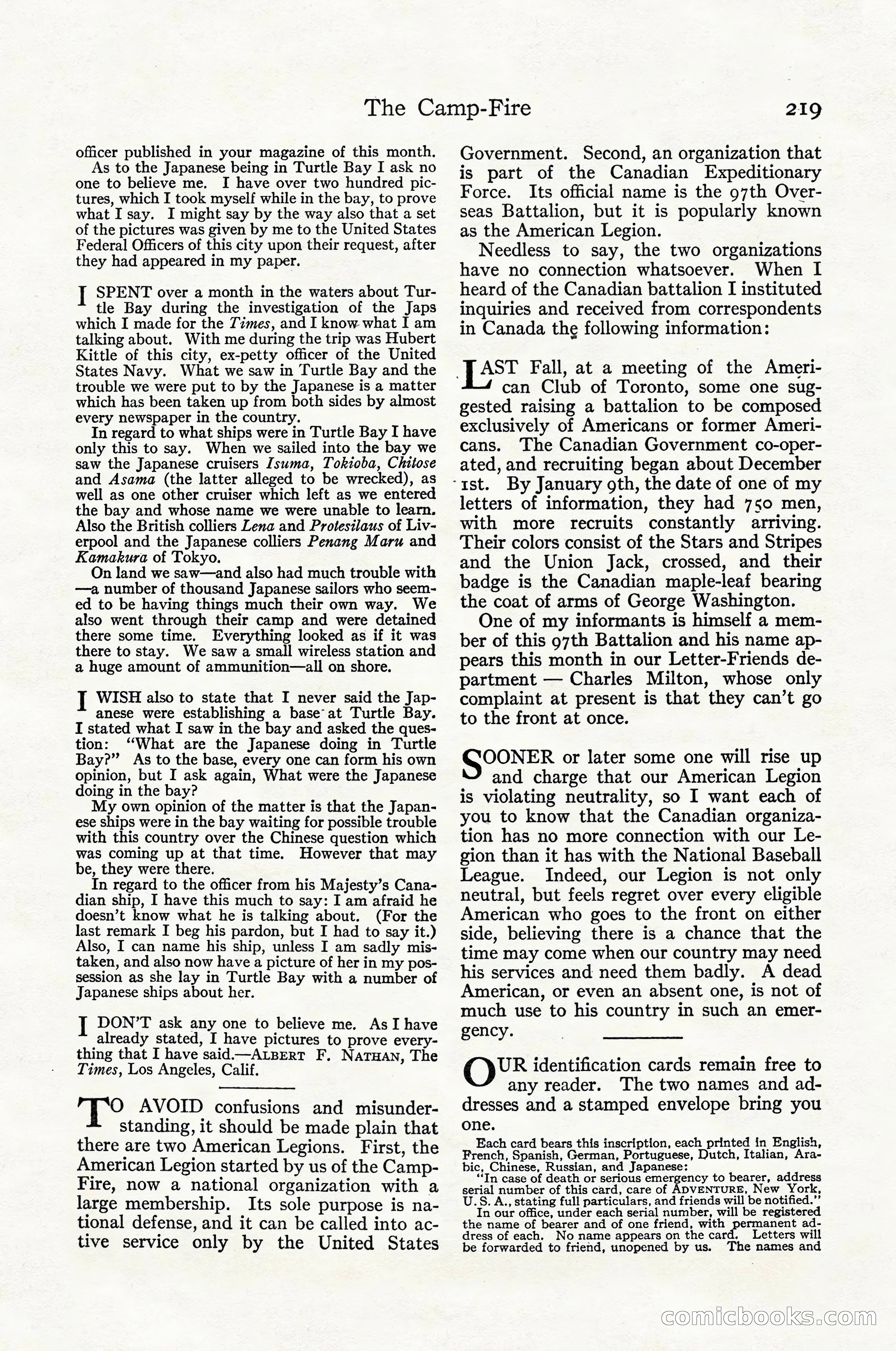
A restored page from Pulp Fiction, 1916. Page through the whole issue in the reader above.
📄 Transcribed text from this page (OCR, searchable)
Machine-transcribed from the original scan — historical spelling and the odd misread are preserved.
The Camp-Fire officer published in your magazine of this month. As to the Japanese being in Turtle Bay I ask no one to believe me. I have over two hundred pic- tures, which I took myself while in the bay, to prove what I say. I might say by the way also that a set of the pictures was given by me to the United States Federal Officers of this city upon their request, after they had appeared in my paper. SPENT over a month in the waters about Tur- tle Bay during the investigation of the Japs which I made for the Times, and I know what I am talking about. With me during the trip was Hubert Kittle of this city, ex-petty officer of the United States Navy. What we saw in Turtle Bay and the trouble we were put to by the Japanese is a matter which has been taken up from both sides by almost every newspaper in the country. In regard to what ships were in Turtle Bay I have only this to say. When we sailed into the bay we saw the Japanese cruisers Isuma, Tokioba, Chitose and Asama (the latter alleged to be wrecked), as well as one other cruiser which left as we entered the bay and whose name we were unable to learn. Also the British colliers Lena and Protesilaus of Liv- erpool and the Japanese colliers Penang Maru and Kamakura of Tokyo. On land we saw—and also had much trouble with —a number of thousand Japanese sailors who seem- ed to be having things much their own way. We also went through their camp and were detained there some time. Everything looked as if it was there to stay. We saw a small wireless station and a huge amount of ammunition—all on shore. WISH also to state that I never said the Jap- anese were establishing a base’at Turtle Bay. I stated what I saw in the bay and asked the ques- tion: ‘What are the Japanese doing in Turtle Bay?” As to the base, every one can form his own opinion, but I ask again, What were the Japanese doing in the bay? My own opinion of the matter is that the Japan- ese ships were in the bay waiting for possible trouble with this country over the Chinese question which was coming up at that time. However that may be, they were there. In regard to the officer from his Majesty’s Cana- dian ship, I have this much to say: I am afraid he doesn’t know what he is talking about. (For the last remark I beg his pardon, but I had to say it.) Also, I can name his ship, unless I am sadly mis- taken, and also now have a picture of her in my pos- session as she lay in Turtle Bay with a number of Japanese ships about her. DON’T ask any one to believe me. As I have already stated, I have pictures to prove every- thing that I have said——ALBERT F. NATHAN, The Times, Los Angeles, Calif. O AVOID confusions and misunder- standing, it should be made plain that there are two American Legions. First, the American Legion started by us of the Camp- Fire, now a national organization with a large membership. Its sole purpose is na- tional defense, and it can be called into ac- tive service only by the United States 219 Government. Second, an organization that is part of the Canadian Expeditionary Force. Its official name is the 97th Over- seas Battalion, but it is popularly known as the American Legion. Needless to say, the two organizations have no connection whatsoever. When I heard of the Canadian battalion I instituted inquiries and received from correspondents in Canada the following information: past Fall, at a meeting of the Ameri- can Club of Toronto, some one sug- gested raising a battalion to be composed exclusively of Americans or former Ameri- cans. The Canadian Government co-oper- ated, and recruiting began about December ‘ist. By January oth, the date of one of my letters of information, they had 750 men, with more recruits constantly arriving. Their colors consist of the Stars and Stripes and the Union Jack, crossed, and their badge is the Canadian maple-leaf bearing the coat of arms of George Washington. One of my informants is himself a mem- ber of this 97th Battalion and his name ap- pears this month in our Letter-Friends de- partment — Charles Milton, whose only complaint at present is that they can’t go to the front at once. GOONER or later some one will rise up and charge that our American Legion is violating neutrality, so I want each of you to know that the Canadian organiza- tion has no more connection with our Le- gion than it has with the National Baseball League. Indeed, our Legion is not only neutral, but feels regret over every eligible American who goes to the front on either side, believing there is a chance that the time may come when our country may need his services and need them badly. A dead American, or even an absent one, is not of much use to his country in such an emer- gency. UR identification cards remain free to any reader. The two names and ad- dresses and a stamped envelope bring you one. Each card bears this inscription, each printed {n English, French, Spanish, German, Portuguese, Dutch, Italian, Ara- bic, Chinese, Russian, and Japanese: “In case of death or serious emergency to bearer, address serial number of this card, care of ADVENTURE, New York, U.S. A., stating full particulars, and friends will be notified.”’ In our office, under each serial number, will be registered the name of bearer and of one friend, with permanent ad- dress of each. No name appears on the card. Letters will be forwarded to friend, unopened by us. The names and CoMmichoooks (CO