
Pulp Fiction, 1916 · page 222 of 228
Adventure Magazine Cover, April 1916 — page 222: what you’re looking at
A restored page from Pulp Fiction, 1916. Page through the whole issue in the reader above.
📄 Transcribed text from this page (OCR, searchable)
Machine-transcribed from the original scan — historical spelling and the odd misread are preserved.
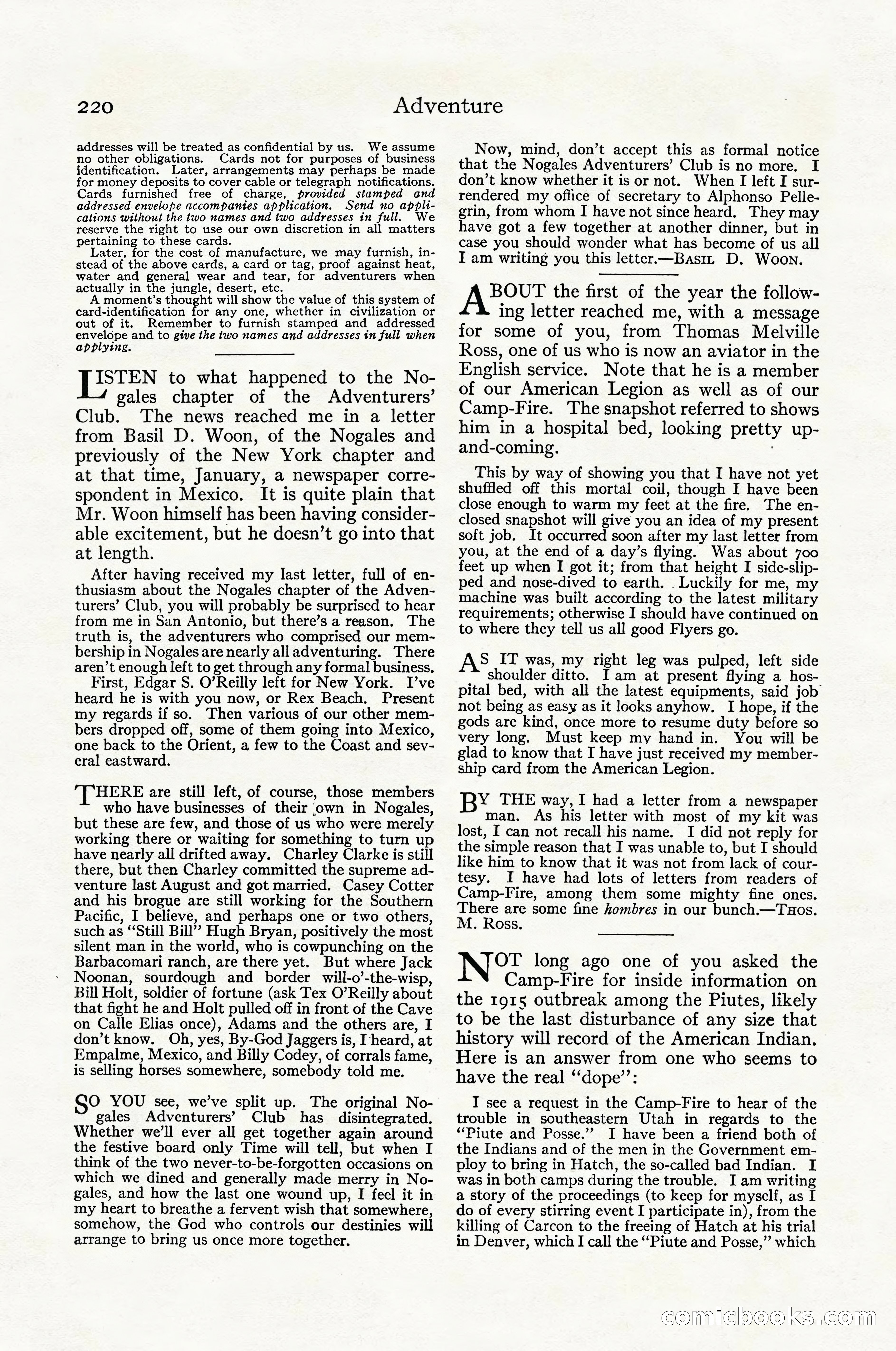
220 addresses will be treated as confidential by us. We assume no other obligations. Cards not for purposes of business {dentification. Later, arrangements may perhaps be made for money deposits to cover cable or telegraph notifications. Cards furnished free of charge, provided stamped and addressed envelope accompanies application. Send no appli- cations without the two names and two addresses in full. We reserve the right to use our own discretion in all matters pertaining to these cards. : Later, for the cost of manufacture, we may furnish, in- stead of the above cards, a card or tag, proof against heat, water and general wear and tear, for adventurers when actually in the jungle, desert, etc. A moment’s thought will show the value of this system of card-identification for any one, whether in civilization or out of it. Remember to furnish stamped and addressed envelope and to give the two names and addresses in full when applying. | eee to what happened to the No- gales chapter of the Adventurers’ Club. The news reached me in a letter from Basil D. Woon, of the Nogales and previously of the New York chapter and at that time, January, a newspaper corre- spondent in Mexico. It is quite plain that Mr. Woon himself has been having consider- able excitement, but he doesn’t go into that at length. After having received my last letter, full of en- thusiasm about the Nogales chapter of the Adven- turers’ Club, you will probably be surprised to hear from me in San Antonio, but there’s a reason. The truth is, the adventurers who comprised our mem- bership in Nogales are nearly alladventuring. There aren’t enough left to get through any formal business. First, Edgar S. O’Reilly left for New York. I’ve heard he is with you now, or Rex Beach. Present my regards if so. Then various of our other mem- bers dropped off, some of them going into Mexico, one back to the Orient, a few to the Coast and sev- eral eastward. "THERE are still left, of course, those members who have businesses of their own in Nogales, but these are few, and those of us who were merely working there or waiting for something to turn up have nearly all drifted away. Charley Clarke is still there, but then Charley committed the supreme ad- venture last August and got married. Casey Cotter and his brogue are still working for the Southern Pacific, I believe, and perhaps one or two others, such as “‘Still Bill” Hugh Bryan, positively the most silent man in the world, who is cowpunching on the Barbacomari ranch, are there yet. But where Jack Noonan, sourdough and border will-o’-the-wisp, Bill Holt, soldier of fortune (ask Tex O’Reilly about that fight he and Holt pulled off in front of the Cave on Calle Elias once), Adams and the others are, I don’t know. Oh, yes, By-God Jaggers is, I heard, at Empalme, Mexico, and Billy Codey, of corrals fame, is selling horses somewhere, somebody told me. O YOU see, we’ve split up. The original No- gales Adventurers’ Club has disintegrated. Whether we'll ever all get together again around the festive board only Time will tell, but when I think of the two never-to-be-forgotten occasions on which we dined and generally made merry in No- gales, and how the last one wound up, I feel it in my heart to breathe a fervent wish that somewhere, somehow, the God who controls our destinies will arrange to bring us once more together. Adventure Now, mind, don’t accept this as formal notice that the Nogales Adventurers’ Club is no more. I don’t know whether it is or not. When I left I sur- rendered my office of secretary to Alphonso Pelle- grin, from whom I have not since heard. They may have got a few together at another dinner, but in case you should wonder what has become of us all I am writing you this letter—Basit D. Woon. A BOUT the first of the year the follow- ing letter reached me, with a message for some of you, from Thomas Melville Ross, one of us who is now an aviator in the English service. Note that he is a member of our American Legion as well as of our Camp-Fire. The snapshot referred to shows him in a hospital bed, looking pretty up- and-coming. This by way of showing you that I have not yet shuffled off this mortal coil, though I have been close enough to warm my feet at the fire. The en- closed snapshot will give you an idea of my present soft job. It occurred soon after my last letter from you, at the end of a day’s flying. Was about 700 feet up when I got it; from that height I side-slip- ped and nose-dived to earth. . Luckily for me, my machine was built according to the latest military requirements; otherwise I should have continued on to where they tell us all good Flyers go. S IT was, my right leg was pulped, left side shoulder ditto. Iam at present flying a hos- pital bed, with all the latest equipments, said job not being as easy as it looks anyhow. I hope, if the gods are kind, once more to resume duty before so very long. Must keep my hand in. You will be glad to know that I have just received my member- ship card from the American Legion. BY THE way, I had a letter from a newspaper man. As his letter with most of my kit was lost, I can not recall his name. I did not reply for the simple reason that I was unable to, but I should like him to know that it was not from lack of cour- tesy. I have had lots of letters from readers of Camp-Fire, among them some mighty fine ones. There are some fine hombres in our bunch.—Tuos. M. Ross. INGS long ago one of you asked the Camp-Fire for inside information on the 1915 outbreak among the Piutes, likely to be the last disturbance of any size that history will record of the American Indian. Here is an answer from one who seems to have the real “‘dope’’: T see a request in the Camp-Fire to hear of the trouble in southeastern Utah in regards to the “‘Piute and Posse.” I have been a friend both of the Indians and of the men in the Government em- ploy to bring in Hatch, the so-called bad Indian. I was in both camps during the trouble. I am writing a story of the proceedings (to keep for myself, as I do of every stirring event I participate in), from the killing of Carcon to the freeing of Hatch at his trial in Denver, which I call the ‘‘Piute and Posse,”’ which CoOMmichoooks (CO