
Pulp Fiction, 1924 · page 108 of 200
Adventure Magazine Cover — page 108: what you’re looking at
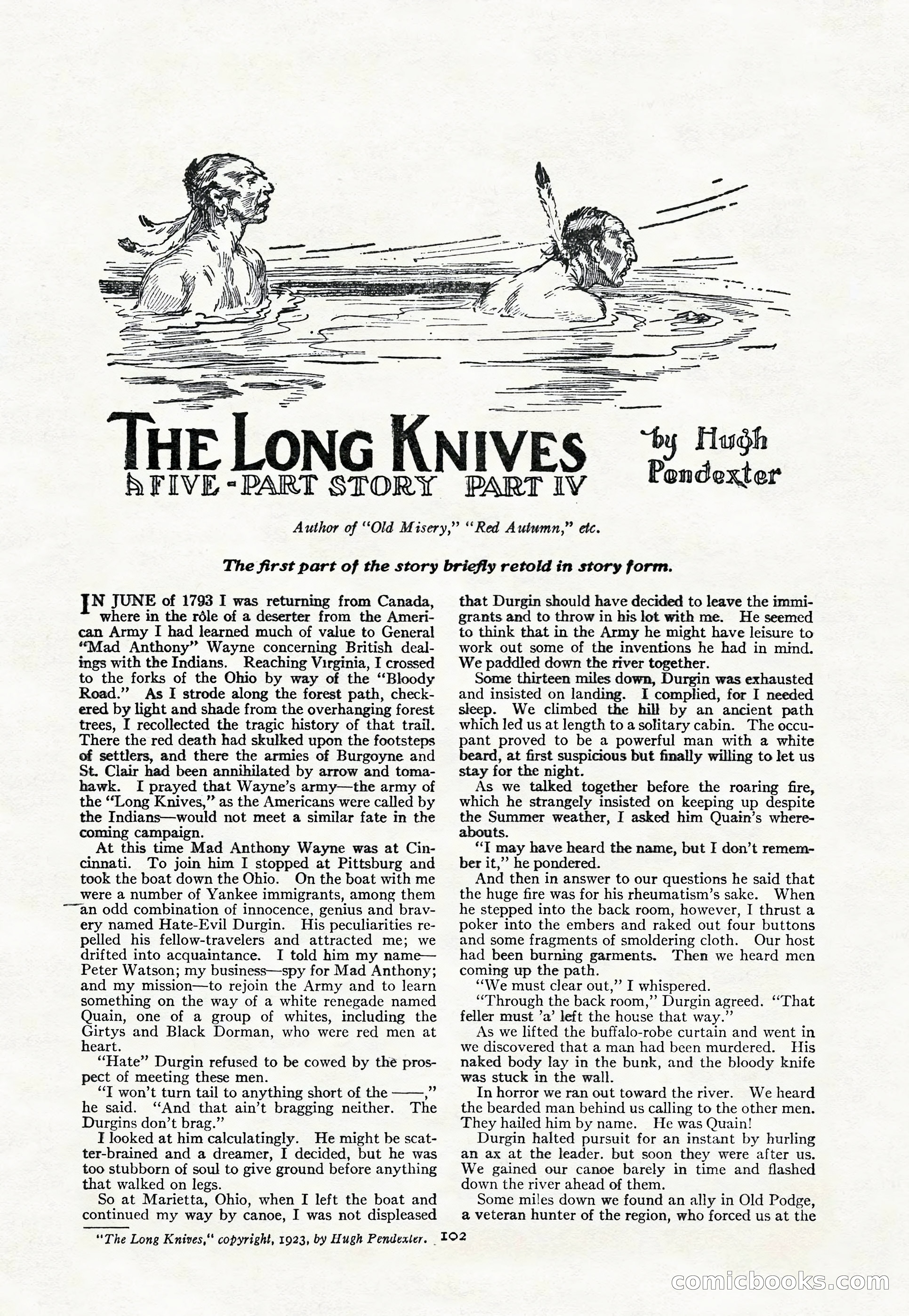
A restored page from Pulp Fiction, 1924. Page through the whole issue in the reader above.
📄 Transcribed text from this page (OCR, searchable)
Machine-transcribed from the original scan — historical spelling and the odd misread are preserved.
ee cancinonntaiirieetan <== ee SSS SSS eee THE — a — Lonc KNIVES SFIVE-PART STORY PART IV “by Hugh Pendexter Author of “Old Misery,” “Red Autumn,” etc. The first part of the story briefly retold in story form. JN JUNE of 1793 I was returning from Canada, where in the réle of a deserter from the Ameri- can Army I had learned much of value to General “Mad Anthony” Wayne concerning British deal- ings with the Indians. Reaching Virginia, I crossed to the forks of the Ohio by way of the ‘Bloody Road.”’ As I strode along the forest path, check- ered by light and shade from the overhanging forest trees, I recollected the tragic history of that trail. There the red death had skulked upon the footsteps of settlers, and there the armies of Burgoyne and St. Clair had been annihilated by arrow and toma- hawk. I prayed that Wayne’s army—the army of the “Long Knives,” as the Americans were called by the Indians—would not meet a similar fate mn the coming campaign. At this time Mad Anthony Wayne was at Cin- cinnati. To join him I stopped at Pittsburg and took the boat down the Ohio. On the boat with me were a number of Yankee immigrants, among them an odd combination of innocence, genius and brav- ery named Hate-Evil Durgin. His peculiarities re- pelled his fellow-travelers and attracted me; we drifted into acquaintance. I told him my name— Peter Watson; my business—spy for Mad Anthony; and my mission—to rejoin the Army and to learn something on the way of a white renegade named Quain, one of a group of whites, including the we and Black Dorman, who were red men at eart. “Fate” Durgin refused to be cowed by the pros- pect of meeting these men. “IT won’t turn tail to anything short of the ——,” he said. ‘And that ain’t bragging neither. The Durgins don’t brag.”’ TI looked at him calculatingly. He might be scat- ter-brained and a dreamer, I decided, but he was too stubborn of soul to give ground before anything that walked on legs. So at Marietta, Ohio, when I left the boat and continued my way by canoe, I was not displeased that Durgin should have decided to leave the immi- grants and to throw in his lot with me. He seemed to think that in the Army he might have leisure to work out some of the inventions he had in mind. We paddled down the river together. Some thirteen miles down, Durgin was exhausted and insisted on landing. I complied, for I needed sleep. We climbed the hill by an ancient path which led us at length to a solitary cabin. The occu- pant proved to be a powerful man with a white beard, at first suspicious but fimally willing to let us stay for the night. As we talked together before the roaring fire, which he strangely insisted on keeping up despite the Summer weather, I asked him Quain’s where- abouts. *‘T may have heard the name, but I don’t remem- ber it,”’ he pondered. And then in answer to our questions he said that the huge fire was for his rheumatism’s sake. When he stepped into the back room, however, I thrust a poker into the embers and raked out four buttons and some fragments of smoldering cloth. Our host had been burning garments. Then we heard men coming up the path. “‘We must clear out,”’ I whispered. “Through the back room,” Durgin agreed. ‘That feller must ’a’ left the house that way.” As we lifted the buffalo-robe curtain and went in we discovered that a man had been murdered. His naked body lay in the bunk, and the bloody knife was stuck in the wall. In horror we ran out toward the river. We heard the bearded man behind us calling to the other men. They hailed him by name. He was Quain! Durgin halted pursuit for an instant by hurling an ax at the leader. but soon they were after us. We gained our canoe barely in time and flashed down the river ahead of them. Some miles down we found an ally in Old Podge, a veteran hunter of the region, who forced us at the “The Long Knives,“ copyright, 1923, by Hugh Pendexter. 102 oO COMmicloo Sj S|