
Pulp Fiction, 1924 · page 109 of 200
Adventure Magazine Cover — page 109: what you’re looking at
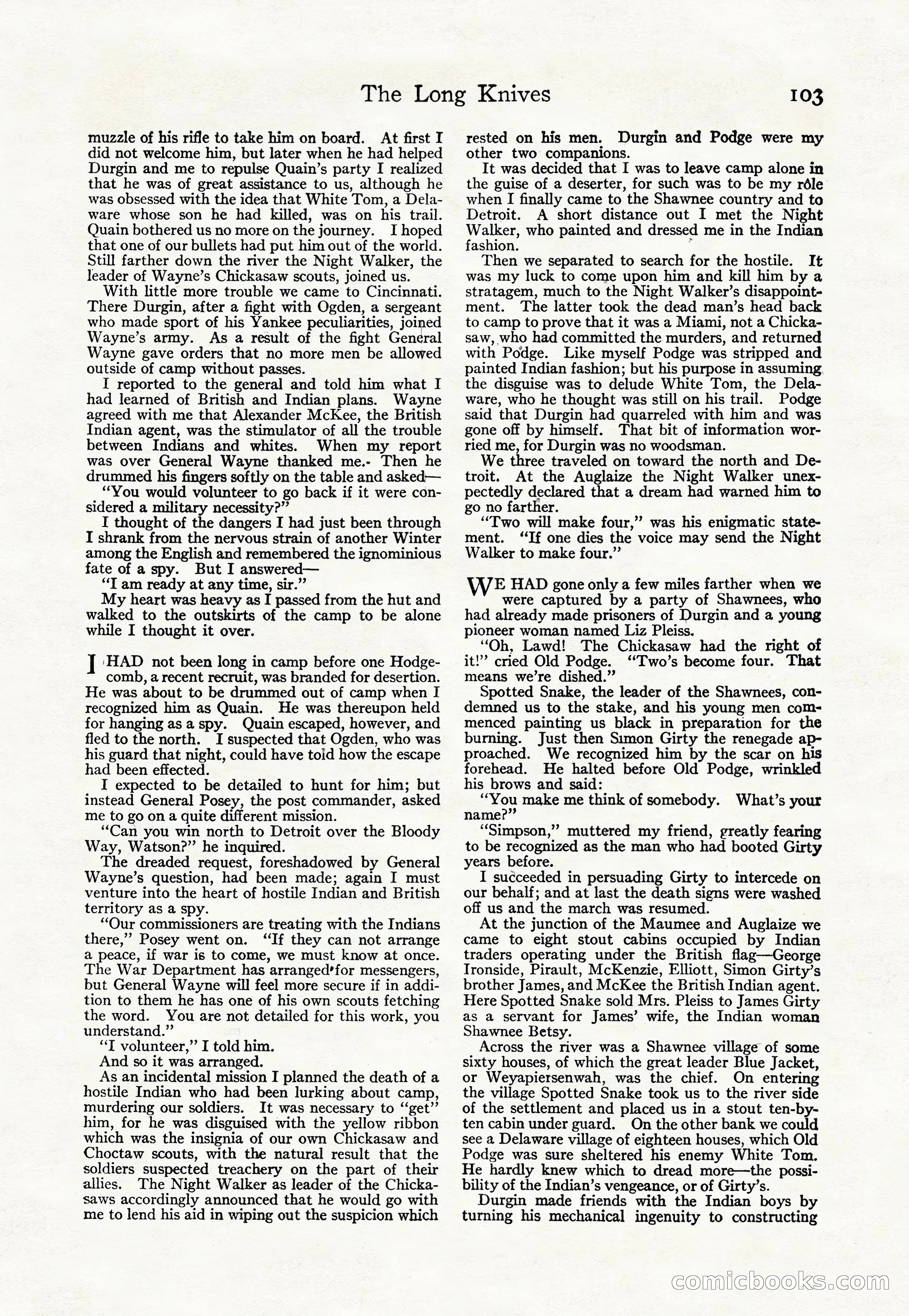
A restored page from Pulp Fiction, 1924. Page through the whole issue in the reader above.
📄 Transcribed text from this page (OCR, searchable)
Machine-transcribed from the original scan — historical spelling and the odd misread are preserved.
The Long Knives muzzle of his rifle to take him on board. At first I did not welcome him, but later when he had helped Durgin and me to repulse Quain’s party I realized that he was of great assistance to us, although he was obsessed with the idea that White Tom, a Dela- ware whose son he had killed, was on his trail. Quain bothered us no more on the journey. I hoped that one of our bullets had put him out of the world. Still farther down the river the Night Walker, the leader of Wayne’s Chickasaw scouts, joined us. With little more trouble we came to Cincinnati. There Durgin, after a fight with Ogden, a sergeant who made sport of his Yankee peculiarities, joined Wayne’s army. As a result of the fight General Wayne gave orders that no more men be allowed outside of camp without passes. I reported to the general and told him what I had learned of British and Indian plans. Wayne agreed with me that Alexander McKee, the British Indian agent, was the stimulator of all the trouble between Indians and whites. When my report was over General Wayne thanked me.- Then he drummed his fingers softly on the table and asked— “You would volunteer to go back if it were con- sidered a military necessity?” I thought of the dangers I had just been through I shrank from the nervous strain of another Winter among the English and remembered the ignominious fate of a spy. But I answered— “TI am ready at any time, sir.” My heart was heavy as I passed from the hut and walked to the outskirts of the camp to be alone while I thought it over. ‘HAD not been long in camp before one Hodge- comb, a recent recruit, was branded for desertion. He was about to be drummed out of camp when I recognized him as Quain. He was thereupon held for hanging asaspy. Quain escaped, however, and fled to the north. I suspected that Ogden, who was his guard that night, could have toid how the escape had been effected. I expected to be detailed to hunt for him; but instead General Posey, the post commander, asked me to go on a quite different mission. “Can you win north to Detroit over the Bloody Way, Watson?” he inquired. The dreaded request, foreshadowed by General Wayne’s question, had been made; again I must venture into the heart of hostile Indian and British territory as a spy. “Our commissioners are treating with the Indians there,” Posey went on. “If they can not arrange a peace, if war is to come, we must know at once. The War Department has arranged’for messengers, but General Wayne will feel more secure if in addi- tion to them he has one of his own scouts fetching the word. You are not detailed for this work, you understand.” “T volunteer,” I told him. And so it was arranged. As an incidental mission I planned the death of a hostile Indian who had been lurking about camp, murdering our soldiers. It was necessary to “get” him, for he was disguised with the yellow ribbon which was the insignia of our own Chickasaw and Choctaw scouts, with the natural result that the soldiers suspected treachery on the part of their allies. The Night Walker as leader of the Chicka- saws accordingly announced that he would go with me to lend his aid in wiping out the suspicion which 103 rested on his men. Durgin and Podge were my other two companions. It was decided that I was to leave camp alone in the guise of a deserter, for such was to be my réle when I finally came to the Shawnee country and to Detroit. A short distance out I met the Night Walker, who painted and dressed me in the Indian fashion. Then we separated to search for the hostile. It was my luck to come upon him and kill him by a stratagem, much to the Night Walker’s disappoint- ment. The latter took the dead man’s head back to camp to prove that it was a Miami, not a Chicka- saw, who had committed the murders, and returned with Podge. Like myself Podge was stripped and painted Indian fashion; but his purpose in assuming the disguise was to delude White Tom, the Dela- ware, who he thought was still on his trail. Podge said that Durgin had quarreled with him and was gone off by himself. That bit of information wor- ried me, for Durgin was no woodsman. We three traveled on toward the north and De- troit. At the Auglaize the Night Walker unex- pectedly declared that a dream had warned him to go no farther. ‘“‘Two will make four,” was his enigmatic state- ment. “If one dies the voice may send the Night Walker to make four.” E HAD gone only a few miles farther when we were captured by a party of Shawnees, who had already made prisoners of Durgin and a young pioneer woman named Liz Pleiss. “Oh, Lawd! The Chickasaw had the right of it!’ cried Old Podge. ‘‘Two’s become four. That means we’re dished.” Spotted Snake, the leader of the Shawnees, con- demned us to the stake, and his young men com- menced painting us black in preparation for the burning. Just then Simon Girty the renegade ap- proached. We recognized him by the scar on his forehead. He halted before Old Podge, wrinkled his brows and said: ‘You make me think of somebody. name?” ‘“Simpson,”’ muttered my friend, greatly fearing to be recognized as the man who had booted Girty years before. I succeeded in persuading Girty to intercede on our behalf; and at last the death signs were washed off us and the march was resumed. , At the junction of the Maumee and Auglaize we came to eight stout cabins occupied by Indian traders operating under the British flag—George Tronside, Pirault, McKenzie, Elliott, Simon Girty’s brother James, and McKee the British Indian agent. Here Spotted Snake sold Mrs. Pleiss to James Girty as a servant for James’ wife, the Indian woman Shawnee Betsy. Across the river was a Shawnee village of some sixty houses, of which the great leader Blue Jacket, or Weyapiersenwah, was the chief. On entering the village Spotted Snake took us to the river side of the settlement and placed us in a stout ten-by- ten cabin under guard. On the other bank we could see a Delaware village of eighteen houses, which Old Podge was sure sheltered his enemy White Tom. He hardly knew which to dread more—the possi- bility of the Indian’s vengeance, or of Girty’s. Durgin made friends with the Indian boys by turning his mechanical ingenuity to constructing What’s your C© MICLOOOKS S|