
Pulp Fiction, 1924 · page 77 of 200
Adventure Magazine Cover — page 77: what you’re looking at
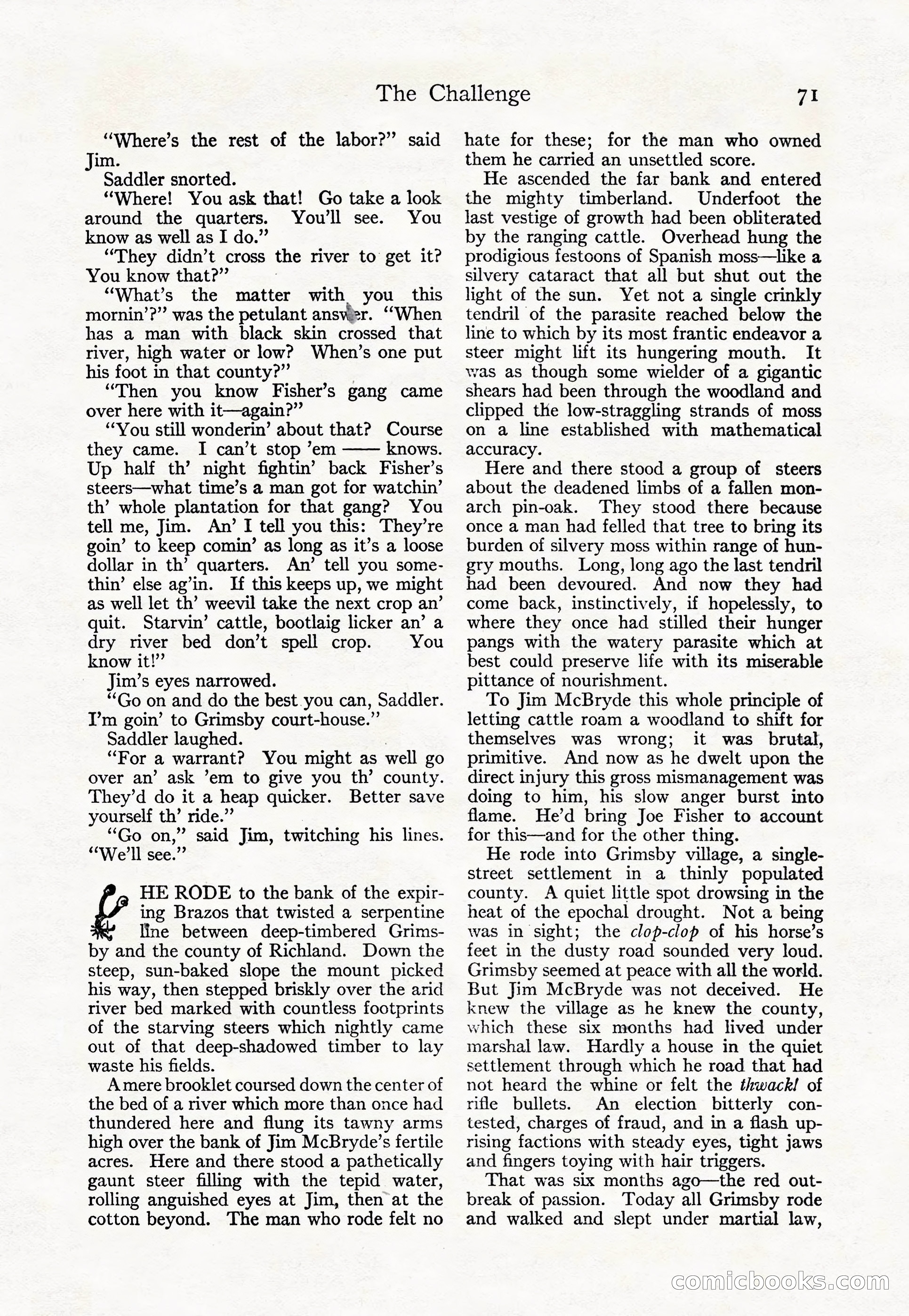
A restored page from Pulp Fiction, 1924. Page through the whole issue in the reader above.
📄 Transcribed text from this page (OCR, searchable)
Machine-transcribed from the original scan — historical spelling and the odd misread are preserved.
The Challenge ‘““‘Where’s the rest of the labor?” said Jim. Saddler snorted. ‘“‘Where! You ask that! Go take a look around the quarters. You'll see. You know as well as I do.” “They didn’t cross the river to get it? You know that?” : “What’s the matter with. you this mornin’?” was the petulant answer. ‘‘When has a man with black skin crossed that river, high water or low? When’s one put his foot in that county?” “Then you know Fisher’s gang came over here with it—again?”’ “You still wonderin’ about that? Course they came. I can’t stop ’em knows. Up half th’ night fightin’ back Fisher’s steers—what time’s a man got for watchin’ th’ whole plantation for that gang? You tell me, Jim. An’ I tell you this: They’re goin’ to keep comin’ as long as it’s a loose dollar in th’ quarters. An’ tell you some- thin’ else ag’in. If this keeps up, we might as well let th’ weevil take the next crop an’ quit. Starvin’ cattle, bootlaig licker an’ a dry river bed don’t spell crop. You know it!” Jim’s eyes narrowed. “‘Go on and do the best. you can, Saddler. I’m goin’ to Grimsby court-house.”’ Saddler laughed. “For a warrant? You might as well go over an’ ask ’em to give you th’ county. They'd do it a heap quicker. Better save yourself th’ ride.” “Go on,” said Jim, twitching his lines. “We'll see.” iG ing Brazos that twisted a serpentine line between deep-timbered Grims- by and the county of Richland. Down the steep, sun-baked slope the mount picked his way, then stepped briskly over the arid river bed marked with countless footprints of the starving steers which nightly came out of that deep-shadowed timber to lay waste his fields. A mere brooklet coursed down the center of the bed of a river which more than once had thundered here and flung its tawny arms high over the bank of Jim McBryde’s fertile acres. Here and there stood a pathetically gaunt steer filling with the tepid water, rolling anguished eyes at Jim, then at the cotton beyond. The man who rode felt no HE RODE to the bank of the expir- ra hate for these; for the man who owned them he carried an unsettled score. He ascended the far bank and entered the mighty timberland. Underfoot the last vestige of growth had been obliterated by the ranging cattle. Overhead hung the prodigious festoons of Spanish moss—like a silvery cataract that all but shut out the light of the sun. Yet not a single crinkly tendril of the parasite reached below the line to which by its most frantic endeavor a steer might lift its hungering mouth. It was as though some wielder of a gigantic shears had been through the woodland and clipped tHe low-straggling strands of moss on a line established with mathematical accuracy. Here and there stood a group of steers about the deadened limbs of a fallen mon- arch pin-oak. They stood there because once a man had felled that tree to bring its burden of silvery moss within range of hun- gry mouths. Long, long ago the last tendril had been devoured. And now they had come back, instinctively, if hopelessly, to where they once had stilled their hunger pangs with the watery parasite which at best could preserve life with its miserable pittance of nourishment. To Jim McBryde this whole principle of letting cattle roam a woodland to shift for themselves was wrong; it was_ brutal, primitive. And now as he dwelt upon the direct injury this gross mismanagement was doing to him, his slow anger burst into flame. He’d bring Joe Fisher to account for this—and for the other thing. He rode into Grimsby village, a single- street settlement in a thinly populated county. A quiet little spot drowsing in the heat of the epochal drought. Not a being was in sight; the clop-clop of his horse’s feet in the dusty road sounded very loud. Grimsby seemed at peace with all the world. But Jim McBryde was not deceived. He knew the village as he knew the county, which these six months had lived under marshal law. Hardly a house in the quiet settlement through which he road that had not heard the whine or felt the thwack/ of rifle bullets. An election bitterly con- tested, charges of fraud, and in a flash up- rising factions with steady eyes, tight jaws and fingers toying with hair triggers. That was six months ago—the red out- break of passion. Today all Grimsby rode and walked and slept under martial law, oO COMmicloo S C©