
Pulp Fiction, 1924 · page 179 of 196
Adventure Magazine, April 10, 1924 — page 179: what you’re looking at
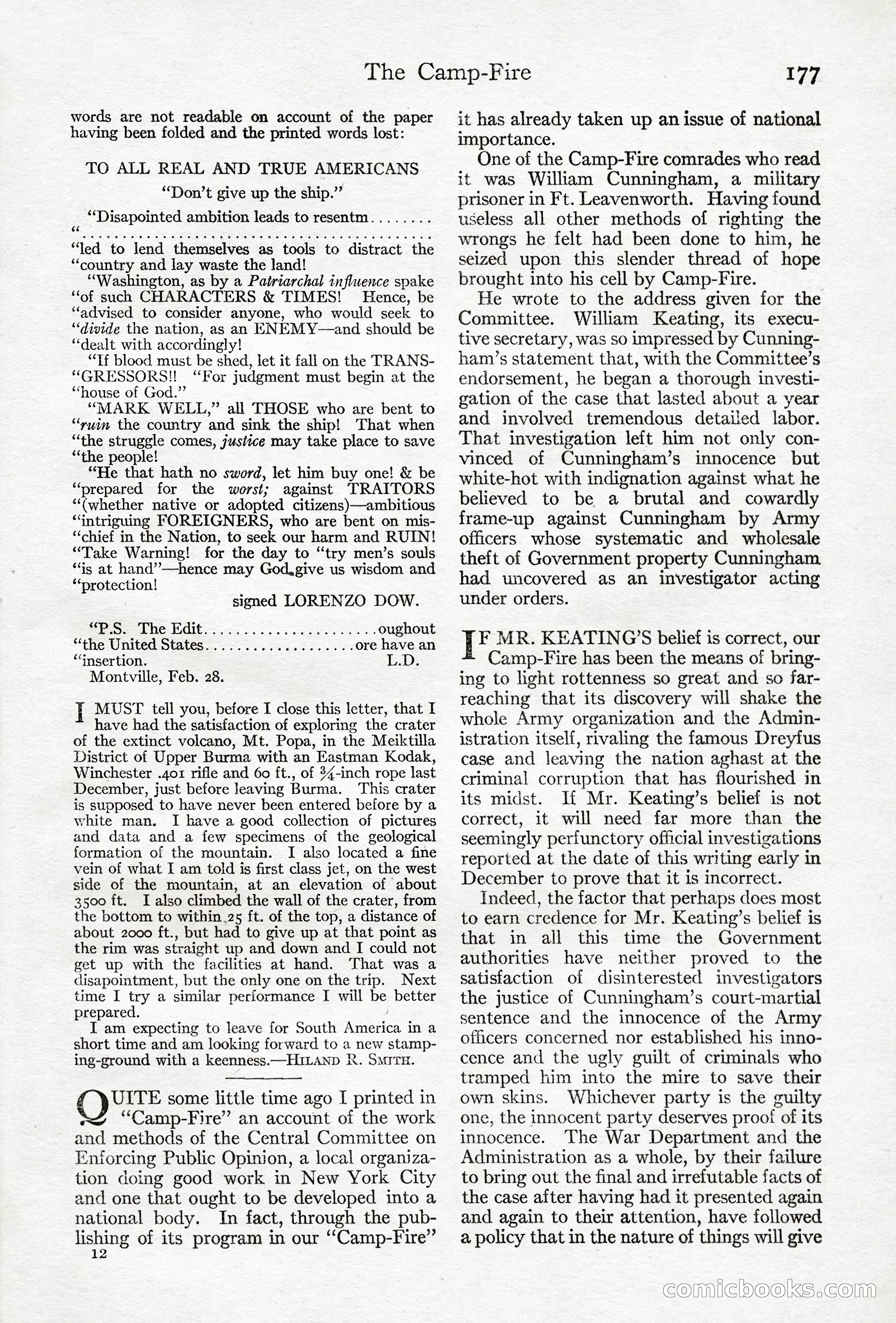
A restored page from Pulp Fiction, 1924. Page through the whole issue in the reader above.
📄 Transcribed text from this page (OCR, searchable)
Machine-transcribed from the original scan — historical spelling and the odd misread are preserved.
The Camp-Fire words are not readable on account of the paper having been folded and the printed words lost: TO ALL REAL AND TRUE AMERICANS “Don’t give up the ship.”’ Ce | “led to lend themselves as tools to distract the “country and lay waste the land! “Washington, as by a Patriarchal influence spake ‘fof such CHARACTERS & TIMES! Hence, be ‘“‘advised to consider anyone, who would seek to “divide the nation, as an ENEMY—and should be “dealt with accordingly! “If blood must be shed, let it fall on the TRANS- “GRESSORS!! “For judgment must begin at the “house of God.” “MARK WELL,” all THOSE who are bent to “ruin the country and sink the ship! That when “the struggle comes, justice may take place to save “the people! “He that hath no sword, let him buy one! & be “prepared for the worst; against TRAITORS ‘““(whether native or adopted citizens)—ambitious “intriguing FOREIGNERS, who are bent on mis- “chief in the Nation, to seek our harm and RUIN! “Take Warning! for the day to “try men’s souls ‘is at hand’’—hence may God, give us wisdom and ‘*protection! signed LORENZO DOW. Bi ee CRO Btiia ne as ea ee . oughout “the United: states:.. = 32.34 hehe et ore have an ““nsertion. L.D. Montville, Feb. 28. if MUST tell you, before I close this letter, that I have had the satisfaction of exploring the crater of the extinct volcano, Mt. Popa, in the Meiktilla District of Upper Burma with an Eastman Kodak, Winchester .401 rifle and 60 ft., of 34-inch rope last December, just before leaving Burma. ‘This crater is supposed to have never been entered before by a white man. I have a good collection of pictures and data and a few specimens of the geological formation of the mountain. I also located a fine vein of what I am told is first class jet, on the west side of the mountain, at an elevation of about 2500 ft. I also climbed the wall of the crater, from the bottom to within.25 ft. of the top, a distance of about 2000 ft., but had to give up at that point as the rim was straight up and down and I could not get up with the facilities at hand. That was a disapointment, but the only one on the trip. Next time I try a similar performance I will be better prepared. : I am expecting to leave for South America in a short time and am looking forward to a new stamp- ing-ground with a keenness.—HILAND R. SMITH. UITE some little time ago I printed in “Camp-Fire”’ an account of the work and methods of the Central Committee on Enforcing Public Opinion, a local organiza- tion doing good work in New York City and one that ought to be developed into a national body. In fact, through the pub- lishing of its program in our “Camp-Fire’’ 177 it has already taken up an issue of national importance. One of the Camp-Fire comrades who read it was William Cunningham, a military prisoner in Ft. Leavenworth. Having found useless all other methods of righting the wrongs he felt had been done to him, he seized upon this slender thread of hope brought into his cell by Camp-Fire. He wrote to the address given for the Committee. William Keating, its execu- tive secretary, was so impressed by Cunning- ham’s statement that, with the Committee’s endorsement, he began a thorough investi- gation of the case that lasted about a year and involved tremendous detailed labor. That investigation left him not only con- vinced of Cunningham’s innocence but white-hot with indignation against what he believed to be a brutal and cowardly frame-up against Cunningham by Army officers whose systematic and wholesale theft of Government property Cunningham had uncovered as an investigator acting under orders. F MR. KEATING’S belief is correct, our Camp-Fire has been the means of bring- ing to light rottenness so great and so far- reaching that its discovery will shake the whole Army organization and the Admin- istration itself, rivaling the famous Dreyfus case and leaving the nation aghast at the criminal corruption that has flourished in its midst. If Mr. Keating’s belief is not correct, it will need far more than the seemingly perfunctory official investigations reported at the date of this writing early in December to prove that it is incorrect. Indeed, the factor that perhaps does most to earn credence for Mr. Keating’s belief is that in all this time the Government authorities have neither proved to the satisfaction of disinterested investigators the justice of Cunningham’s court-martial sentence and the innocence of the Army officers concerned nor established his inno- cence and the ugly guilt of criminals who tramped him into the mire to save their own skins. Whichever party is the guilty one, the innocent party deserves proof of its innocence. The War Department and the Administration as a whole, by their failure to bring out the final and irrefutable facts of the case after having had it presented again and again to their attention, have followed a policy that in the nature of things will give COnIC OOO Cc S (©