
Pulp Fiction, 1924 · page 180 of 196
Adventure Magazine, April 10, 1924 — page 180: what you’re looking at
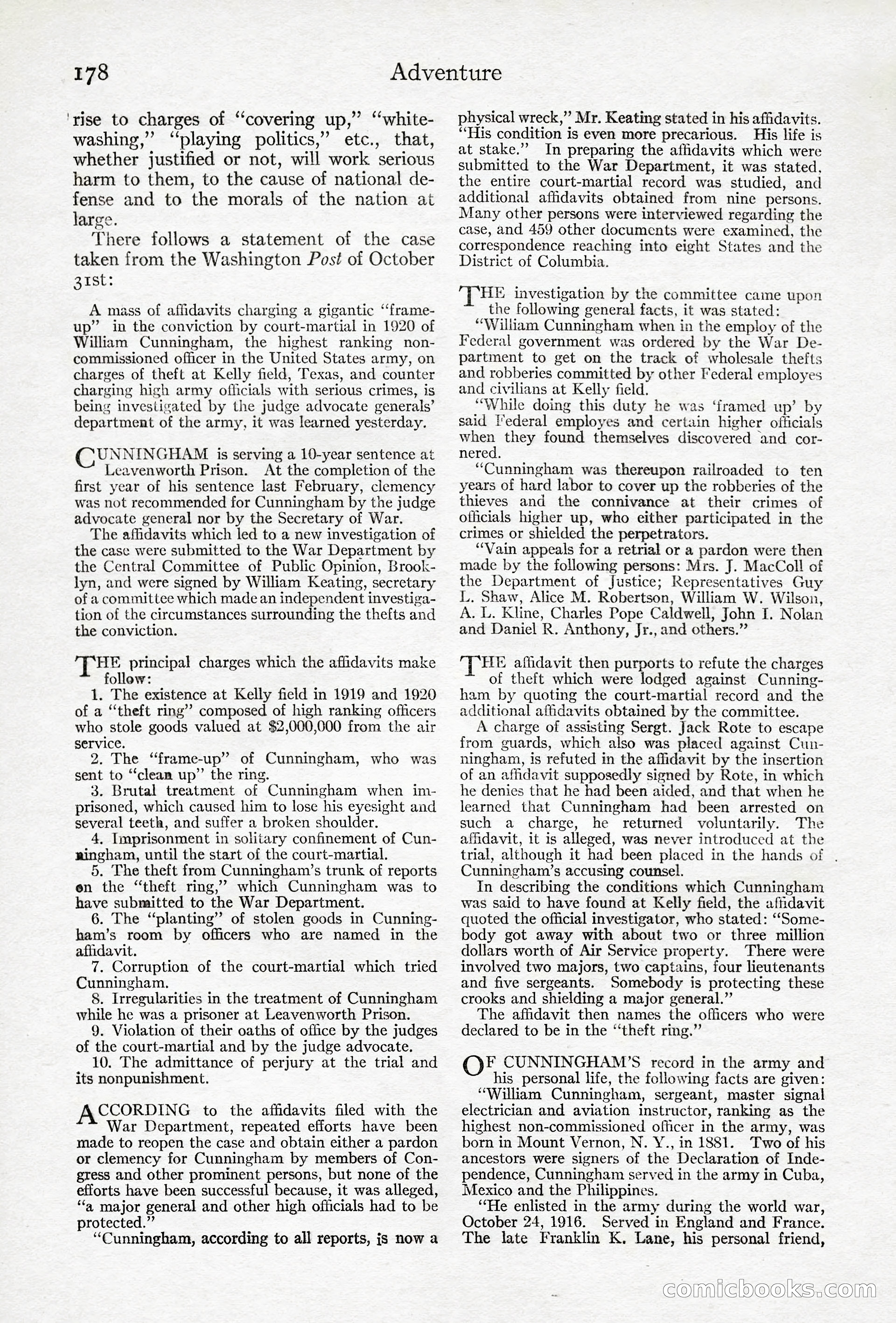
A restored page from Pulp Fiction, 1924. Page through the whole issue in the reader above.
📄 Transcribed text from this page (OCR, searchable)
Machine-transcribed from the original scan — historical spelling and the odd misread are preserved.
178 ‘rise to charges of “covering up,” “‘white- washing,” “‘playing politics,” etc., that, whether justified or not, will work serious harm to them, to the cause of national de- fense and to the morals of the nation at large. There follows a statement of the case taken from the Washington Post of October 31st: A mass of affidavits charging a gigantic ‘“‘frame- up” in the conviction by court-martial in 1920 of William Cunningham, the highest ranking non- commissioned officer in the United States army, on charges of theft at Kelly field, Texas, and counter charging high army officials with serious crimes, is being investigated by the judge advocate generals’ department of the army, it was learned yesterday. (CC UNNINGHAM is serving a 10-year sentence at Leavenworth Prison. At the completion of the first year of his sentence last February, clemency was not recommended for Cunningham by the judge advocate general nor by the Secretary of War. The affidavits which led to a new investigation of the case were submitted to the War Department by the Central Committee of Public Opinion, Brook- lyn, and were signed by William Keating, secretary of a committee which made an independent investiga- tion of the circumstances surrounding the thefts and the conviction. "THE principal charges which the affidavits make follow: 1. The existence at Kelly field in 1919 and 1920 of a “theft ring” composed of high ranking officers who stole goods valued at $2,000,000 from the air service. 2. The “frame-up” of Cunningham, who was sent to “‘cleam up”’ the ring. 3. Brutal treatment of Cunningham when im- prisoned, which caused him to lose his eyesight and several teeth, and suffer a broken shoulder. 4, Imprisonment in solitary confinement of Cun- ningham, until the start of the court-martial. 5. The theft from Cunningham’s trunk of reports en the “theft ring,” which Cunningham was to have submitted to the War Department. 6. The “planting” of stolen goods in Cunning- ham’s room by officers who are named in the affidavit. 7. Corruption of the court-martial which tried Cunningham. 8. Irregularities in the treatment of Cunningham while he was a prisoner at Leavenworth Prison. 9. Violation of their oaths of office by the judges of the court-martial and by the judge advocate. 10. The admittance of perjury at the trial and its nonpunishment. ACCORDING to the affidavits filed with the War Department, repeated efforts have been made to reopen the case and obtain either a pardon or clemency for Cunningham by members of Con- gress and other prominent persons, but none of the efforts have been successful because, it was alleged, ‘“‘a major general and other high officials had to be protected.” “Cunningham, according to all reports, is now a Adventure physical wreck,” Mr. Keating stated in his affidavits. “His condition is even more precarious. His life is at stake.” In preparing the affidavits which were submitted to the War Department, it was stated. the entire court-martial record was studied, and additional affidavits obtained from nine persons. Many other persons were interviewed regarding the case, and 459 other documents were examined, the correspondence reaching into eight States and the District of Columbia. HE investigation by the committee came upon the following general facts, it was stated: “William Cunningham when in the employ of the Federal government was ordered by the War De- partment to get on the track of wholesale thefts and robberies committed by other Federal employes and civilians at Kelly field. “While doing this duty he was ‘framed up’ by said federal employes and certain higher officials aes they found themselves discovered and cor- nered. “Cunningham was thereupon railroaded to ten years of hard labor to cover up the robberies of the thieves and the connivance at their crimes of officials higher up, who either participated in the crimes or shielded the perpetrators. “Vain appeals for a retrial or a pardon were then made by the following persons: Mrs. J. MacColl of the Department of Justice; Representatives Guy L. Shaw, Alice M. Robertson, William W. Wilson, A. L. Kline, Charles Pope Caldwell, John I. Nolan and Daniel R. Anthony, Jr., and others.” THE affidavit then purports to refute the charges of theft which were lodged against Cunning- ham by quoting the court-martial record and the additional affidavits obtained by the committee. A charge of assisting Sergt. Jack Rote to escape from guards, which also was placed against Cun- ningham, is refuted in the affidavit by the insertion of an affidavit supposedly signed by Rote, in which he denies that he had been aided, and that when he learned that Cunningham had been arrested on such a charge, he returned voluntarily. The affidavit, it is alleged, was never introduced at the trial, although it had been placed in the hands of . Cunningham’s accusing counsel. In describing the conditions which Cunningham was said to have found at Kelly field, the affidavit quoted the official investigator, who stated: ‘‘Some- body got away with about two or three million dollars worth of Air Service property. There were involved two majors, two captains, four lieutenants and five sergeants. Somebody is protecting these crooks and shielding a major general.” The affidavit then names the officers who were declared to be in the ‘‘theft ring.” OF CUNNINGHAM’S record in the army and his personal life, the following facts are given: “William Cunningham, sergeant, master signal electrician and aviation instructor, ranking as the highest non-commissioned officer in the army, was born in Mount Vernon, N. Y., in 1881. Two of his ancestors were signers of the Declaration of Inde- pendence, Cunningham served in the army in Cuba, Mexico and the Philippines. “fe enlisted in the army during the world war, October 24, 1916. Served in England and France. The late Franklin K. Lane, his personal friend, GoOmiGcdooksEeo