
Pulp Fiction, 1924 · page 88 of 196
Adventure Magazine, April 10, 1924 — page 88: what you’re looking at
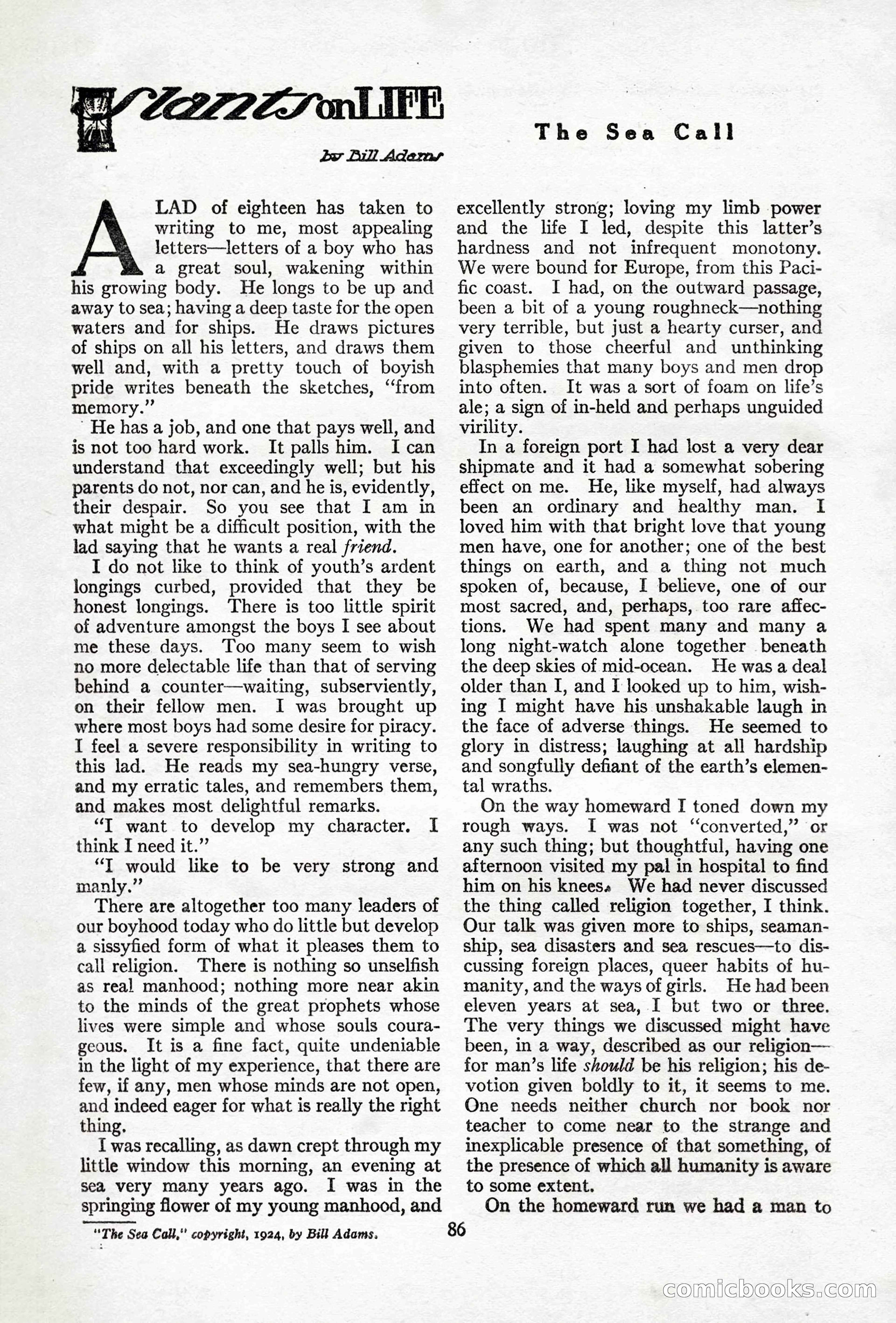
A restored page from Pulp Fiction, 1924. Page through the whole issue in the reader above.
📄 Transcribed text from this page (OCR, searchable)
Machine-transcribed from the original scan — historical spelling and the odd misread are preserved.
LAD of eighteen has taken to writing to me, most appealing letters—letters of a boy who has a great soul, wakening within his growing body. He longs to be up and away to sea; having a deep taste for the open waters and for ships. He draws pictures of ships on all his letters, and draws them well and, with a pretty touch of boyish pride writes beneath the sketches, ‘from memory.” He has a job, and one that pays well, and is not too hard work. It palls him. I can understand that exceedingly well; but his parents do not, nor can, and he is, evidently, their despair. So you see that I am in what might be a difficult position, with the lad saying that he wants a real friend. I do not like to think of youth’s ardent longings curbed, provided that they be honest longings. There is too little spirit of adventure amongst the boys I see about me these days. Too many seem to wish no more delectable life than that of serving behind a counter—waiting, subserviently, on their fellow men. I was brought up where most boys had some desire for piracy. I feel a severe responsibility in writing to this lad. He reads my sea-hungry verse, and my erratic tales, and remembers them, and makes most delightful remarks. “T want to develop my character. I think I need it.” “Tt would like to be very strong and manly.” There are altogether too many leaders of our boyhood today who do little but develop a sissyfied form of what it pleases them to call religion. ‘There is nothing so unselfish as real manhood; nothing more near akin to the minds of the great prophets whose lives were simple and whose souls coura- geous. It is a fine fact, quite undeniable in the light of my experience, that there are few, if any, men whose minds are not open, and indeed eager for what is really the right thing. { was recalling, as dawn crept through my little window this morning, an evening at sea very many years ago. I was in the springing flower of my young manhood, and “The Sea Call," copyright, 1924, by Bill Adams. Gy e772 aL bv Bill Adarns The Sea Call excellently strong; loving my limb power and the life I led, despite this latter’s hardness and not infrequent monotony. We were bound for Europe, from this Paci- fic coast. JI had, on the outward passage, been a bit of a young roughneck—nothing very terrible, but just a hearty curser, and given to those cheerful and unthinking blasphemies that many boys and men drop into often. It was a sort of foam on life’s ale; a sign of in-held and perhaps unguided virility. In a foreign port I had lost a very dear shipmate and it had a somewhat sobering effect on me. He, like myself, had always been an ordinary and healthy man. I loved him with that bright love that young men have, one for another; one of the best things on earth, and a thing not much spoken of, because, I believe, one of our most sacred, and, perhaps, too rare affec- tions. We had spent many and many a long night-watch alone together beneath the deep skies of mid-ocean. He was a deal older than I, and I looked up to him, wish- ing I might have his unshakable laugh in the face of adverse things. He seemed to glory in distress; laughing at all hardship and songfully defiant of the earth’s elemen- tal wraths. On the way homeward I toned down my rough ways. I was not ‘‘converted,” or any such thing; but thoughtful, having one afternoon visited my pal in hospital to find him on his knees» We had never discussed the thing called religion together, I think. Our talk was given more to ships, seaman- ship, sea disasters and sea rescues—to dis- cussing foreign places, queer habits of hu- manity, and the ways of girls. He had been eleven years at sea, I but two or three. The very things we discussed might have been, in a way, described as our religion— for man’s life should be his religion; his de- votion given boldly to it, it seems to me. One needs neither church nor book nor teacher to come near to the strange and inexplicable presence of that something, of the presence of which all humanity is aware to some extent. On the homeward run we had a man to 86 COmiCLOOCkkS.CO©