
Pulp Fiction, 1924 · page 89 of 196
Adventure Magazine, April 10, 1924 — page 89: what you’re looking at
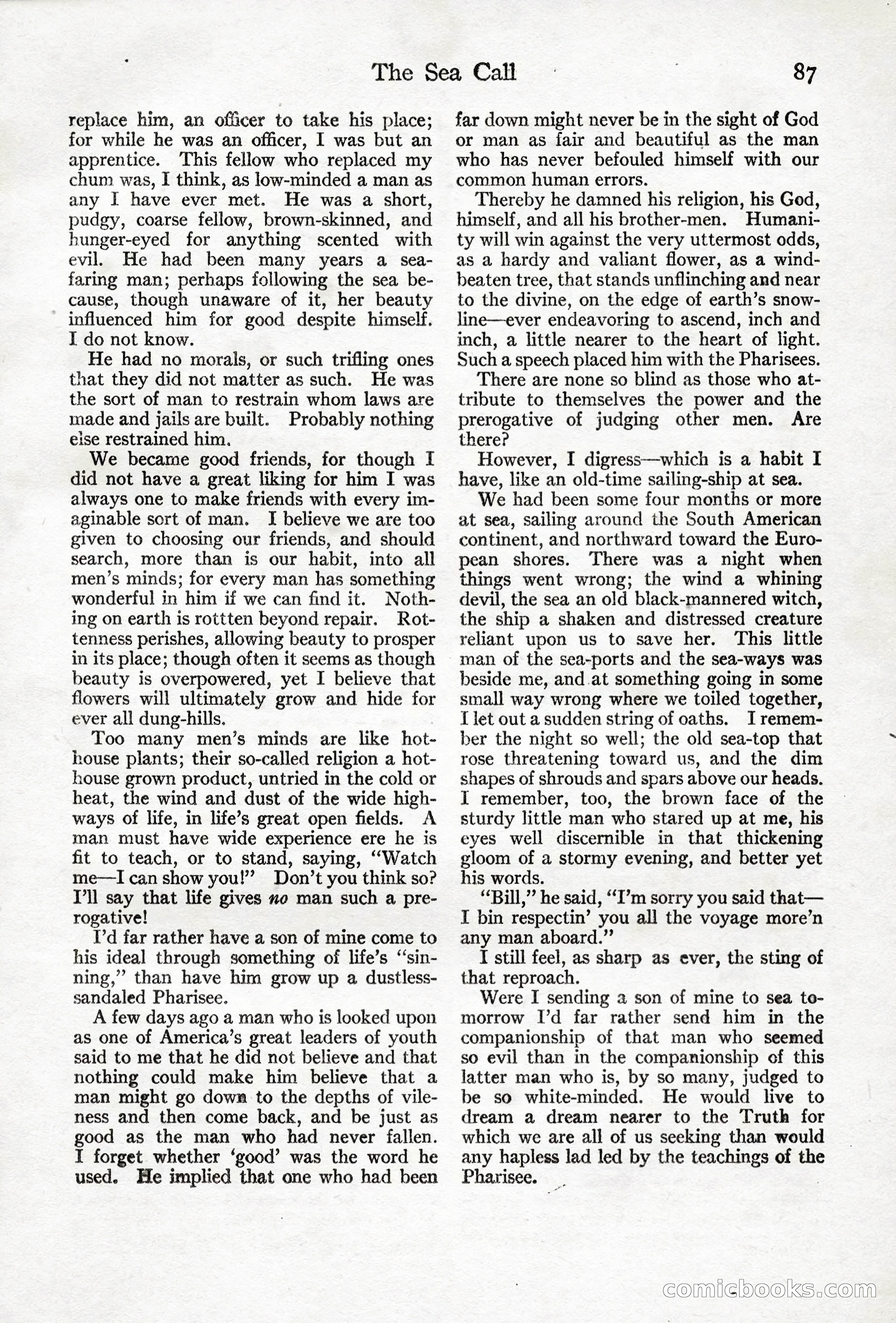
A restored page from Pulp Fiction, 1924. Page through the whole issue in the reader above.
📄 Transcribed text from this page (OCR, searchable)
Machine-transcribed from the original scan — historical spelling and the odd misread are preserved.
The Sea Call | : 87 replace him, an officer to take his place; for while he was an officer, I was but an apprentice. This fellow who replaced my chum was, I think, as low-minded a man as any I have ever met. He was a short, pudgy, coarse fellow, brown-skinned, and hunger-eyed for anything scented with evil. He had been many years a sea- faring man; perhaps following the sea be- cause, though unaware of it, her beauty influenced him for good despite himself. I do not know. He had no morals, or such trifling ones that they did not matter as such. He was the sort of man to restrain whom laws are made and jails are built. Probably nothing eise restrained him. We became good friends, for though I did not have a great liking for him I was always one to make friends with every im- aginable sort of man. I believe we are too given to choosing our friends, and should search, more than is our habit, into all men’s minds; for every man has something wonderful in him if we can find it. Noth- ing on earth is rottten beyond repair. Rot- tenness perishes, allowing beauty to prosper in its place; though often it seems as though beauty is overpowered, yet I believe that flowers will ultimately grow and hide for ever all dung-hills, Too many men’s minds are like hot- house plants; their so-called religion a hot- house grown product, untried in the cold or heat, the wind and dust of the wide high- ways of life, in life’s great open fields. A man must have wide experience ere he is fit to teach, or to stand, saying, “Watch me—lI can show you!”’ Don’t you think so? T’ll say that life gives xo man such a pre- rogative! I’d far rather have a son of mine come to his ideal through something of life’s “‘sin- ning,” than have him grow up a dustless- sandaled Pharisee. A few days ago a man who is looked upon as one of America’s great leaders of youth said to me that he did not believe and that nothing could make him believe that a man might go down to the depths of vile- ness and then come back, and be just as good as the man who had never fallen. I forget whether ‘good’ was the word he used. He implied that one who had been far down might never be in the sight of God or man as fair and beautiful as the man who has never befouled himself with our common human errors. Thereby he damned his religion, his God, himself, and all his brother-men. Humani- ty will win against the very uttermost odds, as a hardy and valiant flower, as a wind- beaten tree, that stands unflinching and near to the divine, on the edge of earth’s snow- line—ever endeavoring to ascend, inch and inch, a little nearer to the heart of light. Such a speech placed him with the Pharisees. There are none so blind as those who at- tribute to themselves the power and the prerogative of judging other men. Are there? However, I digress—which is a habit I have, like an old-time sailing-ship at sea. We had been some four months or more at sea, sailing around the South American continent, and northward toward the Euro- pean shores. There was a night when things went wrong; the wind a whining devil, the sea an old black-mannered witch, the ship a shaken and distressed creature reliant upon us to save her. This little man of the sea-ports and the sea-ways was beside me, and.at something going in some small way wrong where we toiled together, { let out a sudden string of oaths. I remem- ber the night so well; the old sea-top that rose threatening toward us, and the dim shapes of shrouds and spars above our heads. I remember, too, the brown face of the sturdy little man who stared up at me, his eyes well discernible in that thickening gloom of a stormy evening, and better yet his words. “Bill,” he said, “I’m sorry you said that— I bin respectin’ you all the voyage more’n any man aboard.” I still feel, as sharp as ever, the sting of that reproach. Were I sending a son of mine to sea to- morrow I’d far rather send him in the companionship of that man who seemed so evil than in the companionship of this latter man who is, by so many, judged to be so white-minded. He would live to dream a dream nearer to the Truth for which we are all of us seeking than would any hapless lad led by the teachings of the Pharisee. . COMiGCLOOCKKS. CO S|