
Pulp Fiction, 1924 · page 187 of 204
Adventure Magazine Cover — page 187: what you’re looking at
A restored page from Pulp Fiction, 1924. Page through the whole issue in the reader above.
📄 Transcribed text from this page (OCR, searchable)
Machine-transcribed from the original scan — historical spelling and the odd misread are preserved.
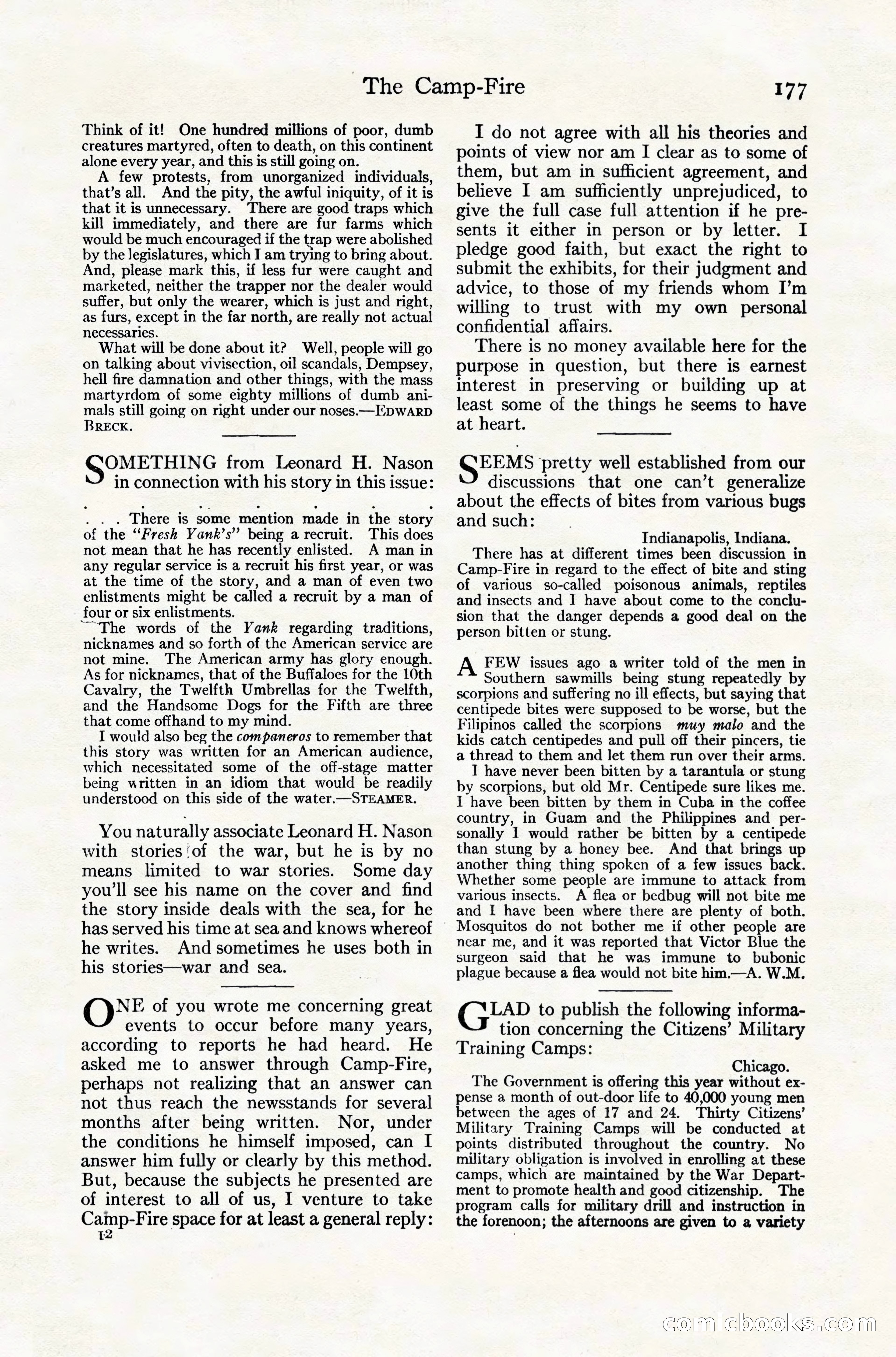
~The Camp-Fire Think of it! One hundred millions of poor, dumb creatures martyred, often to death, on this continent alone every year, and this is still going on. A few protests, from unorganized individuals, that’s all. And the pity, the awful iniquity, of it is that it is unnecessary. There are good traps which kill immediately, and there are fur farms which would be much encouraged if the trap were abolished by the legislatures, which I am trying to bring about. And, please mark this, if less fur were caught and marketed, neither the trapper nor the dealer would suffer, but only the wearer, which is just and right, as furs, except in the far north, are really not actual necessaries. What will be done about it? Well, people will go on talking about vivisection, oil scandals, Dempsey, hell fire damnation and other things, with the mass martyrdom of some eighty millions of dumb ani- mals still going on right under our noses.—EDWARD BRECK. OMETHING from Leonard H. Nason in connection with his story in this issue: _. There is some mention made in the story of the “Fresh Yank’s” being a recruit. This does not mean that he has recently enlisted. A man in any regular service is a recruit his first year, or was at the time of the story, and a man of even two enlistments might be called a recruit by a man of four or six enlistments. ~The words of the Yank regarding traditions, nicknames and so forth of the American service are not mine. The American army has glory enough. As for nicknames, that of the Buffaloes for the 10th Cavalry, the Twelfth Umbrellas for the Twelfth, and the Handsome Dogs for the Fifth are three that come ofthand to my mind. I would also beg the com paneros to remember that this story was written for an American audience, which necessitated some of the off-stage matter being written in an idiom that would be readily understood on this side of the water.—STEAMER. You naturally associate Leonard H. Nason with stories‘of the war, but he is by no means limited to war stories. Some day you'll see his name on the cover and find the story inside deals with the sea, for he has served his time at sea and knows whereof he writes. And sometimes he uses both in his stories—war and sea. Cy of you wrote me concerning great events to occur before many years, according to reports he had heard. He asked me to answer through Camp-Fire, perhaps not realizing that an answer can not thus reach the newsstands for several months after being written. Nor, under the conditions he himself imposed, can I answer him fully or clearly by this method. But, because the subjects he presented are of interest to all of us, I venture to take Camp-Fire space for at least a general reply: T 177 I do not agree with all his theories and points of view nor am I clear as to some of them, but am in sufficient agreement, and believe I am sufficiently unprejudiced, to give the full case full attention if he pre- sents it either in person or by letter. I pledge good faith, but exact the right to submit the exhibits, for their judgment and advice, to those of my friends whom I’m willing to trust with my own personal confidential affairs. There is no money available here for the purpose in question, but there is earnest interest in preserving or building up at least some of the things he seems to have at heart. SEM ‘pretty well established from our discussions that one can’t generalize about the effects of bites from various bugs and such: Indianapolis, Indiana. There has at different times been discussion in Camp-Fire in regard to the effect of bite and sting of various so-called poisonous animals, reptiles and insects and J have about come to the conclu- sion that the danger depends a good deal on the person bitten or stung. A FEW issues ago a writer told of the men in Southern sawmills being stung repeatedly by scorpions and suffering no ill effects, but saying that centipede bites were supposed to be worse, but the Filipinos called the scorpions muy malo and the kids catch centipedes and pull off their pincers, tie a thread to them and let them run over their arms. ] have never been bitten by a tarantula or stung by scorpions, but old Mr. Centipede sure likes me. I have been bitten by them in Cuba in the coffee country, in Guam and the Philippines and per- sonally I would rather be bitten by a centipede than stung by a honey bee. And that brings up another thing thing spoken of a few issues back. Whether some people are immune to attack from various insects. A flea or bedbug will not bite me and I have been where there are plenty of both. Mosquitos do not bother me if other people are near me, and it was reported that Victor Blue the surgeon said that he was immune to bubonic plague because a flea would not bite him.—A. W.M. ( dh to publish the following informa- tion concerning the Citizens’ Military Training Camps: Chicago. The Government is offering this year without ex- pense a month of out-door life to 40,000 young men between the ages of 17 and 24. Thirty Citizens’ Military Training Camps will be conducted at points distributed throughout the country. No military obligation is involved in enrolling at these camps, which are maintained by the War Depart- ment to promote health and good citizenship. The program calls for military drill and instruction in the forenoon; the afternoons are given to a variety LOOOLK C@