
Pulp Fiction, 1924 · page 188 of 204
Adventure Magazine Cover — page 188: what you’re looking at
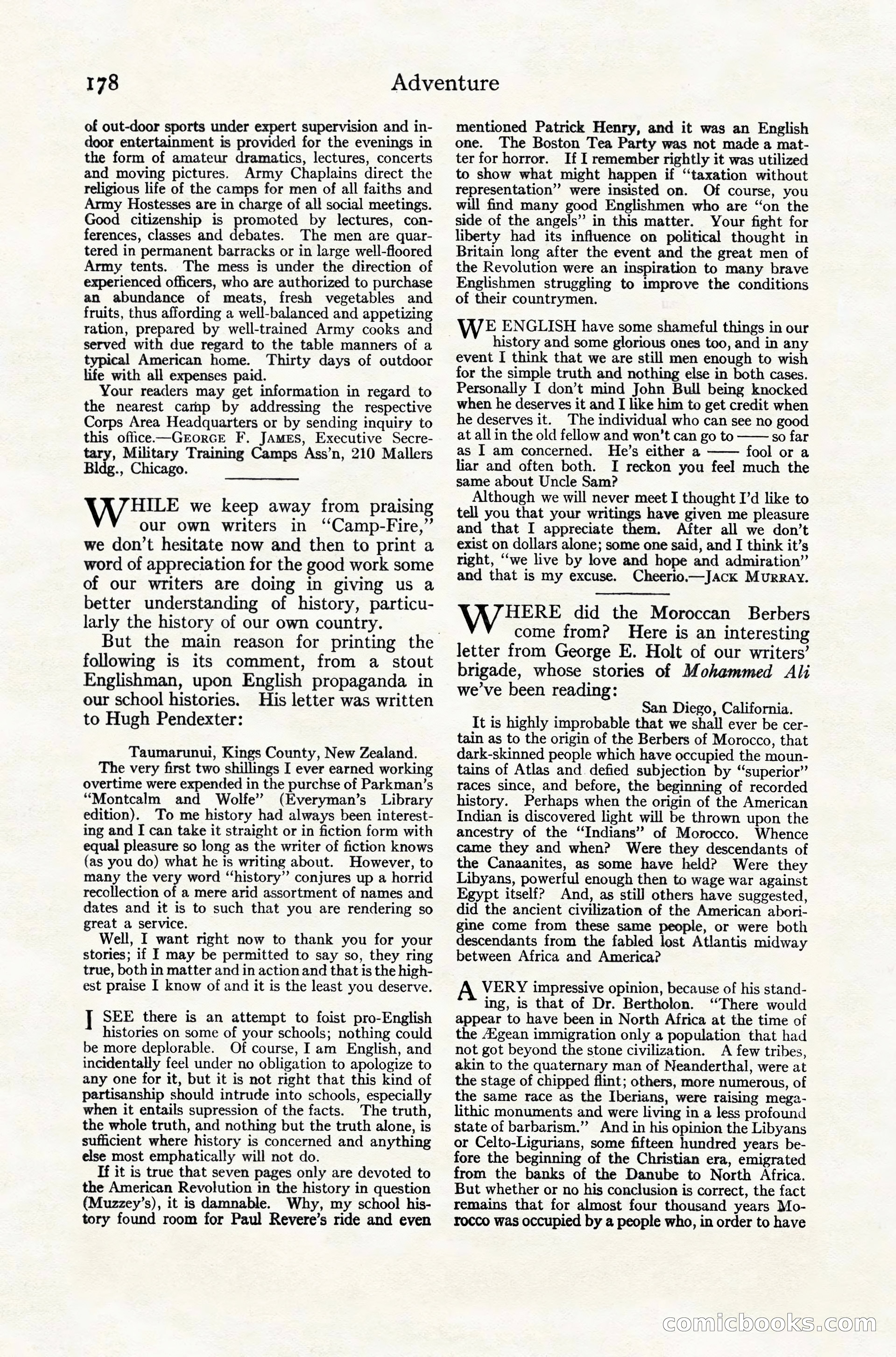
A restored page from Pulp Fiction, 1924. Page through the whole issue in the reader above.
📄 Transcribed text from this page (OCR, searchable)
Machine-transcribed from the original scan — historical spelling and the odd misread are preserved.
178 of out-door sports under expert supervision and in- door entertainment is provided for the evenings in the form of amateur dramatics, lectures, concerts and moving pictures. Army Chaplains direct the religious life of the camps for men of all faiths and Army Hostesses are in charge of all social meetings. Good citizenship is promoted by lectures, con- ferences, classes and debates. The men are quar- tered in permanent barracks or in large well-floored Army tents. The mess is under the direction of experienced officers, who are authorized to purchase an abundance of meats, fresh vegetables and fruits, thus affording a well-balanced and appetizing ration, prepared by well-trained Army cooks and served with due regard to the table manners of a typical American home. Thirty days of outdoor life with all expenses paid. Your readers may get information in regard to the nearest carnp by addressing the respective Corps Area Headquarters or by sending inquiry to this office—GrorGE F. JAmEs, Executive Secre- tary, Military Training Camps Ass’n, 210 Mallers Bldg., Chicago. HILE we keep away from praising our own writers in ‘“Camp-Fire,” we don’t hesitate now and then to print a word of appreciation for the good work some of our writers are doing in giving us a better understanding of history, particu- larly the history of our own country. But the main reason for printing the following is its comment, from a stout Englishman, upon English propaganda in our school histories. His letter was written to Hugh Pendexter: Taumarunui, Kings County, New Zealand. The very first two shillings I ever earned working overtime were expended in the purchse of Parkman’s “Montcalm and Wolfe” (Everyman’s Library edition). To me history had always been interest- ing and I can take it straight or in fiction form with equal pleasure so long as the writer of fiction knows (as you do) what he is writing about. However, to many the very word “history” conjures up a horrid recollection of a mere arid assortment of names and dates and it is to such that you are rendering so great a service. Well, I want right now to thank you for your stories; if I may be permitted to say so, they ring true, both in matter and in action and that is the high- est praise I know of and it is the least you deserve. SEE there is an attempt to foist pro-English histories on some of your schools; nothing could be more deplorable. Of course, I am English, and incidentally feel under no obligation to apologize to any one for it, but it is not right that this kind of partisanship should intrude into schools, especially when it entails supression of the facts. The truth, the whole truth, and nothing but the truth alone, is sufficient where history is concerned and anything else most emphatically will not do. If it is true that seven pages only are devoted to the American Revolution in the history in question (Muzzey’s), it is damnable. Why, my school his- tory found room for Paul Revere’s ride and even Adventure mentioned Patrick Henry, and it was an English one. The Boston Tea Party was not made a mat- ter for horror. If I remember rightly it was utilized to show what might happen if “taxation without representation” were insisted on. Of course, you will find many good Englishmen who are “on the side of the angels” in this matter. Your fight for liberty had its influence on political thought in Britain long after the event and the great men of the Revolution were an inspiration to many brave Englishmen struggling to improve the conditions of their countrymen. WE ENGLISH have some shameful things in our history and some glorious ones too, and in any event [ think that we are still men enough to wish for the simple truth and nothing else in both cases. Personally I don’t mind John Bull being knocked when he deserves it and I like him to get credit when he deserves it. The individual who can see no good at all in the old fellow and won’t can go to —— so far as I am concerned. He’s either a fool or a liar and often both. I reckon you feel much the same about Uncle Sam? Although we will never meet I thought I’d like to tell you that your writings have given me pleasure and that I appreciate them. After all we don’t exist on dollars alone; some one said, and I think it’s right, ‘we live by love and hope and admiration” and that is my excuse. Cheerio.—JAck MuRRAY. HERE did the Moroccan Berbers come from? Here is an interesting letter from George E. Holt of our writers’ brigade, whose stories of Mohammed Ali we’ve been reading: San Diego, California. It is highly improbable that we shall ever be cer- tain as to the origin of the Berbers of Morocco, that dark-skinned people which have occupied the moun- tains of Atlas and defied subjection by “superior” races since, and before, the beginning of recorded history. Perhaps when the origin of the American Indian is discovered light will be thrown upon the ancestry of the “Indians” of Morocco. Whence came they and when? Were they descendants of the Canaanites, as some have held? Were they Libyans, powerful enough then to wage war against Egypt itself? And, as still others have suggested, did the ancient civilization of the American abori- gine come from these same people, or were both descendants from the fabled lost Atlantis midway between Africa and America? A VERY impressive opinion, because of his stand- ing, is that of Dr. Bertholon. “There would appear to have been in North Africa at the time of the Agean immigration only a population that had not got beyond the stone civilization. A few tribes, akin to the quaternary man of Neanderthal, were at the stage of chipped flint; others, more numerous, of the same race as the Iberians, were raising mega- lithic monuments and were living in a less profound state of barbarism.” And in his opinion the Libyans or Celto-Ligurians, some fifteen hundred years be- fore the beginning of the Christian era, emigrated from the banks of the Danube to North Africa. But whether or no his conclusion is correct, the fact remains that for almost four thousand years Mo- rocco was occupied by a people who, in order to have NOOK @) (©