
Pulp Fiction, 1924 · page 190 of 204
Adventure Magazine Cover, October 30, 1924 — page 190: what you’re looking at
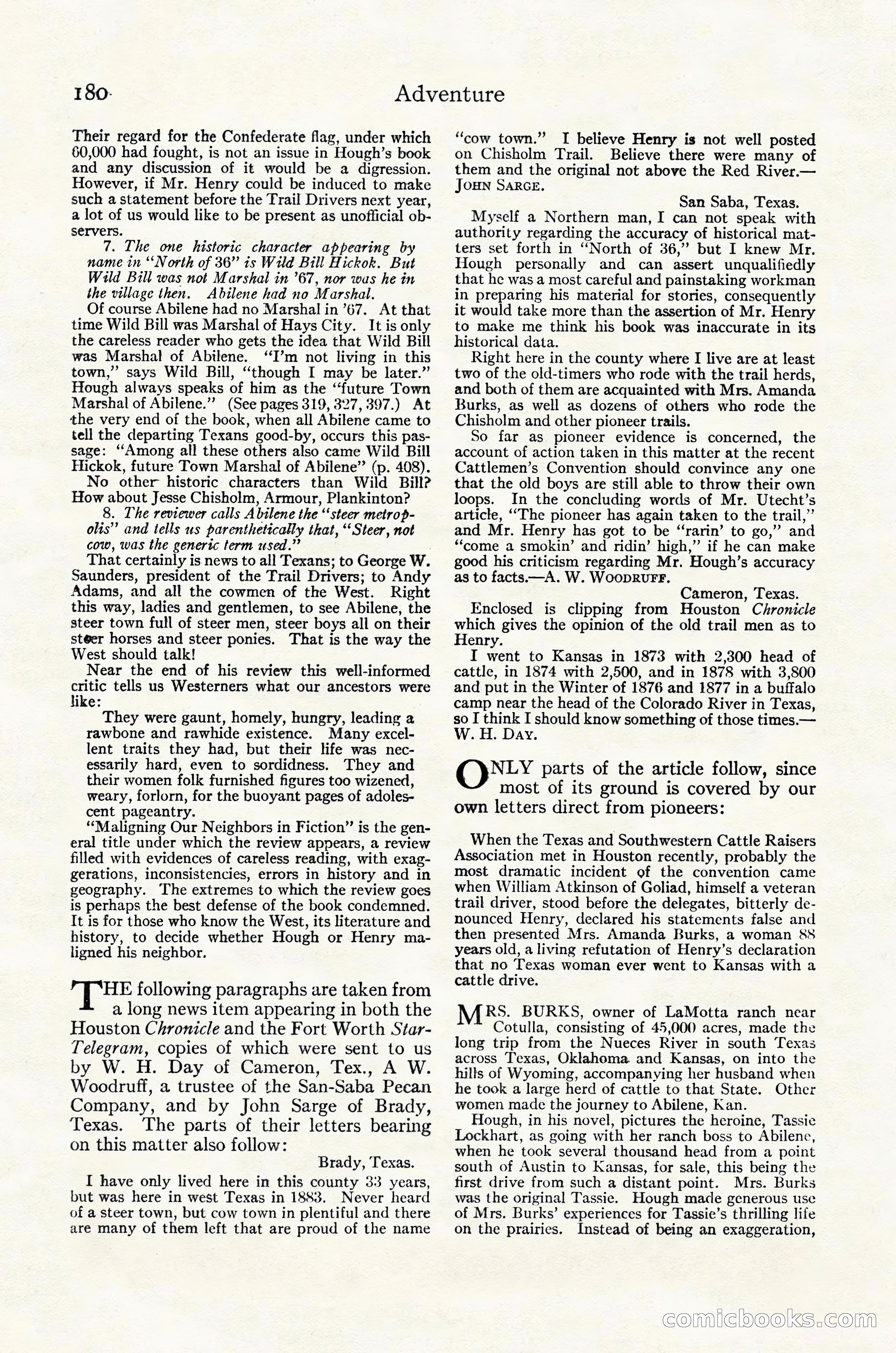
A restored page from Pulp Fiction, 1924. Page through the whole issue in the reader above.
📄 Transcribed text from this page (OCR, searchable)
Machine-transcribed from the original scan — historical spelling and the odd misread are preserved.
18O- Their regard for the Confederate flag, under which 60,000 had fought, is not an issue in Hough’s book and any discussion of it would be a digression. However, if Mr. Henry could be induced to make such a statement before the Trail Drivers next year, a lot of us would like to be present as unofficial ob- servers. 7. The one historic character appearing by name in ‘‘North of 36” is Wild Bill Hickok. But Wild Bill was not Marshal in ’67, nor was he in the village then. Abilene had no Marshal. Of course Abilene had no Marshal in ’67. At that time Wild Bill was Marshal of Hays City. It is only the careless reader who gets the idea that Wild Bill was Marshal of Abilene. “I’m not living in this town,” says Wild Bill, “though I may be later.” Hough always speaks of him as the “future Town Marshal of Abilene.” (See pages 319, 327, 397.) At the very end of the book, when all Abilene came to tell the departing Texans good-by, occurs this pas- sage: ‘‘Among all these others also came Wild Bill Hickok, future Town Marshal of Abilene”? (p. 408). No other historic characters than Wild Bill? How about Jesse Chisholm, Armour, Plankinton? 8. The reviewer calls Abilene the ‘steer metrop- olis”’ and tells us parenthetically that, ‘Steer, not cow, was the generic term used.”’ That certainly is news to all Texans; to George W. Saunders, president of the Trail Drivers; to Andy Adams, and all the cowmen of the West. Right this way, ladies and gentlemen, to see Abilene, the steer town full of steer men, steer boys all on their steer horses and steer ponies. That is the way the West should talk! Near the end of his review this well-informed cout tells us Westerners what our ancestors were ike: They were gaunt, homely, hungry, leading a rawbone and rawhide existence. Many excel- lent traits they had, but their life was nec- essarily hard, even to sordidness. They and their women folk furnished figures too wizened, weary, forlorn, for the buoyant pages of adoles- cent pageantry. ““Maligning Our Neighbors in Fiction’’ is the gen- eral title under which the review appears, a review filled with evidences of careless reading, with exag- gerations, inconsistencies, errors in history and in geography. The extremes to which the review goes is perhaps the best defense of the book condemned. It is for those who know the West, its literature and history, to decide whether Hough or Henry ma- ligned his neighbor. oT HE following paragraphs are taken from a long news item appearing in both the Houston Chronicle and the Fort Worth Star- Telegram, copies of which were sent to us by W. H. Day of Cameron, Tex., A W. Woodruff, a trustee of the San-Saba Pecan Company, and by John Sarge of Brady, Texas. The parts of their letters bearing on this matter also follow: Brady, Texas. I have only lived here in this county 33 years, but was here in west Texas in 1883. Never heard of a steer town, but cow town in plentiful and there are many of them left that are proud of the name Adventure “cow town.” I believe Henry is not well posted on Chisholm Trail. Believe there were many of them and the original not above the Red River.— JOHN SARGE. San Saba, Texas. Myself a Northern man, I can not speak with authority regarding the accuracy of historical mat- ters set forth in “North of 36,” but I knew Mr. Hough personally and can assert unqualifiedly that he was a most careful and painstaking workman in preparing his material for stories, consequently it would take more than the assertion of Mr. Henry to make me think his book was inaccurate in its historical data. Right here in the county where I live are at least two of the old-timers who rode with the trail herds, and both of them are acquainted with Mrs. Amanda Burks, as well as dozens of others who rode the Chisholm and other pioneer trails. So far as pioneer evidence is concerned, the account of action taken in this matter at the recent Cattlemen’s Convention should convince any one that the old boys are still able to throw their own loops. In the concluding words of Mr. Utecht’s article, ‘“The pioneer has again taken to the trail,”’ and Mr. Henry has got to be “rarin’ to go,” and ‘come a smokin’ and ridin’ high,” if he can make good his criticism regarding Mr. Hough’s accuracy as to facts.—A. W. WooDRUFF. Cameron, Texas. Enclosed is clipping from Houston Chronicle which gives the opinion of the old trail men as to Henry. I went to Kansas in 1873 with 2,300 head of cattle, in 1874 with 2,500, and in 1878 with 3,800 and put in the Winter of 1876 and 1877 in a buffalo camp near the head of the Colorado River in Texas, so I think I should know something of those times.— W. H. Day. Ones parts of the article follow, since most of its ground is covered by our own letters direct from pioneers: When the Texas and Southwestern Cattle Raisers Association met in Houston recently, probably the most dramatic incident of the convention came when William Atkinson of Goliad, himself a veteran trail driver, stood before the delegates, bitterly de- nounced Henry, declared his statements false and then presented Mrs. Amanda Burks, a woman &S years old, a living refutation of Henry’s declaration that no Texas woman ever went to Kansas with a cattle drive. RS. BURKS, owner of LaMotta ranch near Cotulla, consisting of 45,000 acres, made the long trip from the Nueces River in south Texas across Texas, Oklahoma and Kansas, on into the hills of Wyoming, accompanying her husband when he took a large herd of cattle to that State. Other women made the journey to Abilene, Kan. Hough, in his novel, pictures the heroine, Tassie Lockhart, as going with her ranch boss to Abilene, when he took several thousand head from a point south of Austin to Kansas, for sale, this being the first drive from such a distant point. Mrs. Burks was the original Tassie. Hough made generous use of Mrs. Burks’ experiences for Tassie’s thrilling life on the prairies. Instead of being an exaggeration, CoOmiclbooks