
Pulp Fiction, 1924 · page 191 of 204
Adventure Magazine Cover, October 30, 1924 — page 191: what you’re looking at
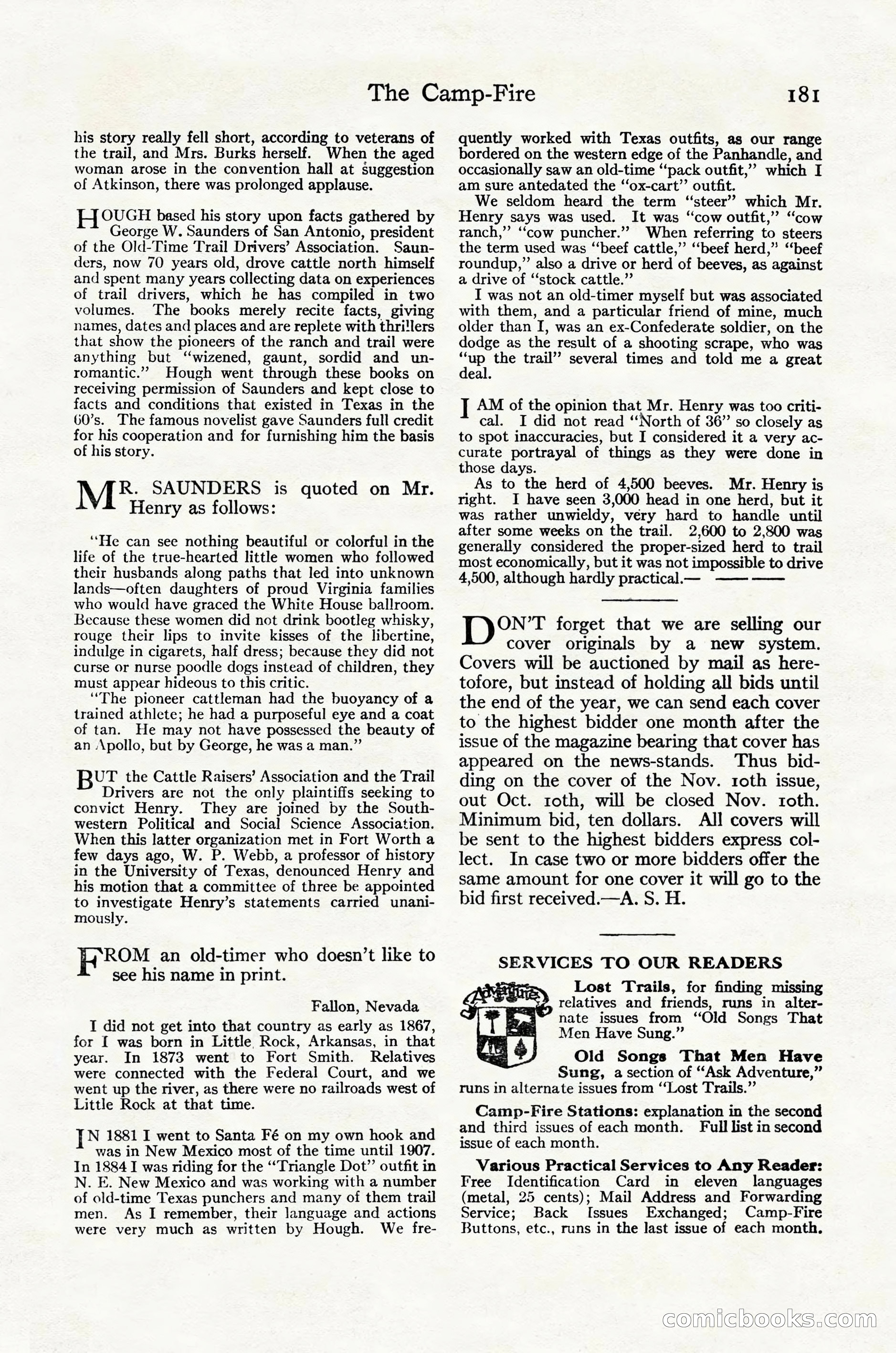
A restored page from Pulp Fiction, 1924. Page through the whole issue in the reader above.
📄 Transcribed text from this page (OCR, searchable)
Machine-transcribed from the original scan — historical spelling and the odd misread are preserved.
The Camp-Fire his story really fell short, according to veterans of the trail, and Mrs. Burks herself. When the aged woman arose in the convention hall at suggestion of Atkinson, there was prolonged applause. OUGH based his story upon facts gathered by George W. Saunders of San Antonio, president of the Old-Time Trail Drivers’ Association. Saun- ders, now 70 years old, drove cattle north himself and spent many years collecting data on experiences of trail drivers, which he has compiled in two volumes. The books merely recite facts, giving names, dates and places and are replete with thri'lers that show the pioneers of the ranch and trail were anything but ‘“‘wizened, gaunt, sordid and un- romantic.” Hough went through these books on receiving permission of Saunders and kept close to facts and conditions that existed in Texas in the 60’s. The famous novelist gave Saunders full credit for his cooperation and for furnishing him the basis of his story. ME: SAUNDERS is quoted on Mr. Henry as follows: ‘‘He can see nothing beautiful or colorful in the life of the true-hearted little women who followed their husbands along paths that led into unknown lands—often daughters of proud Virginia families who would have graced the White House ballroom. Because these women did not drink bootleg whisky, rouge their lips to invite kisses of the libertine, indulge in cigarets, half dress; because they did not curse or nurse poodle dogs instead of children, they must appear hideous to this critic. “The pioneer cattleman had the buoyancy of a trained athlete; he had a purposeful eye and a coat of tan. He may not have possessed the beauty of an .\pollo, but by George, he was a man.”’ Rut the Cattle Raisers’ Association and the Trail Drivers are not the only plaintiffs seeking to convict Henry. They are joined by the South- western Political and Social Science Association. When this latter organization met in Fort Worth a few days ago, W. P. Webb, a professor of history in the University of Texas, denounced Henry and his motion that a committee of three be appointed to investigate Henry’s statements carried unani- mously. ROM an old-timer who doesn’t like to see his name in print. Fallon, Nevada I did not get into that country as early as 1867, for I was born in Little Rock, Arkansas, in that year. In 1873 went to Fort Smith. Relatives were connected with the Federal Court, and we went up the river, as there were no railroads west of Little Rock at that time. [IN 1881 I went to Santa Fé on my own hook and was in New Mexico most of the time until 1907. In 1884 I was riding for the “Triangle Dot” outfit in N. E. New Mexico and was working with a number of old-time Texas punchers and many of them trail men. As I remember, their language and actions were very much as written by Hough. We fre- 18I quently worked with Texas outfits, as our range bordered on the western edge of the Panhandle, and occasionally saw an old-time “pack outfit,” which I am sure antedated the “‘ox-cart’’ outfit. We seldom heard the term ‘steer’ which Mr. Henry says was used. It was “cow outfit,” “cow ranch,” ‘‘cow puncher.’”’ When referring to steers the term used was “‘beef cattle,” ‘beef herd,” “beef roundup,” also a drive or herd ‘of beeves, as against a drive of ‘‘stock cattle.” I was not an old-timer myself but was associated with them, and a particular friend of mine, much older than I, was an ex-Confederate soldier, on the dodge as the result of a shooting scrape, who was “up the trail” several times and told me a great deal. | AM of the opinion that Mr. Henry was too criti- cal. I did not read ‘North of 36” so closely as to spot inaccuracies, but I considered it a very ac- curate portrayal of things as they were done in those days. As to the herd of 4,500 beeves. Mr. Henry is right. I have seen 3 000 head in one herd, but it was rather unwieldy, very hard to handle until after some weeks on the trail. 2,600 to 2,800 was generally considered the proper-sized herd to trail most economically, but it was not impossible to drive 4,500, although hardly practical — ———— Eos *T forget that we are selling our cover originals by a new system. Covers will be auctioned by mail as here- tofore, but instead of holding all bids until the end of the year, we can send each cover to the highest bidder one month after the issue of the magazine bearing that cover has appeared on the news-stands. Thus bid- ding on the cover of the Nov. roth issue, out Oct. roth, will be closed Nov. roth. Minimum bid, ten dollars. All covers will be sent to the highest bidders express col- lect. In case two or more bidders offer the same amount for one cover it will go to the bid first received.—A. S. H. SERVICES TO OUR READERS Lost Trails, for finding missing 7 relatives and friends, runs in alter- nate issues from “Old Songs That Men Have Sung.” Old Songs That Men Have Sung, a section of “Ask Adventure,” runs in alternate issues from ‘‘Lost Trails.” Camp-Fire Stations: explanation in the second and third issues of each month. Full list in second issue of each month. Various Practical Services to Any Reader: Free Identification Card in eleven languages (metal, 25 cents); Mail Address and Forwarding Service; Back Issues Exchanged; Camp-Fire Buttons, etc., runs in the last issue of each month. 1DOOLK (© inn