
Pulp Fiction, 1924 · page 166 of 216
Adventure Magazine, December 10, 1924 — page 166: what you’re looking at
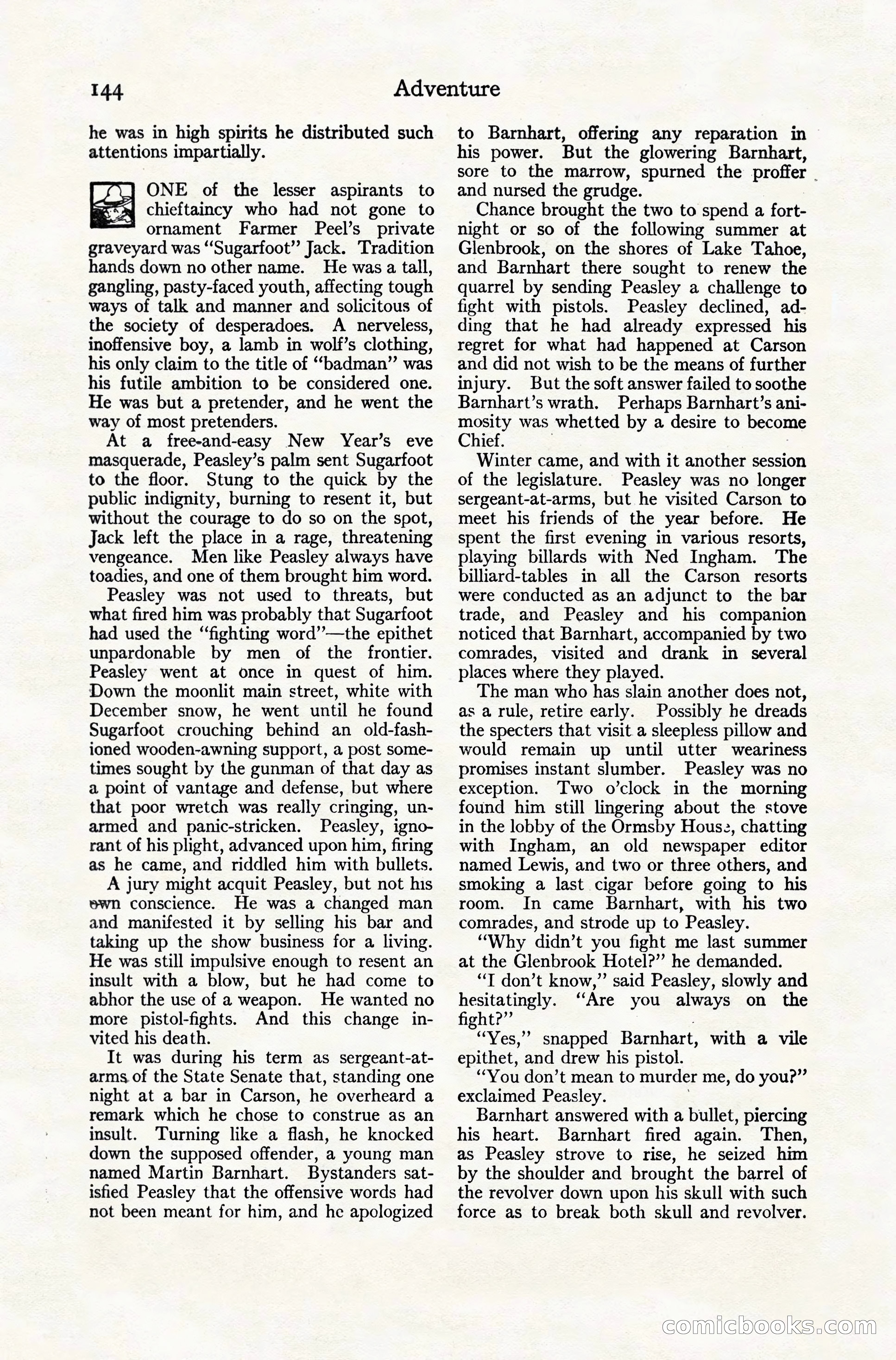
A restored page from Pulp Fiction, 1924. Page through the whole issue in the reader above.
📄 Transcribed text from this page (OCR, searchable)
Machine-transcribed from the original scan — historical spelling and the odd misread are preserved.
144 he was in high spirits he distributed such attentions impartially. ,] ONE of the lesser aspirants to x<x chieftaincy who had not gone to =<! ornament Farmer Peel’s private graveyard was “‘Sugarfoot” Jack. Tradition hands down no other name. He was a tall, gangling, pasty-faced youth, affecting tough ways of talk and manner and solicitous of the society of desperadoes. A nerveless, inoffensive boy, a lamb in wolf’s clothing, his only claim to the title of ‘‘badman”’ was his futile ambition to be considered one. He was but a pretender, and he went the way of most pretenders. At a free-and-easy New Year’s eve masquerade, Peasley’s palm sent Sugarfoot to the floor. Stung to the quick by the public indignity, burning to resent it, but without the courage to do so on the spot, Jack left the place in a rage, threatening vengeance. Men like Peasley always have toadies, and one of them brought him word. Peasley was not used to threats, but what fired him was probably that Sugarfoot had used the “fighting word’’—the epithet unpardonable by men of the frontier. Peasley went at once in quest of him. Down the moonlit main street, white with December snow, he went until he found Sugarfoot crouching behind an old-fash- ioned wooden-awning support, a post some- times sought by the gunman of that day as a point of vantage and defense, but where that poor wretch was really cringing, un- armed and panic-stricken. Peasley, igno- rant of his plight, advanced upon him, firing as he came, and riddled him with bullets. A jury might acquit Peasley, but not his sewn conscience. He was a changed man and manifested it by selling his bar and taking up the show business for a living. He was still impulsive enough to resent an insult with a blow, but he had come to abhor the use of a weapon. He wanted no more pistol-fghts. And this change in- vited his death. It was during his term as sergeant-at- arms of the State Senate that, standing one night at a bar in Carson, he overheard a remark which he chose to construe as an insult. Turning like a flash, he knocked down the supposed offender, a young man named Martin Barnhart. Bystanders sat- isfied Peasley that the offensive words had not been meant for him, and he apologized Adventure to Barnhart, offering any reparation in his power. But the glowering Barnhart, sore to the marrow, spurned the proffer . and nursed the grudge. Chance brought the two to spend a fort- night or so of the following summer at Glenbrook, on the shores of Lake Tahoe, and Barnhart there sought to renew the quarrel by sending Peasley a challenge to fight with pistols. Peasley declined, ad- ding that he had already expressed his regret for what had happened at Carson and did not wish to be the means of further injury. But the soft answer failed to soothe Barnhart’s wrath. Perhaps Barnhart’s ani- mosity was whetted by a desire to become Chief. : Winter came, and with it another session of the legislature. Peasley was no longer sergeant-at-arms, but he visited Carson to meet his friends of the year before. He spent the first evening in various resorts, playing billards with Ned Ingham. The billiard-tables in all the Carson resorts were conducted as an adjunct to the bar trade, and Peasley and his companion noticed that Barnhart, accompanied by two comrades, visited and drank in several places where they played. The man who has slain another does not, as a rule, retire early. Possibly he dreads the specters that visit.a sleepless pillow and would remain up until utter weariness promises instant slumber. Peasley was no exception. Two o’clock in the morning found him still lingering about the stove in the lobby of the Ormsby House, chatting with Ingham, an old newspaper editor named Lewis, and two or three others, and smoking a last cigar before going to his room. In came Barnhart, with his two comrades, and strode up to Peasley. “Why didn’t you fight me last summer at the Glenbrook Hotel?” he demanded. “T don’t know,” said Peasley, slowly and hesitatingly. ‘‘Are you always on the fight?” “Ves,” snapped Barnhart, with a vile epithet, and drew his pistol. ‘“‘You don’t mean to murder me, do you?”’ exclaimed Peasley. Barnhart answered with a bullet, piercing his heart. Barnhart fired again. Then, as Peasley strove to rise, he seized him by the shoulder and brought the barrel of the revolver down upon his skull with such force as to break both skull and revolver. CoOMmiclhook Wh) CO 5}