
Pulp Fiction, 1924 · page 167 of 216
Adventure Magazine, December 10, 1924 — page 167: what you’re looking at
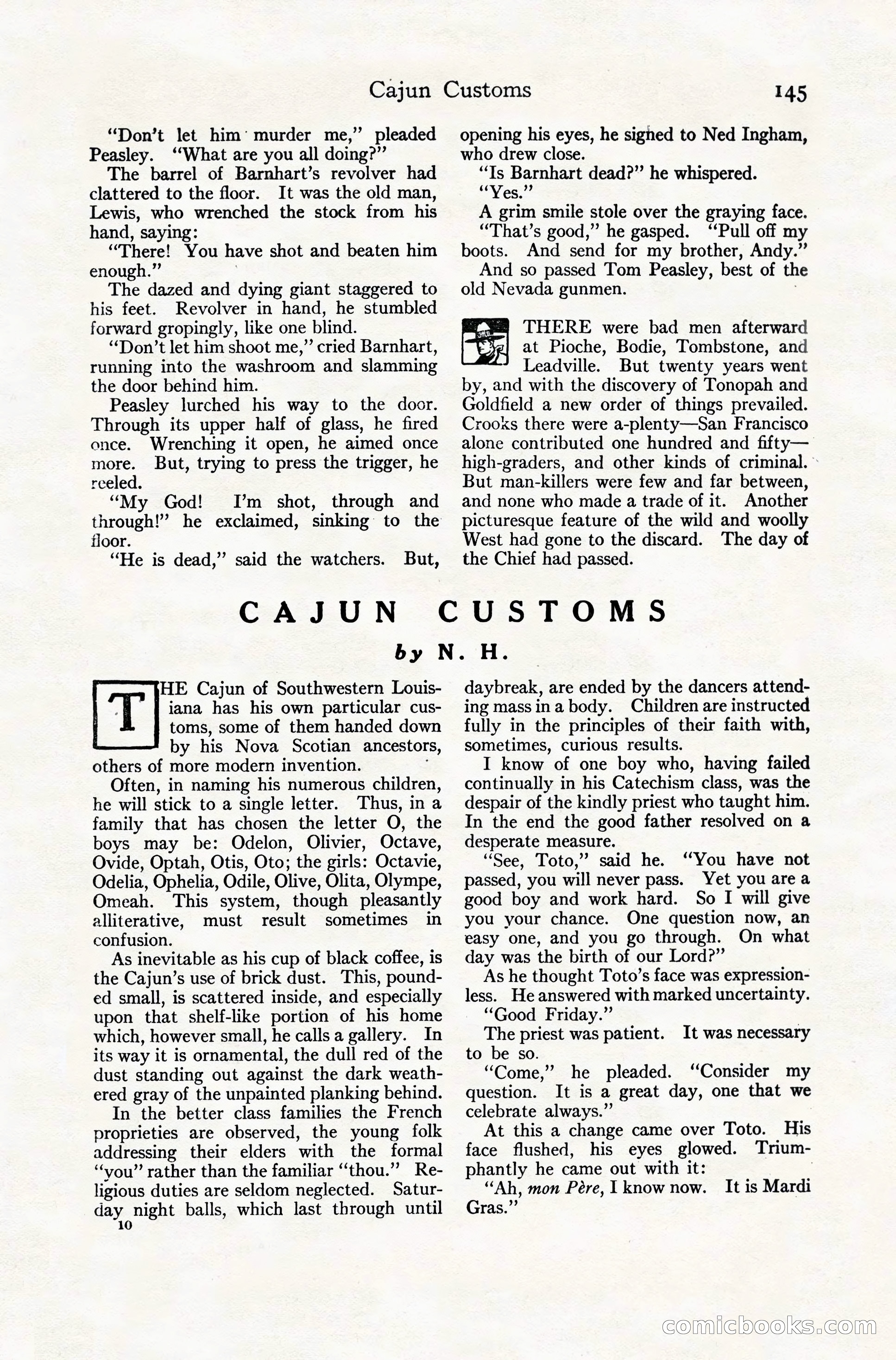
A restored page from Pulp Fiction, 1924. Page through the whole issue in the reader above.
📄 Transcribed text from this page (OCR, searchable)
Machine-transcribed from the original scan — historical spelling and the odd misread are preserved.
Cajun Customs “Don’t let him’ murder me,” pleaded Peasley. ‘What are you all doing?” The barrel of Barnhart’s revolver had clattered to the floor. It was the old man, Lewis, who wrenched the stock from his hand, saying: “There! You have shot and beaten him enough.” The dazed and dying giant staggered to his feet. Revolver in hand, he stumbled forward gropingly, like one blind. “Don’t let him shoot me,” cried Barnhart, running into the washroom and slamming the door behind him. Peasley lurched his way to the door. Through its upper half of glass, he fired once. Wrenching it open, he aimed once more. But, trying to press the trigger, he reeled. “My God! I’m shot, through and through!” he exclaimed, sinking to the floor. “He is dead,”’ said the watchers. But, 145 opening his eyes, he sighed to Ned Ingham, who drew close. “Ts Barnhart dead?” he whispered. Vag A grim smile stole over the graying face. “That’s good,” he gasped. ‘Pull off my boots. And send for my brother, Andy.” And so passed Tom Peasley, best of the old Nevada gunmen. THERE were bad men afterward at Pioche, Bodie, Tombstone, and Leadville. But twenty years went by, and with the discovery of Tonopah and Goldfield a new order of things prevailed. Crooxs there were a-plenty—San Francisco alone contributed one hundred and fifty— high-graders, and other kinds of criminal. © But man-killers were few and far between, and none who made a trade of it. Another picturesque feature of the wild and woolly West had gone to the discard. The day of the Chief had passed. CAJUN CUSTOMS by N. H. HE Cajun of Southwestern Louis- | iana has his own particular cus- toms, some of them handed down by his Nova Scotian ancestors, others of more modern invention. Often, in naming his numerous children, he will stick to a single letter. Thus, ina family that has chosen the letter O, the boys may be: Odelon, Olivier, Octave, Ovide, Optah, Otis, Oto; the girls: Octavie, Odelia, Ophelia, Odile, Olive, Olita, Olympe, Omeah. This system, though pleasantly alliterative, must result sometimes in confusion. As inevitable as his cup of black coffee, is the Cajun’s use of brick dust. This, pound- ed small, is scattered inside, and especially upon that shelf-like portion of his home which, however small, he calls a gallery. In its way it is ornamental, the dull red of the dust standing out against the dark weath- ered gray of the unpainted planking behind. In the better class families the French proprieties are observed, the young folk addressing their elders with the formal “vou” rather than the familiar “‘thou.’”’ Re- ligious duties are seldom neglected. Satur- day | night balls, which last through until daybreak, are ended by the dancers attend- ing massina body. Children are instructed fully in the principles of their faith with, sometimes, curious results. I know of one boy who, having failed continually in his Catechism class, was the despair of the kindly priest who taught him. In the end the good father resolved on a desperate measure. “See, Toto,” said he. “You have not passed, you will never pass. Yet you area good boy and work hard. So I will give you your chance. One question now, an easy one, and you go through. On what day was the birth of our Lord?” As he thought Toto’s face was expression- less. He answered with marked uncertainty. “Good Friday.” The priest was patient. It was necessary to be so. “Come,” he pleaded. “Consider my question. It is a great day, one that we celebrate always.” At this a change came over Toto. His face flushed, his eyes glowed. Tnum- phantly he came out with it: : “Ah, mon Pére, 1 know now. It is Mardi Gras.”’ CoMmiclbool ) (© 5}