
Pulp Fiction, 1924 · page 95 of 216
Adventure Magazine, December 10, 1924 — page 95: what you’re looking at
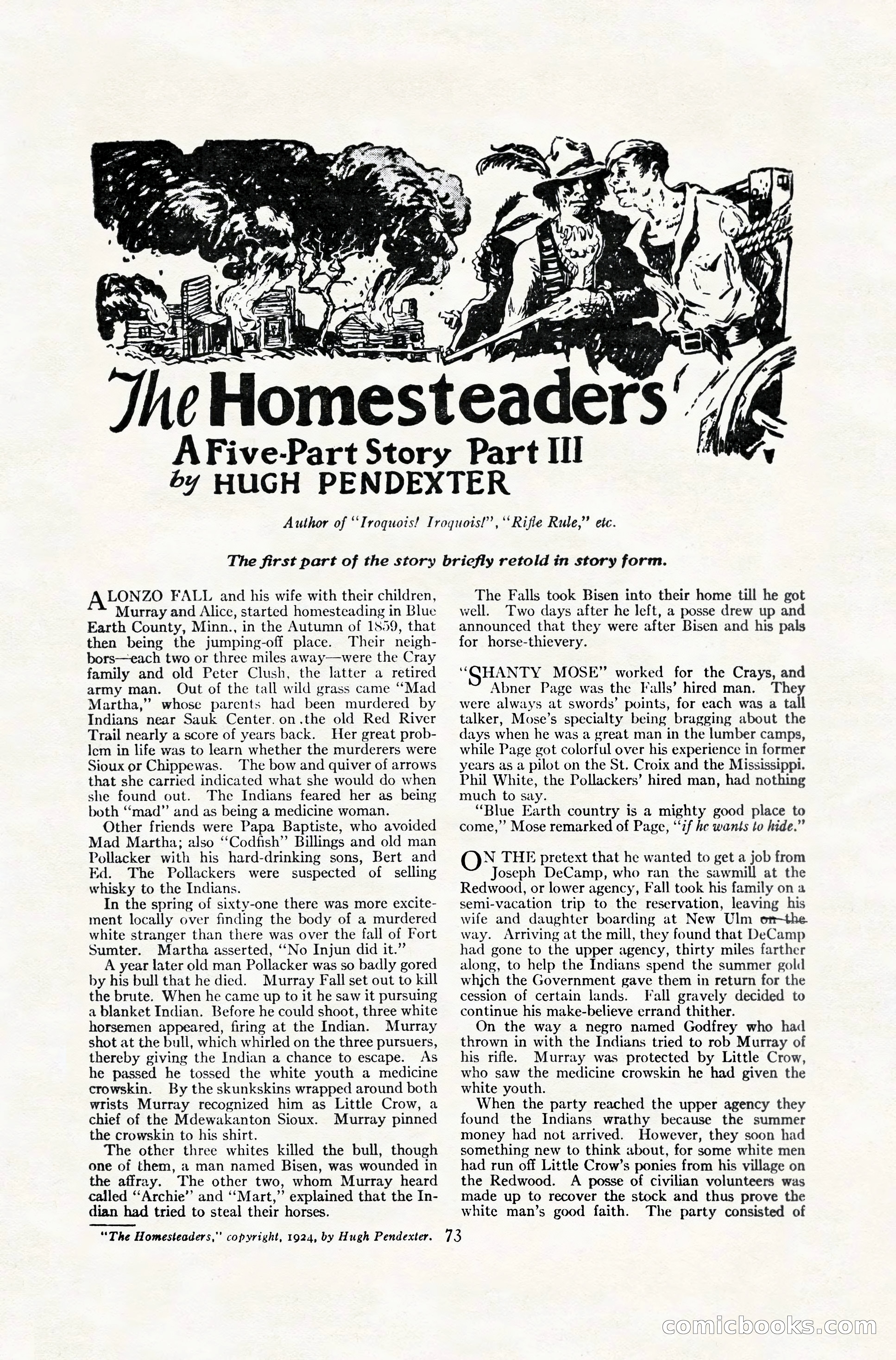
A restored page from Pulp Fiction, 1924. Page through the whole issue in the reader above.
📄 Transcribed text from this page (OCR, searchable)
Machine-transcribed from the original scan — historical spelling and the odd misread are preserved.
“a Bentena: = XS i— — AFive-Part Story Part III TF 46y HUGH PENDEXTER Author of “Iroquois! Troquoist’”’, ‘Rifle Rule,” etc. The first part of the story briefly retold in story form. LONZO FALL and his wife with their children, Murray and Alice, started homesteading in Blue Earth County, Minn., in the Autumn of 1559, that then being the jumping-off place. Their neigh- bors—each two or three miles away—were the Cray family and old Peter Clush, the latter a retired army man. Out of the tall wild grass came “Mad Martha,” whose parents had been murdered by Indians near Sauk Center. on.the old Red River Trail nearly a score of years back. Her great prob- lem in life was to learn whether the murderers were Sioux or Chippewas. The bow and quiver of arrows that she carried indicated what she would do when she found out. The Indians feared her as being both “‘mad”’ and as being a medicine woman. Other friends were Papa Baptiste, who avoided Mad Martha; also ‘“‘Codfish” Billings and old man Pollacker with his hard-drinking sons, Bert and Ed. The Pollackers were suspected of selling whisky to the Indians. In the spring of sixty-one there was more excite- ment locally over finding the body of a murdered white stranger than there was over the fall of Fort Sumter. Martha asserted, ‘‘No Injun did it.” A year later old man Pollacker was so badly gored by his bull that he died. Murray Fall set out to kill the brute. When he came up to it he saw it pursuing a blanket Indian. Before he could shoot, three white horsemen appeared, firing at the Indian. Murray shot at the bull, which whirled on the three pursuers, thereby giving the Indian a chance to escape. As he passed he tossed the white youth a medicine crowskin. By the skunkskins wrapped around both wrists Murray recognized him as Little Crow, a chief of the Mdewakanton Sioux. Murray pinned the crowskin to his shirt. The other three whites killed the bull, though one of them, a man named Bisen, was wounded in the affray. The other two, whom Murray heard called ‘‘Archie” and ‘‘Mart,”’ explained that the In- dian had tried to steal their horses. The Falls took Bisen into their home till he got well. Two days after he left, a posse drew up and announced that they were after Bisen and his pals for horse-thievery. HANTY MOSE” worked for the Crays, and Abner Page was the Falls’ hired man. They were always at swords’ points, for each was a tall talker, Mose’s specialty being bragging about the days when he was a great man in the lumber camps, while Page got colorful over his experience in former years as a pilot on the St. Croix and the Mississippi. Phil White, the Pollackers’ hired man, had nothing much to say. “Blue Earth country is a mighty good place to come,” Mose remarked of Page, “‘7f he wants to hide.” ON THE pretext that he wanted to get a job from Joseph DeCamp, who ran the sawmill at the Redwood, or lower agency, Fall took his family on a semi-vacation trip to the reservation, leaving his wife and daughter boarding at New Ulm omthe way. Arriving at the mill, they found that DeCamp had gone to the upper agency, thirty miles farther along, to help the Indians spend the summer gold whjch the Government gave them in return for the cession of certain lands. Fall gravely decided to continue his make-believe errand thither. On the way a negro named Godfrey who had thrown in with the Indians tried to rob Murray of his rifle. Murray was protected by Little Crow, who saw the medicine crowskin he had given the white youth. When the party reached the upper agency they found the Indians wrathy because the summer money had not arrived. However, they soon had something new to think about, for some white men had run off Little Crow’s ponies from his village on the Redwood. A posse of civilian volunteers was made up to recover the stock and thus prove the white man’s good faith. The party consisted of ‘The Homesteaders,”’ copyright, 1924, by Hugh Pendexter. 73 CO MICLOOOKS © 5}