
Pulp Fiction, 1924 · page 96 of 216
Adventure Magazine, December 10, 1924 — page 96: what you’re looking at
A restored page from Pulp Fiction, 1924. Page through the whole issue in the reader above.
📄 Transcribed text from this page (OCR, searchable)
Machine-transcribed from the original scan — historical spelling and the odd misread are preserved.
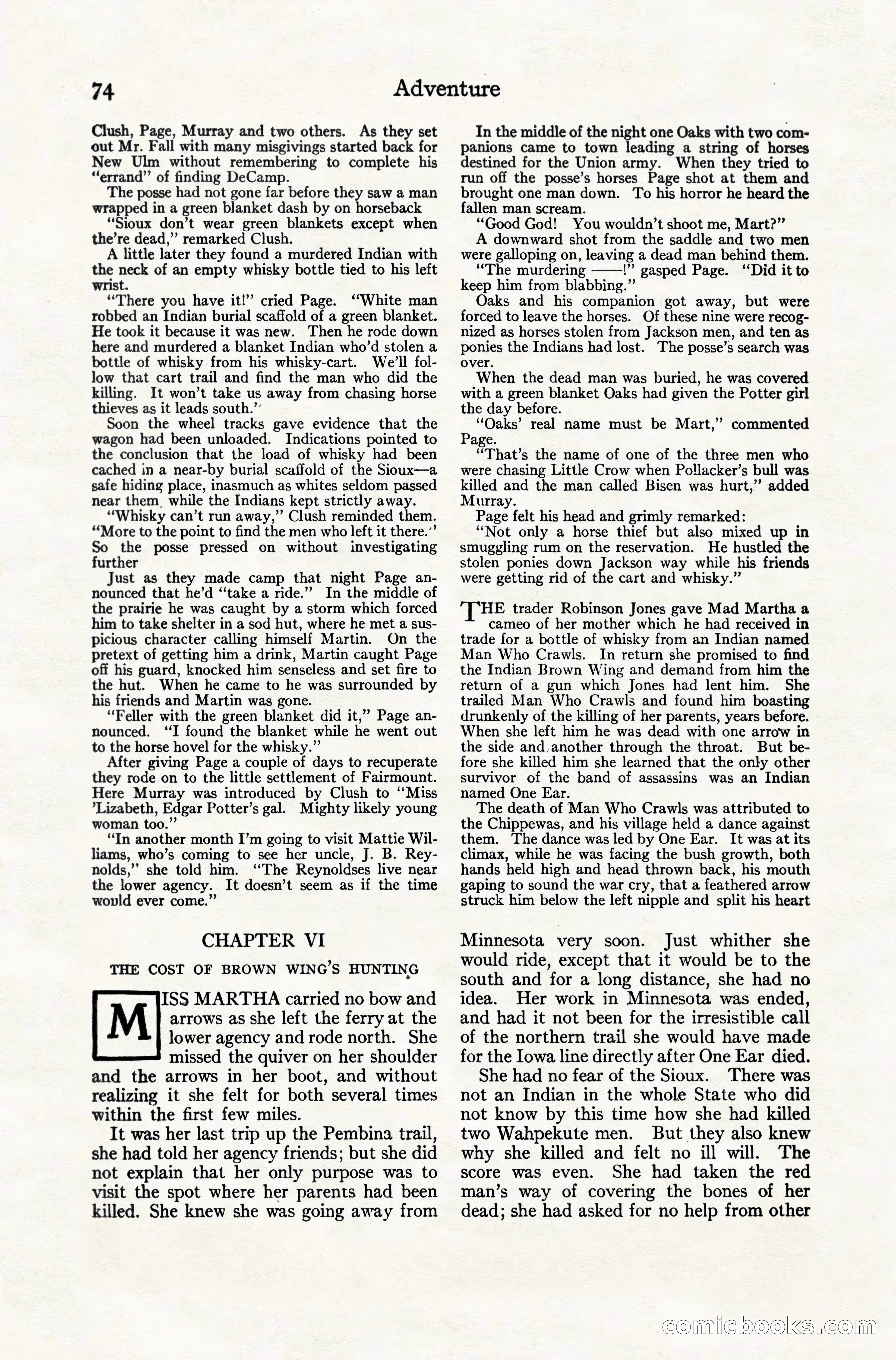
74 Clush, Page, Murray and two others. As they set out Mr. Fall with many misgivings started back for New Ulm without remembering to complete his “errand” of finding DeCamp. The posse had not gone far before they saw a man wrapped in a green blanket dash by on horseback “Sioux don’t wear green blankets except when the’re dead,”’ remarked Clush. A little later they found a murdered Indian with the neck of an empty whisky bottle tied to his left wrist. “There you have it!”’ cried Page. ‘“‘White man robbed an Indian burial scaffold of a green blanket. He took it because it was new. Then he rode down here and murdered a blanket Indian who’d stolen a bottle of whisky from his whisky-cart. We’ll fol- low that cart trail and find the man who did the killing. It won’t take us away from chasing horse thieves as it leads south.”’ Soon the wheel tracks gave evidence that the wagon had been unloaded. Indications pointed to the conclusion that the load of whisky had been cached in a near-by burial scaffold of the Sioux—a safe hiding place, inasmuch as whites seldom passed near them while the Indians kept strictly away. “Whisky can’t run away,’ Clush reminded them. “More to the point to find the men who left it there.’’ So the posse pressed on without investigating further Just as they made camp that night Page an- nounced that he’d “take a ride.” In the middle of the prairie he was caught by a storm which forced him to take shelter in a sod hut, where he met a sus- picious character calling himself Martin. On the pretext of getting him a drink, Martin caught Page off his guard, knocked him senseless and set fire to the hut. When he came to he was surrounded by his friends and Martin was gone. “Feller with the green blanket did it,” Page an- nounced. “I found the blanket while he went out to the horse hovel for the whisky.” After giving Page a couple of days to recuperate they rode on to the little settlement of Fairmount. Here Murray was introduced by Clush to ‘‘Miss ’Lizabeth, Edgar Potter’s gal. Mighty likely young woman too.” “Tn another month I’m going to visit Mattie Wil- liams, who’s coming to see her uncle, J. B. Rey- nolds,”’ she told him. ‘‘The Reynoldses live near the lower agency. It doesn’t seem as if the time would ever come.” CHAPTER VI THE COST OF BROWN WING’S HUNTING ISS MARTHA carried no bow and M arrows as She left the ferry at the lower agency and rode north. She missed the quiver on her shoulder and the arrows in her boot, and without realizing it she felt for both several times within the first few miles. It was her last trip up the Pembina trail, she had told her agency friends; but she did not explain that her only purpose was to visit the spot where her parents had been killed. She knew she was going away from Adventure In the middle of the night one Oaks with two com- panions came to town leading a string of horses destined for the Union army. When they tried to run off the posse’s horses Page shot at them and brought one man down. To his horror he heard the fallen man scream. “Good God! You wouldn’t shoot me, Mart?” A downward shot from the saddle and two men were galloping on, leaving a dead man behind them. “The murdering !”? gasped Page. ‘‘Did it to keep him from blabbing.” Oaks and his companion got away, but were forced to leave the horses. Of these nine were recog- nized as horses stolen from Jackson men, and ten as ponies the Indians had lost. The posse’s search was over. When the dead man was buried, he was covered with a green blanket Oaks had given the Potter girl the day before. “‘Oaks’ real name must be Mart,” commented Page. “That’s the name of one of the three men who were chasing Little Crow when Pollacker’s bull was killed and the man called Bisen was hurt,” added Murray. Page felt his head and grimly remarked: “Not only a horse thief but also mixed up in smuggling rum on the reservation. He hustled the stolen ponies down Jackson way while his friends were getting rid of the cart and whisky.” HE trader Robinson Jones gave Mad Martha a cameo of her mother which he had received in trade for a bottle of whisky from an Indian named Man Who Crawls. In return she promised to find the Indian Brown Wing and demand from him the return of a gun which Jones had lent him. She trailed Man Who Crawls and found him boasting drunkenly of the killing of her parents, years before. When she left him he was dead with one arrow in the side and, another through the throat. But be- fore she killed him she learned that the only other survivor of the band of assassins was an Indian named One Ear. The death of Man Who Crawls was attributed to the Chippewas, and his village held a dance against them. The dance was led by One Ear. It was at its climax, while he was facing the bush growth, both hands held high and head thrown back, his mouth gaping to sound the war cry, that a feathered arrow struck him below the left nipple and split his heart Minnesota very soon. Just whither she would ride, except that it would be to the south and for a long distance, she had no idea. Her work in Minnesota was ended, and had it not been for the irresistible call of the northern trail she would have made for the Iowa line directly after One Ear died. She had no fear of the Sioux. There was not an Indian in the whole State who did not know by this time how she had killed two Wahpekute men. But they also knew why she killed and felt no ill will. The score was even. She had taken the red man’s way of covering the bones of her dead; she had asked for no help from other CoOMmiclhoo 5}