
Pulp Fiction, 1925 · page 147 of 212
Adventure Magazine Cover, March 20, 1925 — page 147: what you’re looking at
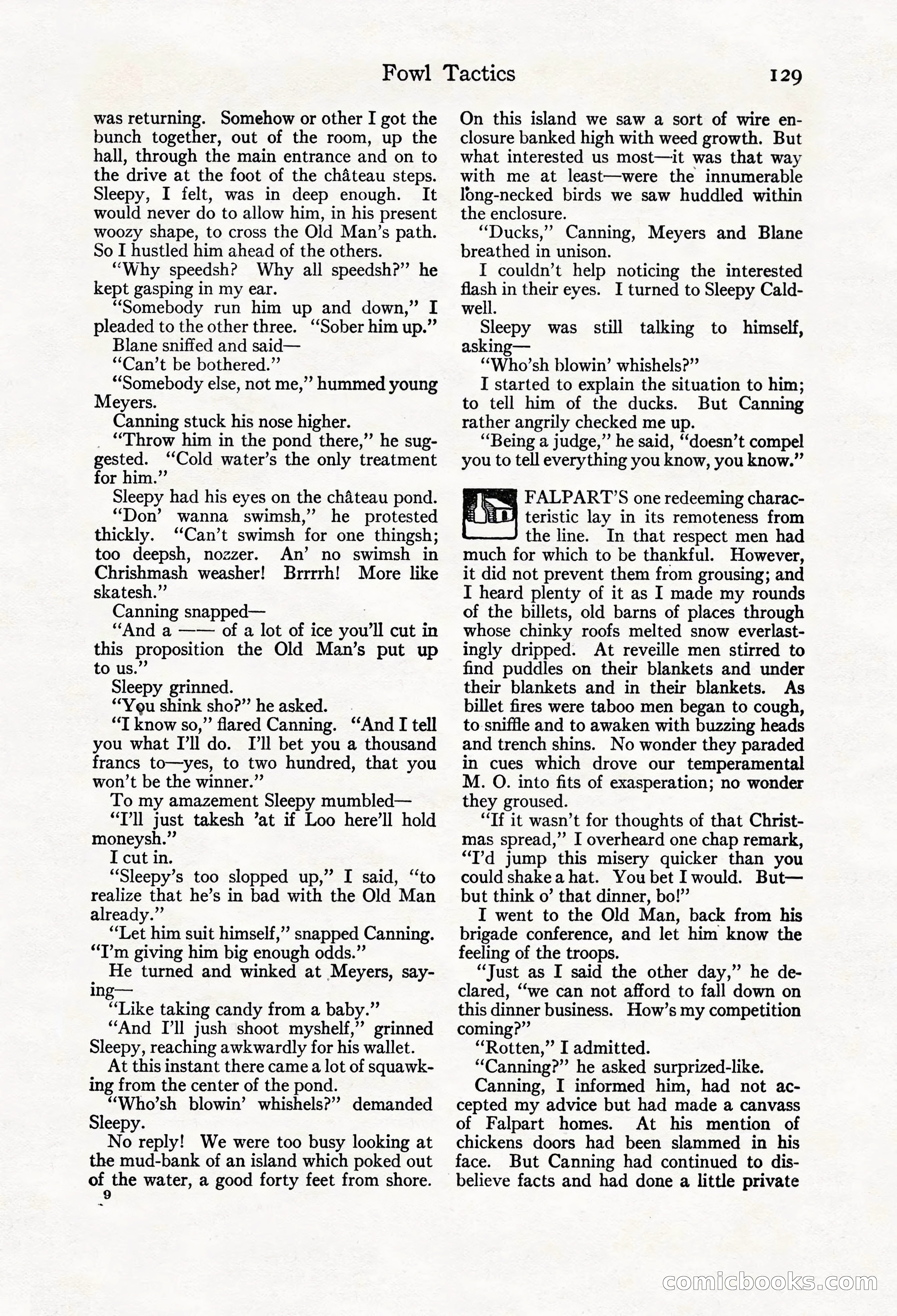
A restored page from Pulp Fiction, 1925. Page through the whole issue in the reader above.
📄 Transcribed text from this page (OCR, searchable)
Machine-transcribed from the original scan — historical spelling and the odd misread are preserved.
Fowl Tactics was returning. Somehow or other I got the bunch together, out of the room, up the hall, through the main entrance and on to the drive at the foot of the chAteau steps. Sleepy, I felt, was in deep enough. It would never do to allow him, in his present woozy shape, to cross the Old Man’s path. So I hustled him ahead of the others. “‘Why speedsh? Why all speedsh?” he kept gasping in my ear. “Somebody run him up and down,” I pleaded to the other three. ‘Sober him up.” Blane sniffed and said— “‘Can’t be bothered.” “Somebody else, not me,” hummed young Meyers. Canning stuck his nose higher. _ “Throw him in the pond there,’’ he sug- gested. “Cold water’s the only treatment for him.”’ Sleepy had his eyes on the chateau pond. “Don’ wanna swimsh,” he protested thickly. ‘“Can’t swimsh for one thingsh; too deepsh, nozzer. An’ no swimsh in Chrishmash weasher! Brrrrh! More like skatesh.”’ Canning snapped— “And a —— of a lot of ice you'll cut in this proposition the Old Man’s put up to us.” Sleepy grinned. ‘You shink sho?” he asked. “T know so,” flared Canning. “And I tell you what [ll do. I’ll bet you a thousand francs to—yes, to two hundred, that you won’t be the winner.” To my amazement Sleepy mumbled— “Vil just takesh ’at if Loo here’ll hold moneysh.” I cut in. “Sleepy’s too slopped up,” I said, “‘to realize that he’s in bad with the Old Man already.”’ “Let him suit himself,” snapped Canning. “Tm giving him big enough odds.” He turned and winked at Meyers, say- ing— “Like taking candy from a baby.” “And I’ll jush shoot myshelf,” grinned Sleepy, reaching awkwardly for his wallet. At this instant there came a lot of squawk- ing from the center of the pond. “Who’sh blowin’ whishels?’’ demanded Sleepy. No reply! We were too busy looking at the mud-bank of an island which poked out of the water, a good forty feet from shore. 129 On this island we saw a sort of wire en- closure banked high with weed growth. But what interested us most—it was that way with me at least—were the innumerable long-necked birds we saw huddled within the enclosure. “Ducks,” Canning, Meyers and Blane breathed in unison. I couldn’t help noticing the interested flash in their eyes. I turned to Sleepy Cald- well. Sleepy was still talking to himself, asking— “‘Who’sh blowin’ whishels?”’ I started to explain the situation to him; to tell him of the ducks. But Canning rather angrily checked me up. “Being a judge,” he said, ‘doesn’t compel you to tell everything you know, you know.” Sy FALPART’S one redeeming charac- teristic lay in its remoteness from the line. In that respect men had much for which to be thankful. However, it did not prevent them from grousing; and I heard plenty of it as I made my rounds of the billets, old barns of places through whose chinky roofs melted snow everlast- ingly dripped. At reveille men stirred to find puddles on their blankets and under their blankets and in their blankets. As billet fires were taboo men began to cough, to sniffle and to awaken with buzzing heads and trench shins. No wonder they paraded in cues which drove our temperamental M. O. into fits of exasperation; no wonder they groused. “Tf it wasn’t for thoughts of that Christ- mas spread,” I overheard one chap remark, “T’d jump this misery quicker than you could shakea hat. Youbet Iwould. But— but think o’ that dinner, bo!”’ I went to the Old Man, back from his brigade conference, and let him know the feeling of the troops. “Just as I said the other day,” he de- clared, “‘we can not afford to fall down on this dinner business. How’s my competition coming?” “Rotten,” I admitted. “‘Canning?” he asked surprized-like. Canning, I informed him, had not ac- cepted my advice but had made a canvass of Falpart homes. At his mention of chickens doors had been slammed in his face. But Canning had continued to dis- believe facts and had done a little private QO COMiiCcloOo