
Pulp Fiction, 1925 · page 198 of 212
Adventure Magazine Cover, March 20, 1925 — page 198: what you’re looking at
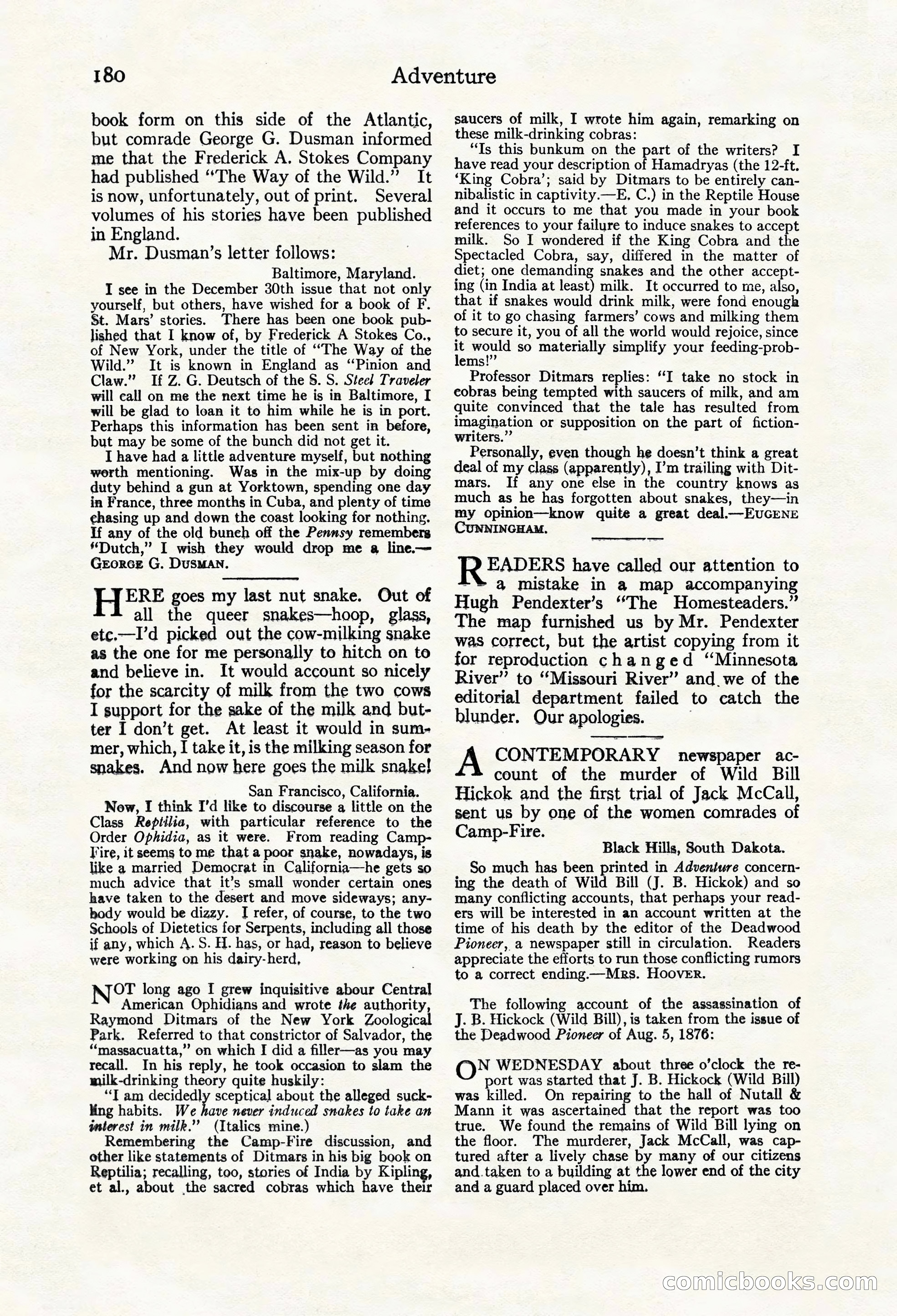
A restored page from Pulp Fiction, 1925. Page through the whole issue in the reader above.
📄 Transcribed text from this page (OCR, searchable)
Machine-transcribed from the original scan — historical spelling and the odd misread are preserved.
180 book form on this side of the Atlantic, but comrade George G. Dusman informed me that the Frederick A. Stokes Company had published ‘The Way of the Wild.” It is now, unfortunately, out of print. Several volumes of his stories have been published in England. Mr. Dusman’s letter follows: Baltimore, Maryland. I see in the December 30th issue that not only yourself, but others, have wished for a book of F. St. Mars’ stories. There has been one book pub- lished that I know of, by Frederick A Stokes Co., of New York, under the title of ‘“The Way of the Wild.” It is known in England as ‘Pinion and Claw.” If Z. G. Deutsch of the 8S. S. Steel Traveler will call on me the next time he is in Baltimore, I will be glad to loan it to him while he is in port. Perhaps this information has been sent in before, but may be some of the bunch did not get it. I have had a little adventure myself, but nothing werth mentioning. Was in the mix-up by doing duty behind a gun at Yorktown, spending one day in France, three months in Cuba, and plenty of time chasing up and down the coast looking for nothing. If any of the old buneh off the Pennsy remembers Dutch,” I wish they would drop me a line— Grorcg G. DUSMAN. HERE goes my last nut snake. Out of all the queer snakes—hoop, glass, etc.—I’d picked out the cow-milking snake as the one for me personally to hitch on to and believe in. It would account so nicely for the scarcity of milk from the two cows I support for the sake of the milk and but- ter I don’t get. At least it would in sum- mer, which, I take it, is the milking season for snakes. And now here goes the milk snake! San Francisco, California. Now, I think I'd like to discourse a little on the Class Reptilia, with particular reference to the Order Ophidia, as it were. From reading Camp- Tire, it seems to me that a poor snake, nowadays, is like a married Democrat in California—he gets so much advice that it’s small wonder certain ones have taken to the desert and move sideways; any- hody would be dizzy. I refer, of course, to the two Schools of Dietetics for Serpents, including all those if any, which A. S. H. has, or had, reason to believe were working on his dairy-herd, Nor long ago I grew inquisitive abour Central American Ophidians and wrote the authority, Raymond Ditmars of the New York Zoological Park. Referred to that constrictor of Salvador, the “massacuatta,” on which I did a filler—as you may recall. In his reply, he took occasion to slam the milk-drinking theory quite huskily: “T am decidedly sceptical about the alleged suck- ling habits. We have never induced snakes to take an interest in milk.”’ (Italics mine.) Remembering the Camp-Fire discussion, and other like statements of Ditmars in his big book on Reptilia; recalling, too, stories of India by Kipling, et al., about the sacred cobras which have their Adventure saucers of milk, I wrote him again, remarking on these milk-drinking cobras: “Is this bunkum on the part of the writers? I have read your description iL Hated (the 12-ft. ‘King Cobra’; said by Ditmars to be entirely can- nibalistic in captivity.—E, C.) in the Reptile House and it occurs to me that you made in your book references to your failure to induce snakes to accept milk. So I wondered if the King Cobra and the Spectacled Cobra, say, differed in the matter of diet; one demanding snakes and the other accept- ing (in India at least) milk. It occurred to me, also, that if snakes would drink milk, were fond enough of it to go chasing farmers’ cows and milking them to secure it, you of all the world would rejoice, since . xo so materially simplify your feeding-prob- ems!’ Professor Ditmars replies: ‘I take no stock in cobras being tempted with saucers of milk, and am quite convinced that the tale has resulted from imagination or supposition on the part of fiction- writers.” Personally, even though he doesn’t think a great deal of my class (apparently), I’m trailing with Dit- mars. If any one else in the country knows as much as he has forgotten about snakes, they—in my opinion—know quite a great deal.—EUGENE CUNNINGHAM. EADERS have called our attention to ** a mistake in a map accompanying Hugh Pendexter’s “The Homesteaders.” The map furnished us by Mr. Pendexter was correct, but the artist copying from it for reproduction changed “Minnesota River” to ‘Missouri River’ and we of the editorial department failed to catch the blunder. Our apologies. A CONTEMPORARY newspaper ac- * count of the murder of Wild Bill Hickok and the first trial of Jack McCall, sent us by one of the women comrades of Camp-Fire. a ee Black Hills, South Dakota. So much has been printed in Adventure concern- ing the death of Wild Bill (J. B. Hickok) and so many conflicting accounts, that perhaps your read- ers will be interested in an account written at the time of his death by the editor of the Deadwood Pioneer, a newspaper still in circulation. Readers appreciate the efforts to run those conflicting rumors to a correct ending.—Mrs. Hoover. The following account of the assassination of J. B. Hickock (Wild Bill), is taken from the issue of the Deadwood Pioneer of Aug. 5, 1876: ON WEDNESDAY about three o’clock the re- port was started that J. B. Hickock (Wild Bill) was killed. On repairing to the hall of Nutall & Mann it was ascertained that the report was too true. We found the remains of Wild Bill lying on the floor. The murderer, Jack McCall, was cap- tured after a lively chase by many of our citizens and.taken to a building at the lower end of the city and a guard placed over him. GOMIGIOO (C©