
Pulp Fiction, 1925 · page 199 of 212
Adventure Magazine Cover, March 20, 1925 — page 199: what you’re looking at
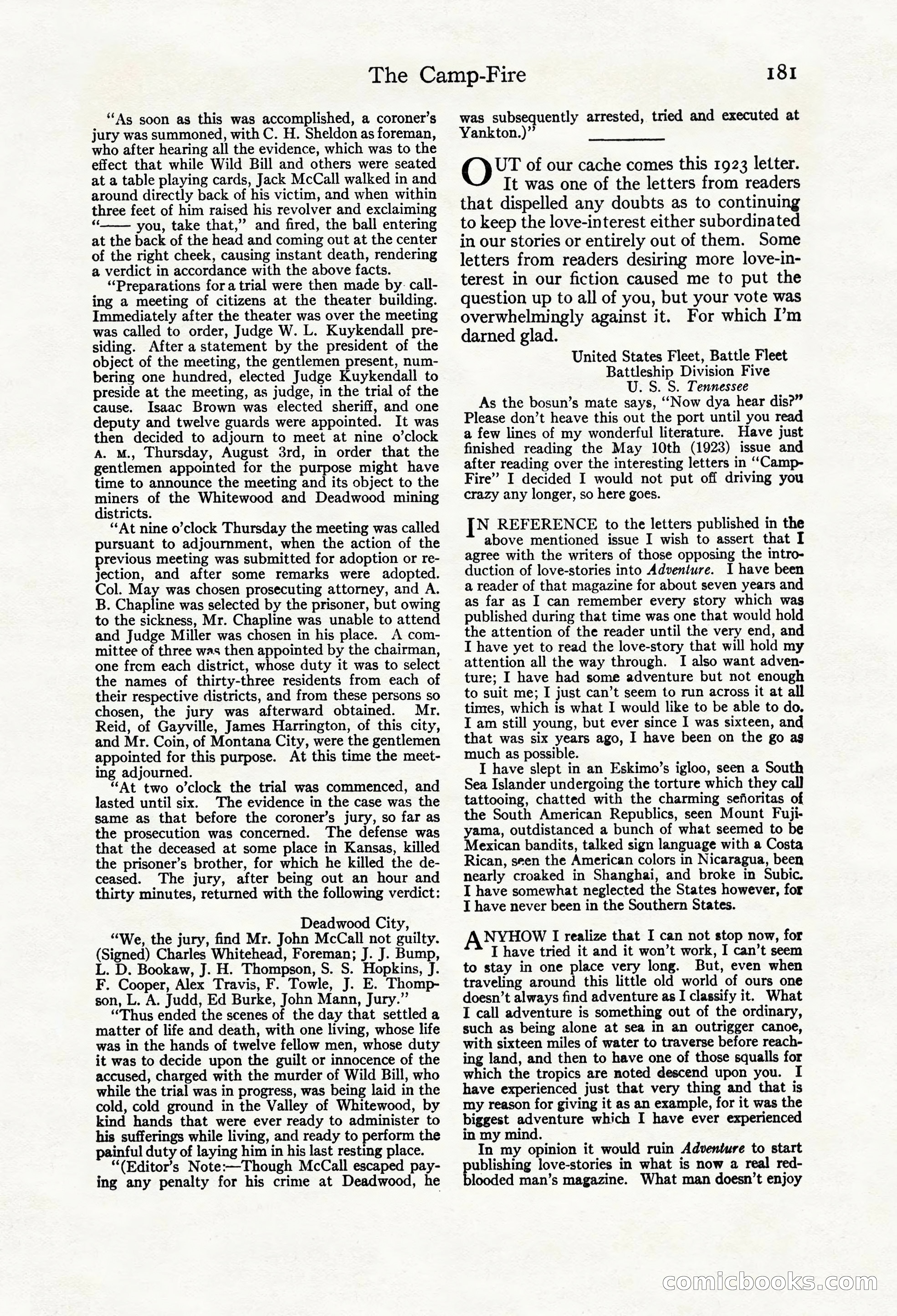
A restored page from Pulp Fiction, 1925. Page through the whole issue in the reader above.
📄 Transcribed text from this page (OCR, searchable)
Machine-transcribed from the original scan — historical spelling and the odd misread are preserved.
The Camp-Fire “As soon as this was accomplished, a coroner’s jury was summoned, with C. H. Sheldon as foreman, who after hearing all the evidence, which was to the effect that while Wild Bill and others were seated at a table playing cards, Jack McCall walked in and around directly back of his victim, and when within three feet of him raised his revolver and exclaiming : you, take that,”’ and fired, the ball entering at the back of the head and coming out at the center of the right cheek, causing instant death, rendering a verdict in accordance with the above facts. “Preparations fora trial were then made by. call- ing a meeting of citizens at the theater building. Immediately after the theater was over the meeting was called to order, Judge W. L. Kuykendall pre- siding. After a statement by the president of the object of the meeting, the gentlemen present, num- bering one hundred, elected Judge Kuykendall to preside at the meeting, as judge, in the trial of the cause. Isaac Brown was elected sheriff, and one deputy and twelve guards were appointed. It was then decided to adjourn to meet at nine o’clock A. M., Thursday, August 3rd, in order that the gentlemen appointed for the purpose might have time to announce the meeting and its object to the miners of the Whitewood and Deadwood mining districts. “At nine o’clock Thursday the meeting was called pursuant to adjournment, when the action of the revious meeting was submitted for adoption or re- jection, and after some remarks were adopted. Col. May was chosen prosecuting attorney, and A. B. Chapline was selected by the prisoner, but owing to the sickness, Mr. Chapline was unable to attend and Judge Miller was chosen in his place. A com- mittee of three was then appointed by the chairman, one from each district, whose duty it was to select the names of thirty-three residents from each of their respective districts, and from these persons so chosen, the jury was afterward obtained. Mr. Reid, of Gayville, James Harrington, of this city, and Mr. Coin, of Montana City, were the gentlemen appointed for this purpose. At this time the meet- ing adjourned. “At two o'clock the trial was commenced, and lasted until six. The evidence in the case was the same as that before the coroner’s jury, so far as the prosecution was concerned. The defense was that the deceased at some place in Kansas, killed the prisoner’s brother, for which he killed the de- ceased. The jury, after being out an hour and thirty minutes, returned with the following verdict: Deadwood City, “We, the jury, find Mr. John McCall not guilty. (Signed) Charles Whitehead, Foreman; J. J. Bump, L. D. Bookaw, J. H. Thompson, S. S. Hopkins, J. F. Cooper, Alex Travis, F. Towle, J. E. Thomp- son, L. A. Judd, Ed Burke, John Mann, Jury.” “Thus ended the scenes of the day that settled a matter of life and death, with one living, whose life was in the hands of twelve fellow men, whose duty it was to decide upon the guilt or innocence of the accused, charged with the murder of Wild Bill, who while the trial was in progress, was being laid in the cold, cold ground in the Valley of Whitewood, by kind hands that were ever ready to administer to his sufferings while living, and ready to perform the painful duty of laying him in his last resting place. “(Editor’s Note:—Though McCall escaped pay- ing any penalty for his crime at Deadwood, he 18I was subsequently arrested, tried and executed at Yankton.)”’ ‘ee of our cache comes this 1923 letter. It was one of the letters from readers that dispelled any doubts as to continuing to keep the love-interest either subordinated in our stories or entirely out of them. Some letters from readers desiring more love-in- terest in our fiction caused me to put the question up to all of you, but your vote was overwhelmingly against it. For which ’m darned glad. United States Fleet, Battle Fleet Battleship Division Five U. S. S. Tennessee As the bosun’s mate says, “Now dya hear dis?” Please don’t heave this out the port until you read a few lines of my wonderful literature. Have just finished reading the May 10th (1923) issue and after reading over the interesting letters in ‘‘(Camp- Fire’ I decided I would not put off driving you crazy any longer, so here goes. [N REFERENCE to the letters published in the above mentioned issue I wish to assert that I agree with the writers of those opposing the intro- duction of love-stories into Adventure. I have been a reader of that magazine for about seven years and as far as I can remember every story which was published during that time was one that would hold the attention of the reader until the very end, and I have yet to read the love-story that will hold my attention all the way through. I also want adven- ture; I have had some adventure but not enough to suit me; I just can’t seem to run across it at all times, which is what I would like to be able to do. I am still young, but ever since I was sixteen, and that was six years ago, I have been on the go as much as possible. I have slept in an Eskimo’s igloo, seen a South Sea Islander undergoing the torture which they call tattooing, chatted with the charming sefioritas of the South American Republics, seen Mount Fuji- yama, outdistanced a bunch of what seemed to be Mexican bandits, talked sign language with a Costa Rican, seen the American colors in Nicaragua, been nearly croaked in Shanghai, and broke in Subic. I have somewhat neglected the States however, for I have never been in the Southern States. ANYHOW I realize that I can not stop now, for I have tried it and it won’t work, I can’t seem to stay in one place very long. But, even when traveling around this little old world of ours one doesn’t always find adventure as I classify it. What I call adventure is something out of the ordinary, such as being alone at sea in an outrigger canoe, with sixteen miles of water to traverse before reach- ing land, and then to have one of those squalls for which the tropics are noted descend upon you. I have experienced just that very thing and that is my reason for giving it as an example, for it was the biggest adventure which I have ever experienced in my mind. In my opinion it would ruin Adventure to start pene love-stories in what is now a real red- looded man’s magazine. What man doesn’t enjoy VOO (©