
Pulp Fiction, 1925 · page 107 of 196
Adventure Magazine Cover — page 107: what you’re looking at
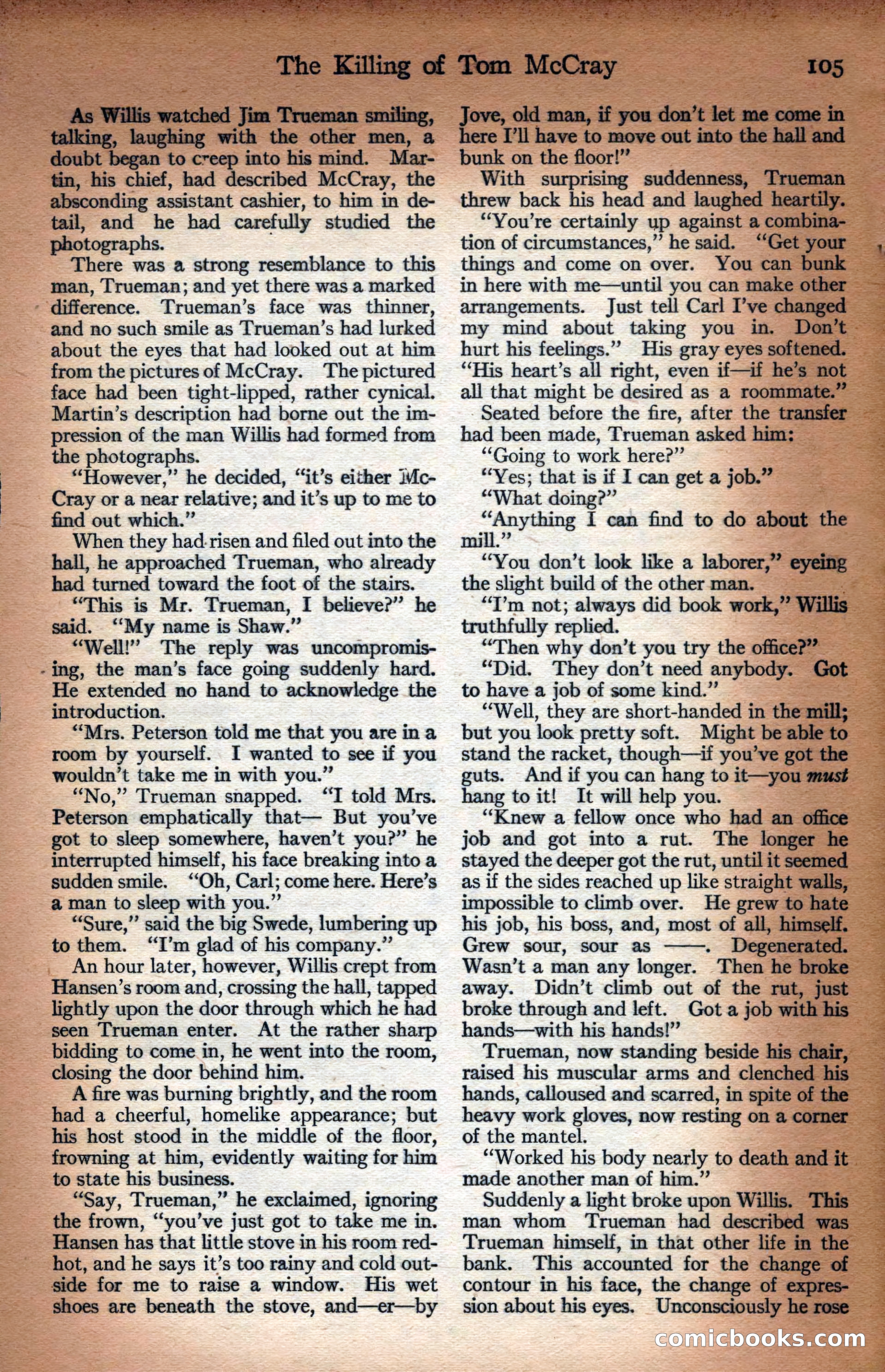
A restored page from Pulp Fiction, 1925. Page through the whole issue in the reader above.
📄 Transcribed text from this page (OCR, searchable)
Machine-transcribed from the original scan — historical spelling and the odd misread are preserved.
SS ae a cee i Naty Se Fg oy! o- sili oe caae As Willis watched Jim Trueman —e talking, laughing with the other men, a doubt began to creep into his mind. Mar- tin, his chief, had described McCray, the absconding assistant cashier, to him in de- tail, and he had carefully studied the photographs. There was a strong resemblance to this man, Trueman; and yet there was a marked ; difference. Trueman’s face was thinner, and no such smile as Trueman’s had lurked about the eyes that had looked out at him from the pictures of McCray. ‘The pictured face had been tight-lipped, rather cynical. Martin’s description had borne out the im- pression of the man Willis had formed from the photographs. “However,” he decided, “it’s either iMc- Cray or a near relative; and it’s up to me to find out which.” When they had-risen and filed out into the hall, he approached Trueman, who already had turned toward the foot of the stairs. “This is Mr. Trueman, I believe?” he said. ‘‘My name is Shaw.” “Well!” The reply was uncompromis- -ing, the man’s face going suddenly hard. He extended no hand to acknowledge the introduction. “Mrs. Peterson told me that you are in a room by yourself. I wanted to see if you wouldn’t take me in with you.” “No,” Trueman snapped. “I told Mrs. Peterson emphatically that— But you’ve got to sleep somewhere, haven’t you?” he interrupted himself, his face breaking into a sudden smile. ‘Oh, Carl; come here. Here’s a man to sleep with you.” “Sure,” said the big Swede, lumbering up to them. “I’m glad of his company.” An hour later, however, Willis crept from Hansen’s room and, crossing the hall, tapped lightly upon the door through which he had seen Trueman enter. At the rather sharp bidding to come in, he went into the room, closing the door behind him. A fire was burning brightly, and the room had a cheerful, homelike appearance; but his host stood in the middle of the floor, frowning at him, evidently waiting for him to state his business. “Say, Trueman,” he exclaimed, ignoring the frown, “you’ve just got to take me in. Hansen has that little stove in his room red- hot, and he says it’s too rainy and cold out- side for me to raise a window. His wet shoes are beneath the stove, and—er—by —_ |=! etl» OS mar et ~ Pe eg a ee ay eee, Penk Oe mae Soy pie —- - - a pe ee ee sn * oe es er oe ~< -s ph Se Ss RES Se Bogie oF: > . ‘ ee a eo oh ey 105 Jove, old man, if you don’t let me come in here I’ll have to move out into the hall and bunk on the floor!” With surprising suddenness, Trueman threw back his head and laughed heartily. ““You’re certainly up against a combina- tion of circumstances,” he said. “Get your things and come on over. You can bunk in here with me—until you can make other arrangements. Just tell Carl I’ve changed my mind about taking you in. Dont hurt his feelings.” His gray eyes softened. “His heart’s all right, even iff he’s not all that might be desired as a roommate.” Seated before the fire, after the transfer had been made, Trueman asked him; “Going to work here?” “Yes; that is if I can get a job.” “What doing?” ee I can find to do about the mi fad “You don’t look like a laborer,” eyeing the slight build of the other man. “I’m not; always did book work,” Willis truthfully replied. “Then why don’t you try the office?” “Did. They don’t need anybody. Got to have a job of some kind.” ‘“‘Well, they are short-handed in the mill; but you look pretty soft. Might be able to stand the racket, though—if you’ve got the guts. And if you can hang to it—you must hang to it! It will help you. “Knew a fellow once who had an office job and got into a rut. The longer he stayed the deeper got the rut, until it seemed as if the sides reached up like straight walls, impossible to climb over. He grew to hate his job, his boss, and, most of all, himself, Grew sour, sour as ——. Degenerated. Wasn’t a man any longer. Then he broke away. Didn’t climb out of the rut, just broke through and left. Got a job with his hands—with his hands!” Trueman, now standing beside his chair, raised his muscular arms and clenched his hands, calloused and scarred, in spite of the heavy work gloves, now resting on a corner of the mantel. “‘Worked his body nearly to death and it made another man of him.” Suddenly a light broke upon Willis. This man whom ‘Trueman had described was Trueman himself, in that other life in the bank. This accounted for the change of contour in his face, the change of expres- sion about his eyes. Unconsciously he rose Eomicbooks.com