
Pulp Fiction, 1925 · page 108 of 196
Adventure Magazine Cover — page 108: what you’re looking at
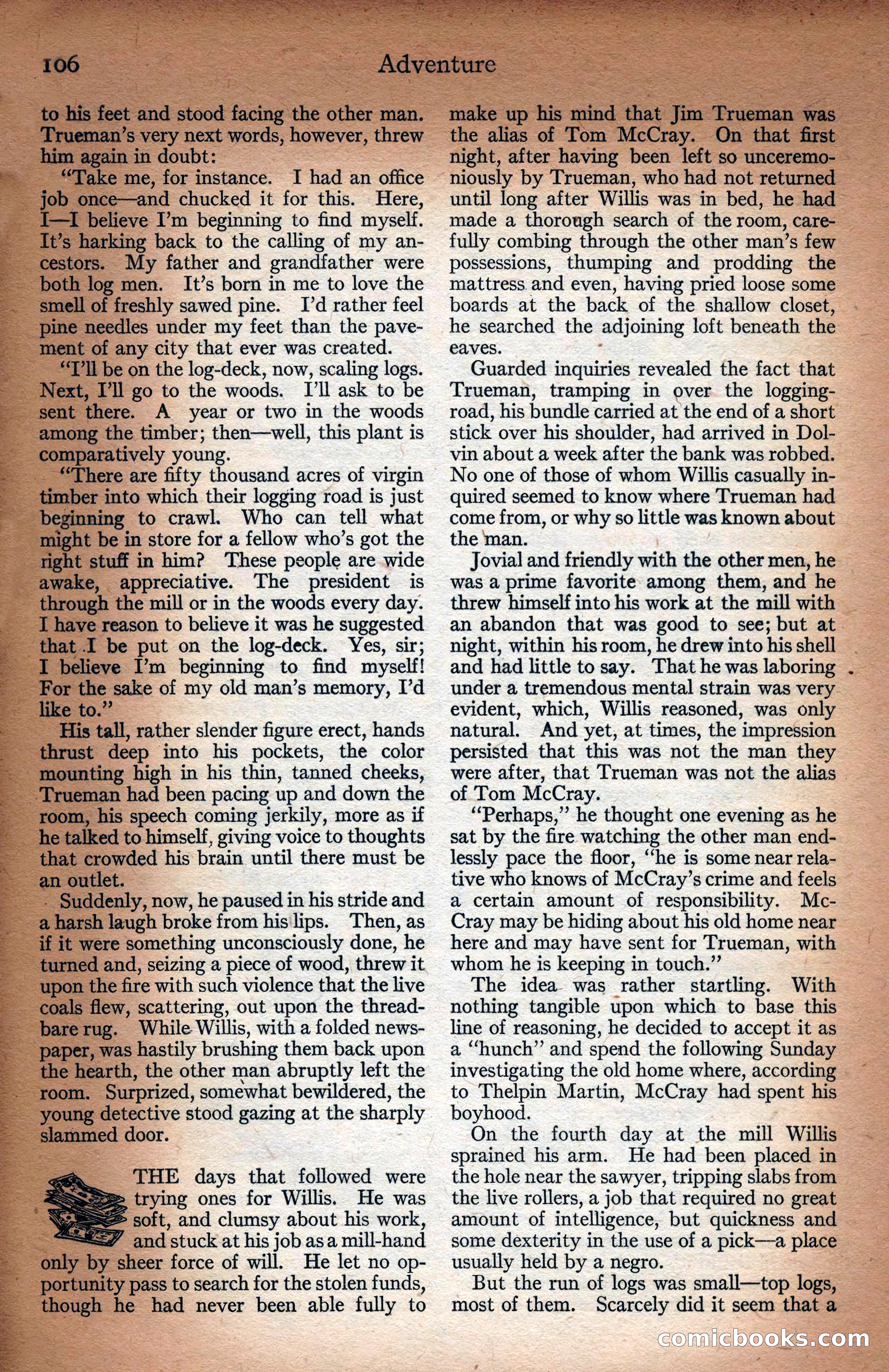
A restored page from Pulp Fiction, 1925. Page through the whole issue in the reader above.
📄 Transcribed text from this page (OCR, searchable)
Machine-transcribed from the original scan — historical spelling and the odd misread are preserved.
106 to his feet and stood facing the other man. Trueman’s very next words, however, threw him again in doubt: “Take me, for instance. I had an office job once—and chucked it for this. Here, I—1I believe I’m beginning to find myself. It’s harking back to the calling of my an- cestors. My father and grandfather were both log men. It’s born in me to love the smell of freshly sawed pine. I’d rather feel pine needles under my feet than the pave- ment of any city that ever was created. “T’'ll be on the log-deck, now, scaling logs. Next, Pll go to the woods. I'll ask to be sent there. A year or two in the woods among the timber; then—well, this plant is comparatively young. “There are fifty thousand acres of virgin timber into which their logging road is just beginning to crawl. Who can tell what might be in store for a fellow who’s got the right stuff in him? ‘These people are wide awake, appreciative. The president is through the mill or in the woods every day. I have reason to believe it was he suggested that I be put on the log-deck. Yes, sir; I believe I’m beginning to find myself! For the sake of my old man’s memory, I’d like to.” His tall, rather slender figure erect, hands thrust deep into his pockets, the color mounting high in his thin, tanned cheeks, ‘Trueman had been pacing up and down the room, his speech coming jerkily, more as if he talked to himself, giving voice to thoughts that crowded his brain until there must be an outlet. - Suddenly, now, he paused in his stride and a harsh laugh broke from his lips. Then, as if it were something unconsciously done, he turned and, seizing a piece of wood, threw it upon the fire with such violence that the live coals flew, scattering, out upon the thread- barerug. While Willis, with a folded news- paper, was hastily brushing them back upon the hearth, the other man abruptly left the room. Surprized, somewhat bewildered, the young detective stood gazing at the sharply slammed door. Cr THE days that followed were Ss trying ones for Willis. He was o=— soit, and clumsy about his work, ——=/ and stuck at his job asa mill-hand only by sheer force of will. He let no op- portunity pass to search for the stolen funds, though he had never been able fully to Adventure make up his mind that Jim Trueman was the alias of Tom McCray. On that first night, after having been left so unceremo- niously by Trueman, who had not returned until long after Willis was in bed, he had made a thorough search of the room, care- fully combing through the other man’s few possessions, thumping and prodding the mattress. and even, having pried loose some boards at the back of the shallow closet, he searched the adjoining loft beneath the eaves. Guarded inquiries revealed the fact that Trueman, tramping in over the logging- road, his bundle carried at the end of a short stick over his shoulder, had arrived in Dol- vin about a week after the bank was robbed. No one of those of whom Willis casually in- quired seemed to know where Trueman had come from, or why so little was known about the man. Jovial and friendly with the other men, he was a prime favorite among them, and he threw himself into his work at the mill with an abandon that was good to see; but at night, within his room, he drew into his shell and had little to say. That he was laboring . under a tremendous mental strain was very evident, which, Willis reasoned, was only natural. And yet, at times, the impression persisted that this was not the man they were after, that Trueman was not the alias of Tom McCray. “Perhaps,” he thought one evening as he sat by the fire watching the other man end- lessly pace the floor, “he is some near rela- tive who knows of McCray’s crime and feels a certain amount of responsibility. Mc- Cray may be hiding about his old home near here and may have sent for Trueman, with whom he is keeping in touch.” The idea was rather startling. With nothing tangible upon which to base this line of reasoning, he decided to accept it as a “hunch” and spend the following Sunday investigating the old home where, according to Thelpin Martin, McCray had spent his boyhood. On the fourth day at the mill Willis sprained his arm. He had been placed in the hole near the sawyer, tripping slabs from the live rollers, a job that required no great amount of intelligence, but quickness and some dexterity in the use of a pick—a place usually held by a negro. But the run of logs was small—top logs, most of them. Scarcely did it seem that a Gomicbooks (ef 0)