
Pulp Fiction, 1925 · page 149 of 196
Adventure Magazine Cover — page 149: what you’re looking at
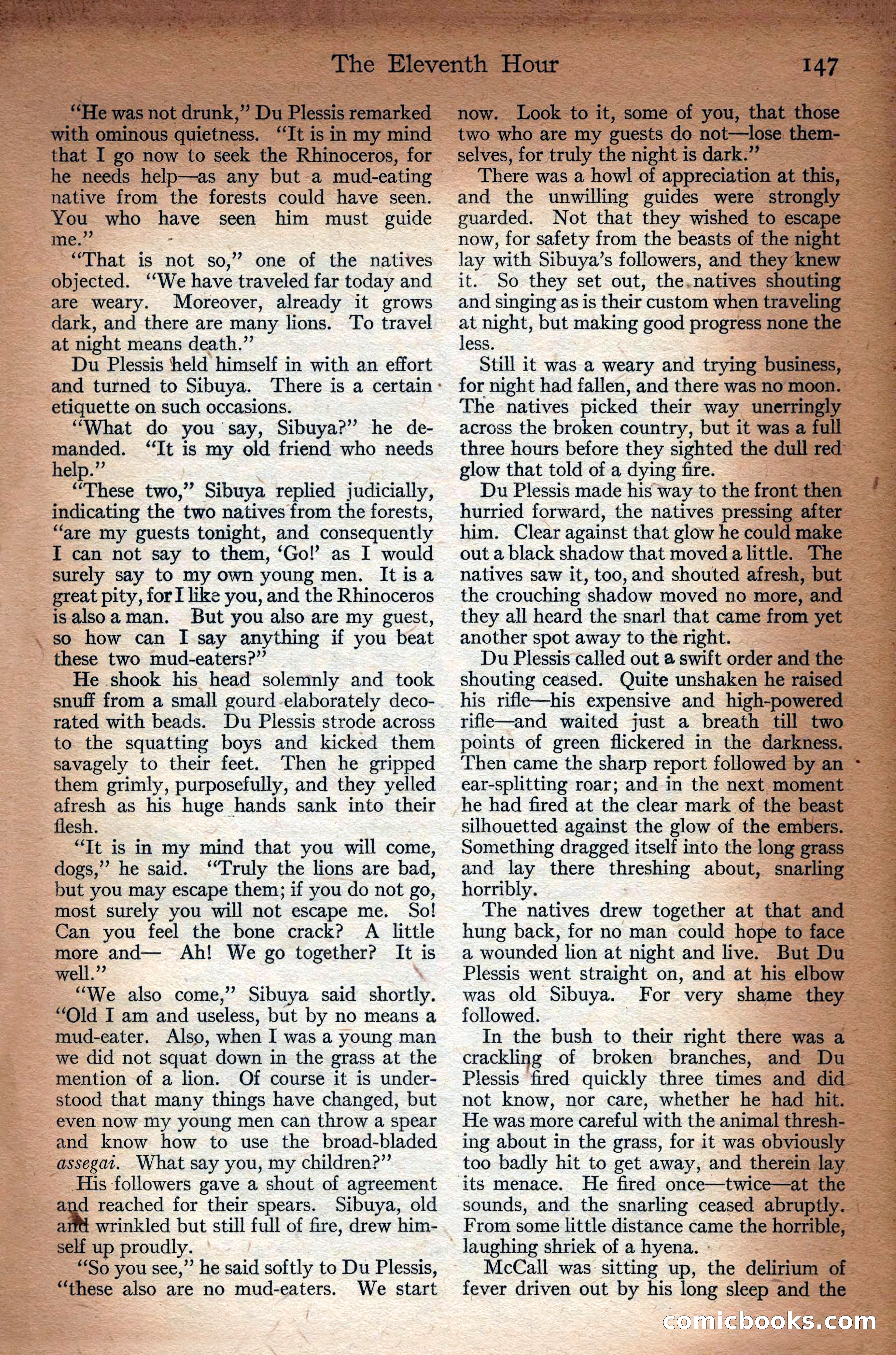
A restored page from Pulp Fiction, 1925. Page through the whole issue in the reader above.
📄 Transcribed text from this page (OCR, searchable)
Machine-transcribed from the original scan — historical spelling and the odd misread are preserved.
iu oie 4, . 2) cif % ve Beli » Melati “fe was not drunk,” Du Plessis remarked with ominous quietness. ‘It is in my mind that I go now to seek the Rhinoceros, for he needs help—as any but a mud-eating native from the forests could have seen. You who have seen him must guide me.” “That is not so,” one of the natives objected. ‘‘We have traveled far today and are weary. Moreover, already it grows dark, and there are many lions. To travel at night means death.” Du Plessis held himself in with an effort and turned to Sibuya. There is a certain - etiquette on such occasions. “What do you say, Sibuya?” he de- manded. “It is my old friend who needs help.”’ “These two,” Sibuya replied judicially, indicating the two natives from the forests, “are my guests tonight, and consequently IT can not say to them, ‘Go!’ as I would surely say to my own young men. Itisa great pity, for I like you, and the Rhinoceros isalsoaman. But you also are my guest, so how can I say anything if you beat these two mud-eaters?”’ He shook his head solemnly and took snuff from a small gourd-elaborately deco- rated with beads. Du Plessis strode across to the squatting boys and kicked them savagely to their feet. Then he gripped them grimly, purposefully, and they yelled afresh as his huge hands sank into their flesh. “It is in my mind that you will come, dogs,” he said. ‘Truly the lions are bad, but you may escape them; if you do not go, most surely you will not escape me. So! Can you feel the bone crack? Ai little more and— Ah! We go together? It is well.” “We also come,” Sibuya said shortly. “Old I am and useless, but by no means a mud-eater. Also, when I was a young man we did not squat down in the grass at the mention of a lion. Of course it is under- stood that many things have changed, but even. now my young men can throw a spear and know how to use the broad-bladed assegat. What say you, my children?” His followers gave a shout of agreement “" reached for their spears. Sibuya, old ame wrinkled but still full of fire, drew him- self up proudly. “So you see,” he said softly to Du Plessis, “these also are no mud-eaters. We start The Eleventh Hour ie oe — iw ae ~~ Yaa hen as 2 2: z - a oe) eS; now. Look to it, some of you, that those two who are my guests do not—lose them- selves, for truly the night is dark.” There was a howl of appreciation at this, and the unwilling guides were strongly guarded. Not that they wished to escape now, for safety from the beasts of the night lay with Sibuya’s followers, and they knew it. So they set out, the.natives shouting and singing as is their custom when traveling at night, but making good progress none the less. Still it was a weary and trying business, for night had fallen, and there was no moon. The natives picked their way unerringly across the broken country, but it was a full three hours before they sighted the dull red glow that told of a dying fire. Du Plessis made his way to the front then hurried forward, the natives pressing after him. Clear against that glow he could make out a black shadow that moved a little. The natives saw it, too, and shouted afresh, but the crouching shadow moved no more, and they all heard the snarl that came from yet another spot away to the right. Du Plessis called out a swift order and the shouting ceased. Quite unshaken he raised his rifle—his expensive and high-powered rifle—and waited just a breath till two points of green flickered in the darkness. 147 Then came the sharp report followed by an ~ ear-splitting roar; and in the next moment he had fired at the clear mark of the beast silhouetted against the glow of the embers. Something dragged itself into the long grass and lay there threshing about, snarling horribly. The natives drew together at that and hung back, for no man could hope to face a wounded lion at night and live. But Du Plessis went straight on, and at his elbow was old Sibuya. For very shame they followed. | In the bush to their right there was a crackling of broken branches, and Du Plessis fired quickly three times and did not know, nor care, whether he had hit. He was more careful with the animal thresh- ing about in the grass, for it was obviously too badly hit to get away, and therein lay its menace. He fired once—twice—at the sounds, and the snarling ceased abruptly. From some little distance came the horrible, laughing shriek of a hyena. McCall was sitting up, the delirium of fever driven out by his long sleep and the GEomichbooks co