
Pulp Fiction, 1925 · page 177 of 196
Adventure Magazine Cover — page 177: what you’re looking at
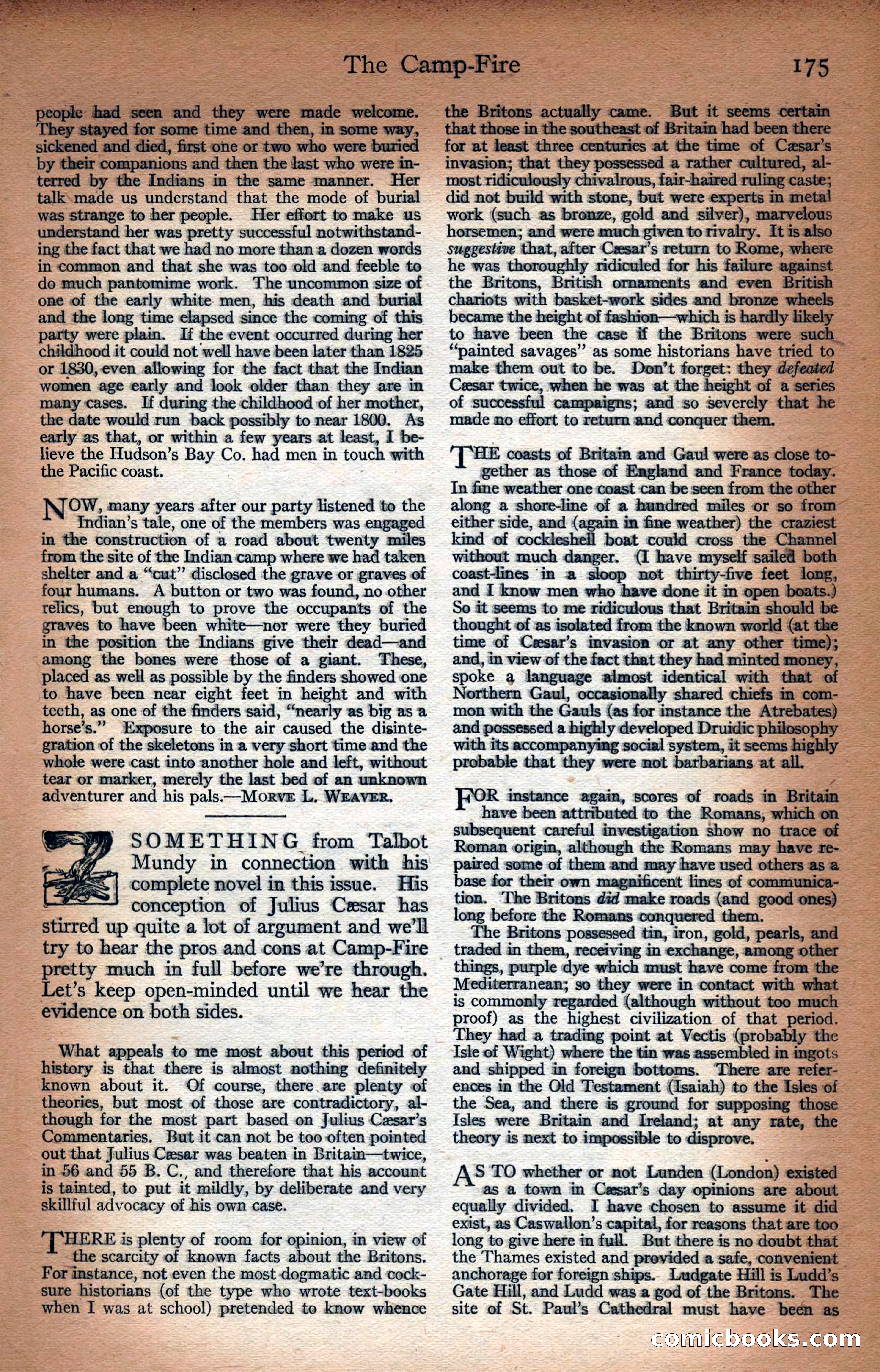
A restored page from Pulp Fiction, 1925. Page through the whole issue in the reader above.
📄 Transcribed text from this page (OCR, searchable)
Machine-transcribed from the original scan — historical spelling and the odd misread are preserved.
The Camp-Fire talk.made us understand that the mode of burial was strange to her people. Her effort to make us understand her was pretty successful notwithstand- ing the fact that we had no more than a dozen words in common and that she was too old and feeble to do much pantomime work. The uncommon size of one of the early white men, his death and burial and the long time elapsed since the coming of this patty were plain. If the event occurred during her childhood it could not well have been later than 1825 or 1830, even allowing for the fact that the Indian women age early and look older than they are in many cases. If during the childhood of her mother, the date would run back possibly to near 1800. As early as that, or within a few years at least, I be- lieve the Hudson’s Bay Co. had men in touch with the Pacific coast. Now, many years after our party listened ‘to the Indian’s tale, one of the members was engaged in the construction of a road about twenty miles from the site of the Indian camp where we had taken shelter and a “cut” disclosed the grave or graves of four humans. A button or two was found, no other relics, but enough to prove the occupants of the graves to have been white—nor were they buried in the position the Indians give their dead—and among the bones were those of a giant. These, placed as well as possible by the finders showed one to have been near eight feet in height and with teeth, as one of the finders said, “nearly as big as a horse’s.” Exposure to the air caused the disinte- gration of the skeletons in a very short time and the whole were cast into another hole and left, without tear or marker, merely the last bed of an unknown adventurer and his pals.—Morve L. WEAVER, SOMETHING from Talbot Mundy in connection with his complete novel in this issue. His conception of Julius Cesar has rs pe Z a up quite a lot of argument and we'll try to hear the pros and cons at Camp-Fire pretty much in full before we’re through. Let’s keep open-minded until we hear the evidence on both sides. What appeals to me most about this period of history is that there is almost nothing definitely known about it. Of course, there are plenty of theories, but most of those are contradictory, al- though for the most part based on Julius Cesar’s Commentaries. But it can not be too often pointed out that Julius Cesar was beaten in Britain—twice, in 56 and 55 B. C., and therefore that his account is tainted, to put it mildly, by deliberate and very skillful advocacy of his own case. ‘T BERE i is plenty of room for opinion, in view of the scarcity of known facts about the Britons. For instance, not even the most dogmatic and cock- sure historians (of the type who wrote text-books when I was at school) pretended to know whence 175 the Britons actually came. But it seems certain that those in the southeast of Britaim had been there for at least three centuries at the time of Caesar's did not build with stone, but were experts in meta! work (such as bronze, gold and silver), marvelous horsemen; and were much given to rivalry. It is also suggestive that, after Ceesar’s return to Rome, where he was thoroug y ridiculed for his failure against the Britons, British ornaments and even British chariots with basket-work sides and bronze wheels became the height of fashion—which is hardly likely to have been the case if the Britons were such “painted savages” as some historians have tried to make them out to be. Don’t forget: they defeated Cesar twice, when he was at the height of a series of successful campaigns; and so severely that he made no effort to return and conquer them. ‘[ BE coasts of Britaim and Gaul were as close to- gether as those of England and France today. In fe weather one coast can be seen from the other along a shore-line of a hundred miles or so from either side, and (agai in fine weather) the craziest kind of cockleshell boat could cross the Channel (I have myself sailed both coast-lines ‘in a sloop not thirty-five feet long, and I know men who have done it in open boats.) So it seems to me ridiculous that Britain should be thought of as isolated from the known world {at the time of Cesar’s invasion or at any other time); and, in view of the fact that they had minted money, spoke a language almost identical with that oi Northern Gaul, shared chiefs in com- FOR instance again, scores of — > snare Seen eee the Romans, which on bsequent careful investigation show no trace of ame 1 origin, although the Romans may have re- paired some of them and may have used others as a The Britons possessed tin, iron, gold, pearls, and traded in them, receiving in exchange, among other things, purple dye wick aaa tein come from the Mediterranean; so they were in contact with what is commonly regarded (although without too much SF as the highest civilization of that period. They had a trading point at Vectis (probably the Isle of Wight) where the tin was assembled in ingots and shipped in foreign bottoms. ‘There are refer- ences in the Old Testament (Isaiah) to the Isles of the Sea, and there is ground for supposing those Isles were Britain and Ireland; at any rate, the theory is next to impossible to disprove. A® TO whether or not Lunden (London) existed as a town in Cesar’s day opinions are about equally divided. I have chosen to assume it did exist, as Caswallon’s capital, for reasons that are too long to give here in full. But there is no doubt that the Thames existed and previded a safe, convenient anchorage for foreign ships. Ludgate Hill is Ludd’s Gate Hill, and Ludd was a god of the Britons. The site of St. Paul’s Cathedral must have been as Gcomicbooks.com