
Pulp Fiction, 1925 · page 178 of 196
Adventure Magazine Cover — page 178: what you’re looking at
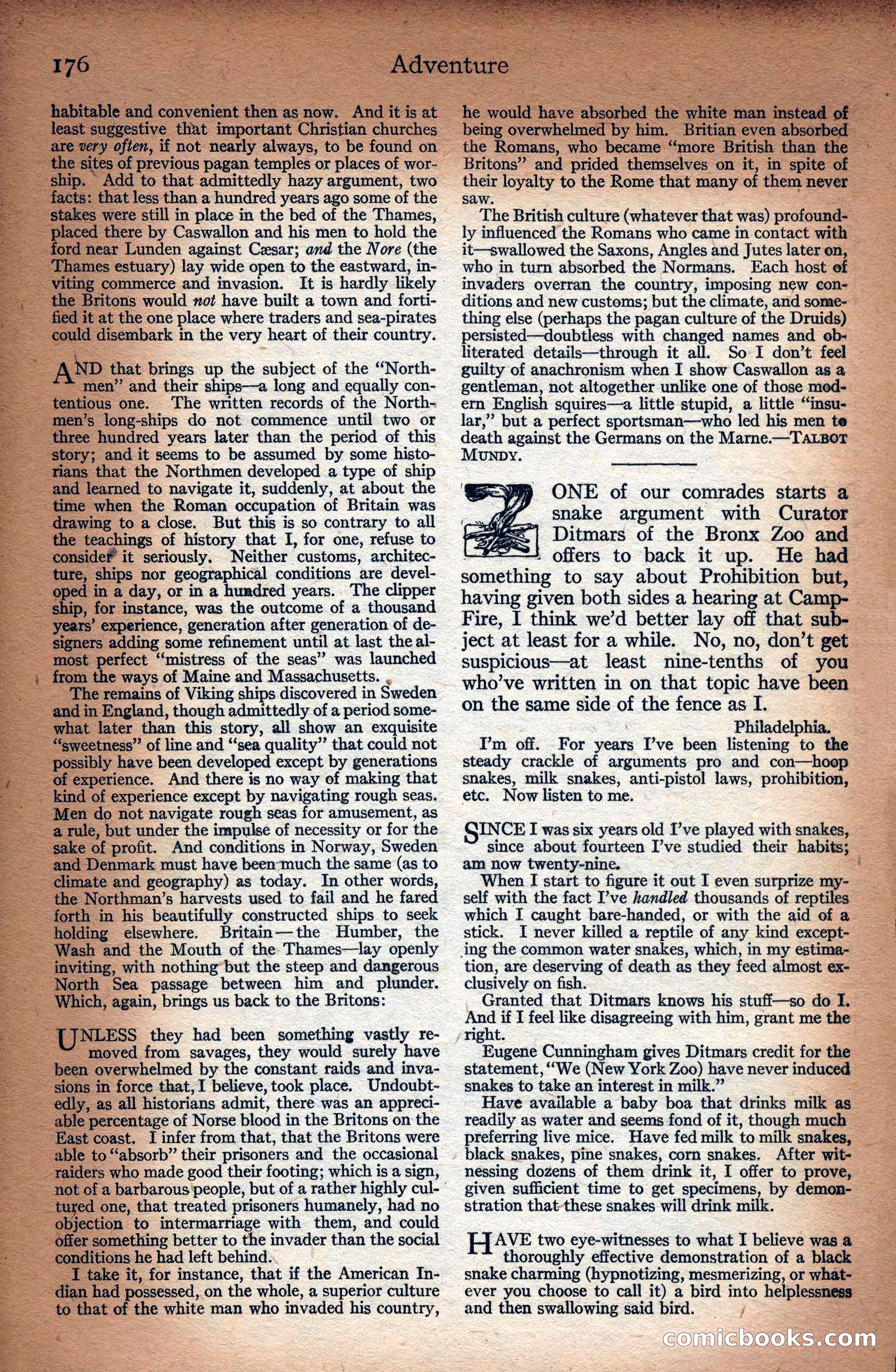
A restored page from Pulp Fiction, 1925. Page through the whole issue in the reader above.
📄 Transcribed text from this page (OCR, searchable)
Machine-transcribed from the original scan — historical spelling and the odd misread are preserved.
‘OeF——" ee Pe Se, “a ee ee ee 7 "oan ‘ ee ee ¥ 176 habitable and convenient then as now. And it is at least suggestive that important Christian churches are very often, if not nearly always, to be found on the sites of previous pagan temples or places of wor- ship. Add to that admittedly hazy argument, two facts: that less than a hundred years ago some of the stakes were still in place in the bed of the Thames, placed there by Caswallon and his men to hold the ford near Lunden against Cesar; and the Nore (the Thames estuary) lay wide open to the eastward, in- viting commerce and invasion. It is hardly likely the Britons would not have built a town and forti- fied it at the one place where traders and sea-pirates could disembark in the very heart of their country. AND that brings up the subject of the ‘‘North- men” and their ships—a long and equally con- tentious one. The written records of the North- men’s long-ships do not commence until two or three hundred years later than the period of this story; and it seems to be assumed by some histo- fians that the Northmen developed a type of ship and learned to navigate it, suddenly, at about the time when the Roman occupation of Britain was drawing to a close. But this is so contrary to all the teachings of history that I, for one, refuse to considef it seriously. Neither customs, architec- ture, ships nor geographical conditions are devel- oped in a day, or in a hundred years. The clipper ship, for instance, was the outcome of a thousand years’ experience, generation after generation of de- signers adding some refinement until at last the al- most perfect ‘‘mistress of the seas” was launched from the ways of Maine and Massachusetts. . The remains of Viking ships discovered in Sweden and in England, though admittedly of a period some- what later than this story, all show an exquisite “sweetness” of line and “‘sea quality” that could not possibly have been developed except by generations Of experience. And there is no way of making that kind of experience except by navigating rough seas. Men do not navigate rough seas for amusement, as a rule, but under the impulse of necessity or for the sake of profit. And conditions in Norway, Sweden and Denmark must have been-much the same (as to climate and geography) as today. In other words, the Northman’s harvests used to fail and he fared forth in his beautifully constructed ships to seek holding elsewhere. Britain—the Humber, the Wash and the Mouth of the Thames—lay openly inviting, with nothing’ but the steep and dangerous North Sea passage between him and plunder. Which, again, brings us back to the Britons: UNLESS they had been something vastly re- moved from savages, they would surely have been overwhelmed by the constant raids and inva- sions in force that, I believe, took place. Undoubt- edly, as all historians admit, there was an appreci- able percentage of Norse blood in the Britons on the East coast. I infer from that, that the Britons were able to “absorb” their prisoners and the occasional raiders who made good their footing; which is a sign, not of a barbarous people, but of a rather highly cul- tured one, that treated prisoners humanely, had no objection to intermarriage with them, and could offer something better to the invader than the social conditions he had left behind. I take it, for instance, that if the American In- dian had possessed, on the whole, a superior culture to that of the white man who invaded his country, Adventure he would have absorbed the white man instead of being overwhelmed by him. Britian even absorbed the Romans, who became “more British than the Britons” and prided themselves on it, in spite of their loyalty to the Rome that many of them never saw. The British culture (whatever that was) profound- ly influenced the Romans who came in contact with it—swallowed the Saxons, Angles and Jutes later on, who in turn absorbed the Normans. Each host of invaders overran the country, imposing new con- ditions and new customs; but the climate, and some- thing else (perhaps the pagan culture of the Druids) persisted—doubtless with changed names and ob- literated details—through it all. So I don’t feel guilty of anachronism when I show Caswallon as a gentleman, not altogether unlike one of those med- ern English squires—a little stupid, a little “insu- lar,” but a perfect sportsman—who led his men te death against the Germans on the Marne.—TALBorT Monpvy. ONE of our comrades starts a snake argument with Curator Ditmars of the Bronx Zoo and | | offers to back it up. He had something to say about Prohibition but, having given both sides a hearing at Camp- Fire, I think we’d better lay off that sub- ject at least for a while. No, no, don’t get suspicious—at least nine-tenths of you who’ve written in on that topic have been on the same side of the fence as I. Philadelphia. I’m off. For years I’ve been listening to the steady crackle of arguments pro and con—hoop snakes, milk snakes, anti-pistol laws, prohibition, etc. Now listen to me. INCE I was six years old I’ve played with snakes, since about fourteen I’ve studied their habits; am now twenty-nine. When I start to figure it out I even surprize my- self with the fact I’ve handled thousands of reptiles which I caught bare-handed, or with the aid of a stick. I never killed a reptile of any kind except- ing the common water snakes, which, in my estima- tion, are deserving of death as they feed almost ex- clusively on fish. Granted that Ditmars knows his stufi—so do I. = if I feel like disagreeing with him, grant me the right. Eugene Cunningham gives Ditmars credit for the statement, ‘““We (New York Zoo) have never induced snakes to take an interest in milk.” Have available a baby boa that drinks milk as readily as water and seems fond of it, though much preferring live mice. Have fed milk to milk snakes, black snakes, pine snakes, corn snakes. After wit- nessing dozens of them drink it, I offer to prove, given sufficient time to get specimens, by demon- stration that-these snakes will drink milk. HAVE two eye-witnesses to what I believe was a thoroughly effective demonstration of a black snake charming (hypnotizing, mesmerizing, or what- ever you choose to call it) a bird into helplessness and then swallowing said bird. EGOMIE ooo) Le)