
Pulp Fiction, 1925 · page 181 of 196
Adventure Magazine Cover — page 181: what you’re looking at
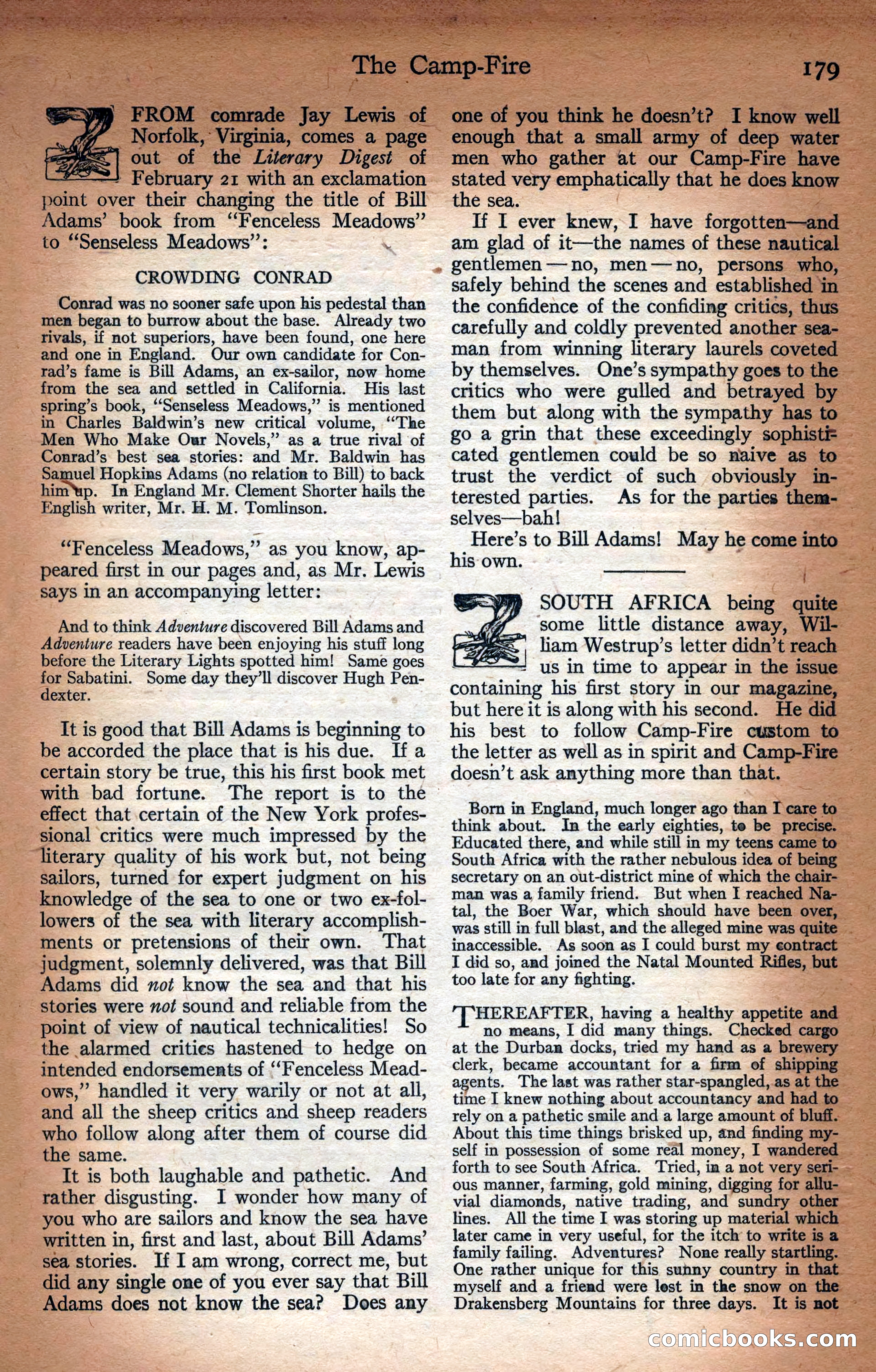
A restored page from Pulp Fiction, 1925. Page through the whole issue in the reader above.
📄 Transcribed text from this page (OCR, searchable)
Machine-transcribed from the original scan — historical spelling and the odd misread are preserved.
— . AP ~~ he 7 ae oe oo , Pn “a =e~ Dy 7 i pall > c - The Camp-Fire FROM comrade Jay Lewis of Norfolk, Virginia, comes a page x] out of the Literary Digest of , + February 21 with an exclamation point « over their changing the title of Bill Adams’ book from ‘“Fenceless Meadows” to “Senseless Meadows”’: ; CROWDING CONRAD Conrad was no sooner safe upon his pedestal than men began to burrow about the base. Already two rivals, if not superiors, have been found, one here and one in England. Our own candidate for Con- rad’s fame is Bill Adams, an ex-sailor, now home from the sea and settled in California. His last spring’s book, ‘‘Senseless Meadows,” is mentioned in Charles Baldwin’s new critical volume, ‘The Men Who Make Our Novels,” as a true rival of Conrad’s best sea stories: and Mr. Baldwin has Samuel Hopkins Adams (no relation to Bill) to back him‘up. In England Mr. Clement Shorter hails the English writer, Mr. H. M. Tomlinson. ““Fenceless Meadows,” as you know, ap- peared first in our pages and, as Mr. Lewis says in an accompanying letter: And to think Adventure discovered Bill Adams and Adventure readers have been enjoying his stuff long before the Literary Lights spotted him! Same goes por Sabatini. Some day they’ll discover Hugh Pen- exter. It is good that Bill Adams is beginning to be accorded the place that is his due. Ifa certain story be true, this his first book met with bad fortune. The report is to the effect that certain of the New York profes- sional critics were much impressed by the literary quality of his work but, not being Sailors, turned for expert judgment on his knowledge of the sea to one or two ex-fol- lowers of the sea with literary accomplish- ments or pretensions of their own. That judgment, solemnly delivered, was that Bill Adams did not know the sea and that his stories were zot sound and reliable from the point of view of nautical technicalities! So the alarmed crities hastened to hedge on intended endorsements of ‘‘Fenceless Mead- ows,” handled it very warily or not at all, and all the sheep critics and sheep readers who follow along after them of course did the same. It is both laughable and pathetic. And rather disgusting. I wonder how many of you who are sailors and know the sea have written in, first and last, about Bill Adams’ sea stories. If I am wrong, correct me, but did any single one of you ever say that Bill Adams does not know the sea? Does any A Dh Bh et Se ae a * oe & 7 xx. .. - a > ~. —< - Mg at ett *- - - 233-3 ee x. 179 one of you think he doesn’t? I know well enough that a small army of deep water men who gather at our Camp-Fire have stated very emphatically that he does know the sea. If I ever knew, I have forgotten—and am glad of it—the names of these nautical gentlemen —no, men—no, persons who, safely behind the scenes and established in the confidence of the confiding crities, thus carefully and coldly prevented another sea- man from winning literary laurels coveted by themselves. One’s sympathy goes to the critics who were gulled and betrayed by them but along with the sympathy has to go a grin that these exceedingly sophist& cated gentlemen could be so naive as to trust the verdict of such obviously in- terested parties. As for the parties them- selves—bah! Here’s to Bill Adams! May he come into his own. SOUTH AFRICA being quite some little distance away, Wil- liam Westrup’s letter didn’t reach us in time to appear in the issue containing his first story in our magazine, but here it is along with his second. He did his best to follow Camp-Fire custom to the letter as well as in spirit and Camp-Fire doesn’t ask anything more than that. Born in England, much longer ago than I care to think about. Im the early eighties, te be precise. Educated there, and while still in my teens came to South Africa with the rather nebulous idea of being secretary on an out-district mine of which the chair- man was a family friend. But when I reached Na- tal, the Boer War, which should have been over, was still in full blast, and the alleged mine was quite inaccessible. As soon as I could burst my eontract I did so, and joined the Natal Mounted Rifles, but too late for any fighting. "[ HEREAFTER, having a healthy appetite and no means, I did many things. Checked cargo at the Durban docks, tried my hand as a brewery clerk, became accountant for a firm of shipping agents. The last was rather star-spangled, as at the time I knew nothing about accountancy and had to rely on a pathetic smile and a large amount of bluff. About this time things brisked up, and finding my- self in possession of some real money, I wandered forth to see South Africa. Tried, im a not very seri- ous manner, farming, gold mining, digging for allu- vial diamonds, native trading, and sun other lines. All the time I was storing up material which later came in very useful, for the itch to write is a family failing. Adventures? None really startling. One rather unique for this suhny country in that myself and a friend were lest in the snow on the Drakensberg Mountains for three days. It is not Gomicbooks com